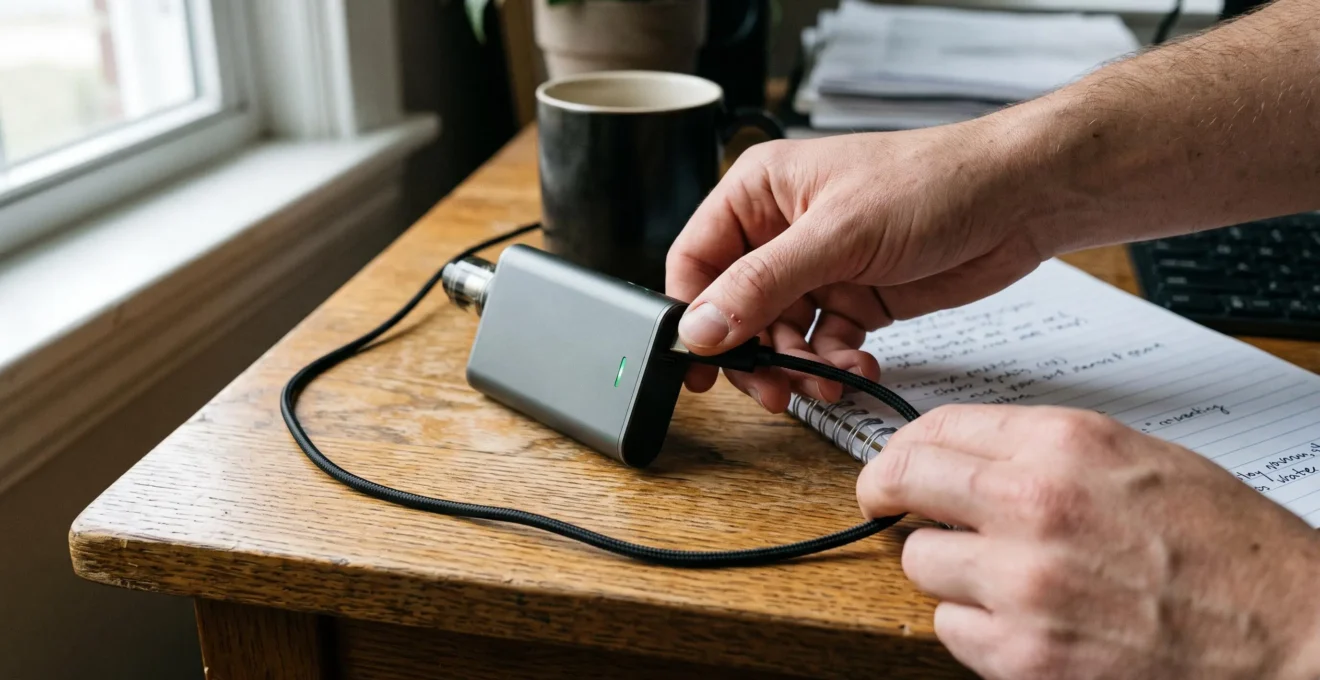
A rechargeable vape battery performs most reliably when it is charged with compatible equipment, protected from excessive heat, and replaced before deterioration becomes a safety concern. Lithium-ion batteries naturally lose some capacity as they age, but charging habits, storage conditions, and everyday handling can influence how quickly that happens.
For adult users who depend on rechargeable devices, reliability means more than having enough power to finish the day. A healthy battery should charge predictably, deliver reasonably consistent runtime under similar settings, and show no physical signs of damage. Sudden changes deserve attention because they may originate from the battery, charging equipment, or device electronics.
The safest approach combines simple performance checks with preventive maintenance. Understanding what normal battery aging looks like, how charging specifications work, and when a cell needs retiring makes it easier to distinguish routine wear from a potentially hazardous fault.
Rechargeable vape battery care essentials
- Reduce unnecessary battery wear by avoiding excessive heat, repeated deep discharges, and prolonged storage at full charge.
- Use manufacturer-approved charging equipment and never ignore swelling, unusual heat, chemical odors, or visible damage.
- Track changes in runtime, investigate charging problems, and recycle worn batteries through appropriate collection services.
- Why Does a Vape Battery Hold Less Charge After Months of Use?
- How Should You Charge a Vape Battery to Reduce Unnecessary Wear?
- Built-In or Removable Vape Battery: Which Is Easier to Manage?
- Which Vape Battery Warning Signs Should Never Be Ignored?
- When Should a Rechargeable Vape Battery Be Replaced Rather Than Recharged?
- Which Lithium-Ion Battery Warning Signs Mean You Should Stop Using It?
- How Can You Check Charger Specifications Before Charging Vape Batteries?
- How Should You Use an External Vape Battery Charger Safely at Home?
Why Does a Vape Battery Hold Less Charge After Months of Use?
A vape battery gradually holds less charge because lithium-ion cells undergo chemical changes during charging, discharging, and storage. These changes reduce the amount of usable energy the battery can retain. A progressive reduction in runtime is therefore a normal part of battery aging, although an abrupt decline may indicate a charging problem, changed device settings, or another fault.
Inside a lithium-ion cell, repeated operation gradually consumes some of the lithium available for reversible energy storage and changes the internal materials. Protective layers can grow on electrode surfaces, while other degradation processes increase resistance or reduce usable capacity. As these effects accumulate, the device may require more frequent charging even when the user’s habits remain unchanged.
Battery aging also occurs while a cell is stored. Research on temperature and lithium-ion battery aging published in 2025 examined lithium iron phosphate/graphite batteries and identified temperature and state of charge as important influences on long-term degradation. Its findings explain relevant electrochemical mechanisms but do not establish exact aging rates for vape batteries using other cell chemistries.
Certain habits can increase unnecessary stress:
- Frequently running the device until its low-battery cutoff activates.
- Leaving a fully charged battery in a hot environment.
- Using rapid charging routinely when it generates additional heat.
- Storing a battery for extended periods at an extreme state of charge.
Not every reduction in apparent battery life means the cell has deteriorated. Higher power settings, changes in coil resistance, heavier usage, charging-port contamination, or device firmware behavior can alter runtime. A battery gauge can also provide an imperfect estimate of remaining energy.
To assess degradation, compare the number of typical vaping sessions delivered by a full charge now with the number delivered when the device was new. Keep power settings, coil type, and approximate usage similar. Repeat the observation over several charging cycles rather than relying on one unusually demanding day.
A consistent downward trend suggests normal wear, while a sudden change should prompt checks of the charger, cable, contacts, and device configuration before any replacement decision.
How Should You Charge a Vape Battery to Reduce Unnecessary Wear?
To reduce avoidable wear, charge a vape battery with manufacturer-approved equipment, keep it away from excessive heat, and disconnect it when charging finishes. Lithium-ion batteries generally experience greater stress near the extremes of their charge range, so moderate charging habits can support longevity. There is no universal ideal charging percentage for every vape battery.
Charging to full capacity is not inherently improper when the manufacturer permits it. However, storing a fully charged lithium-ion battery in warm conditions can accelerate certain degradation mechanisms. Similarly, repeatedly discharging a battery until the device shuts down adds unnecessary cycling stress. The device’s low-voltage cutoff helps prevent excessively deep discharge, but it should not be treated as a routine charging reminder.
A practical routine is to recharge before the battery becomes severely depleted, use the charger during a period when charging can be observed, and unplug the device once its indicator confirms completion. Shorter, supervised charging sessions are preferable to leaving a vape connected overnight.
Most properly designed regulated devices use charging-control circuitry that limits charging and terminates the charging phase at the designated endpoint. Therefore, leaving a device connected does not automatically mean that current continuously forces energy into an already full battery. The concerns are prolonged time at a high state of charge, heat exposure, and the consequences of an undetected charging fault.
Fast charging introduces another trade-off. A device designed for higher charging currents may recharge more quickly, but higher currents can create additional heat depending on the cell and charging system. This does not mean every fast-charging session causes significant damage. Use rapid charging only when the manufacturer supports it, and avoid making it the default when ordinary charging is sufficient.
The charging surface matters as much as the timing. Keep the device on a clean, stable surface away from fabric, direct sunlight, and heat-producing appliances. Do not charge a battery that feels unusually hot or shows physical damage.
Charging discipline can slow avoidable deterioration, but it cannot eliminate chemical aging. The battery’s design also determines how much maintenance is practical.
Built-In or Removable Vape Battery: Which Is Easier to Manage?
Built-in vape batteries are generally easier to manage because users charge the complete device without handling individual cells. Removable batteries require more knowledge about compatibility, handling, and storage, but they offer greater flexibility when a cell wears out. The better choice depends on whether simplicity or long-term replaceability matters more to the adult user.
A built-in battery reduces everyday handling. There is no loose cell to install incorrectly, and the manufacturer can integrate the battery, charging electronics, and enclosure into one system. The limitation appears as capacity declines: if the battery is not user-replaceable, restoring the original runtime may require professional servicing or replacing the whole device.
With a removable-battery mod, a worn cell can usually be replaced without discarding the device, provided an appropriate replacement remains available. Spare batteries also allow continuity of use without waiting for an in-device recharge. However, each cell must be correctly specified, physically protected, and installed according to the manufacturer’s instructions.
The differences become clearer when maintenance tasks are compared directly.
| Maintenance factor | Built-in battery | Removable battery |
|---|---|---|
| Everyday charging | Charge through the device’s designated port. | May use a compatible external charger. |
| Battery replacement | Often requires servicing or device replacement. | Cell can be replaced with an approved compatible model. |
| Handling requirements | Minimal direct cell handling. | Requires attention to wraps, terminals, orientation, and storage. |
| Spare battery management | Usually not applicable. | Spare cells require individual protective cases. |
| Long-term flexibility | Depends on repairability and replacement support. | Greater flexibility where suitable replacement cells exist. |
For a casual user who values minimal handling, a built-in design may be more convenient. Someone using a rechargeable device frequently may prefer removable cells, especially when the device supports straightforward replacement and a dedicated charger.
Removable configurations also introduce responsibilities. Batteries used together in a multi-cell device should follow the manufacturer’s matching and replacement guidance. Cells of different ages, specifications, or states of charge should not be combined in a way the device manufacturer prohibits.
With built-in models, inspect the USB port and cable because their condition affects the charging process. With removable cells, inspect the battery wraps and contact surfaces as part of normal handling.
Whichever arrangement is used, safety depends on recognizing when a battery’s condition has changed beyond ordinary wear.
Which Vape Battery Warning Signs Should Never Be Ignored?
Unusual heat, swelling, chemical odors, hissing, smoke, leakage, and visible battery damage are warning signs that should never be ignored. Any severe physical symptom requires immediate cessation of use and charging. Gradual runtime changes are less conclusive, but persistent abnormal charging behavior or sudden performance deterioration also deserves investigation before the device is used again.
Battery faults are particularly important because the energy stored inside a lithium-ion cell can be released rapidly when its internal safety systems fail. Buckinghamshire Fire & Rescue Service lithium-ion battery safety advice identifies swelling, distortion, unexpected heat, chemical smells, hissing, popping, and smoke as signs that a device may be unsafe.
These warning signs have different implications:
- Swelling or deformation: Internal gas generation or other cell damage may have compromised the battery. Stop using it rather than waiting to see whether the swelling improves.
- Unusual heat: A battery that becomes unexpectedly hot during use, charging, or storage needs immediate attention, particularly if the temperature continues rising.
- Hissing, popping, smoke, or chemical odor: These can indicate a serious internal fault or venting. Keep clear and contact emergency services if there is an immediate fire or exposure hazard.
- Visible physical damage: Dents, punctures, leakage, damaged cell insulation, or a distorted enclosure require assessment before further use.
Performance symptoms can be less definitive. An earlier-than-normal low-battery warning, unusually slow charging, or rapid depletion may reflect capacity loss, poor electrical contact, charger incompatibility, or device settings. These symptoms should not be dismissed, especially when they appear suddenly or together.
A useful distinction is whether the problem involves physical safety or performance consistency. A severe physical sign means stop using the device. A gradual runtime decline without damage can be compared with previous usage and investigated using known-compatible charging equipment.
If a battery is swelling, smoking, leaking, or overheating, do not attempt to recharge, dismantle, puncture, cool it in water, or transport it casually. Follow local emergency and hazardous-battery handling advice.
Once deterioration has been confirmed, continuing to recharge indefinitely is not an effective maintenance strategy. Replacement becomes the next practical decision.
When Should a Rechargeable Vape Battery Be Replaced Rather Than Recharged?
A rechargeable vape battery should be replaced when its reduced capacity no longer meets normal usage needs, when performance problems persist after basic troubleshooting, or immediately when physical damage indicates a safety risk. There is no reliable universal replacement interval measured in months. The appropriate decision depends on battery condition, device compatibility, and how consistently it performs.
For everyday use, one practical indicator is whether a full charge still supports the person’s usual routine. A battery requiring much more frequent charging under otherwise unchanged conditions may have lost enough usable capacity to justify replacement. That threshold is about convenience and dependability rather than a scientifically established safety boundary.
Before concluding that a cell is worn out, check the device’s power settings, coil condition, charging cable, and approved power source. For removable cells, check contact cleanliness and physical condition without opening or modifying the battery itself.
Age-related capacity loss alone does not prove that a cell is dangerous. However, deterioration can coincide with increased internal resistance, producing greater voltage drop under load and potentially additional heating. Unexpected heat or unstable electrical behavior is a reason to stop using the battery and seek appropriate assessment.
Replacement options differ by device design. Users with removable cells can obtain a manufacturer-approved replacement of the required specification and retire the old battery. For built-in devices, battery replacement should only be performed through an authorized or appropriately qualified service where the product is designed to support it. Otherwise, replacing the complete device may be the safer option.
Disposal is part of this decision. EPA guidance on recycling used lithium-ion batteries explains that these cells and devices containing them should not enter ordinary household waste or general recycling streams. Collection arrangements differ between the United States, the United Kingdom, and other English-speaking countries.
For an intact retired removable cell, protect exposed terminals from short circuits using the appropriate nonconductive protection and follow the collection site’s instructions. Batteries showing swelling, leakage, unusual heat, or serious damage may require specialist arrangements rather than an ordinary drop-off bin.
Replacing a battery before it becomes inconvenient can improve reliability; replacing it immediately when it becomes unsafe is essential. Some lithium-ion faults, however, warrant a more specific explanation.
Which Lithium-Ion Battery Warning Signs Mean You Should Stop Using It?
A lithium-ion battery must not be used or charged when it swells, vents, leaks, emits smoke or an unusual chemical odor, or develops unexplained excessive heat. Damage to the casing or protective insulation also requires action before reuse. A battery involved in a serious overheating or venting incident should be retired, even if it subsequently cools down.
The most serious lithium-ion failure mechanism is thermal runaway. This occurs when internal heat-generating reactions accelerate beyond the cell’s ability to dissipate heat. Damage, internal short circuits, excessive heating, or unsuitable charging conditions may contribute to such failures. The resulting event can involve intense heat, flammable gases, fire, and the possibility of reignition.
A battery that has vented or experienced severe overheating cannot be considered reliable merely because it appears normal afterward. Internal damage may remain invisible, and routine charging is not an appropriate way to test whether it has recovered.
Removable cells have an additional external short-circuit risk. Their protective wrap insulates much of the metal casing. When the wrap is torn, conductive metal can become exposed, potentially allowing unintended contact with the battery’s positive terminal through a conductive object or part of the device. This is why loose batteries must never be carried alongside keys, coins, or other metal objects.
Some removable batteries with superficial wrap damage can be professionally re-wrapped when the underlying cell is otherwise confirmed undamaged. This should not be attempted by someone unfamiliar with lithium-ion battery construction, and it is not a remedy for dents, punctures, leakage, or other structural damage. Retiring the cell is the safer choice when its condition is uncertain.
A two-level response helps prevent inappropriate troubleshooting:
- Stop immediately: Swelling, abnormal heat, venting, smoke, chemical odors, or leakage mean no further use or charging. Keep away from the device and seek emergency assistance if necessary.
- Stop and inspect before reuse: A torn wrap, dented casing, damaged charging port, moisture exposure, or abnormal behavior requires a compatibility and safety assessment. Do not restart charging until the cause is resolved.
Temperature exposure matters even without obvious damage. Cells left in a hot vehicle, freezing conditions, or direct sunlight should not be charged immediately. Allow an otherwise undamaged battery to return naturally to the manufacturer’s permitted operating temperature range, then inspect it before deciding whether it remains suitable for use. Severe exposure or uncertain condition warrants professional advice or retirement.
A battery without these warning signs still needs a compatible charging system. Verifying that compatibility is the next step in preventing avoidable electrical and thermal stress.
How Can You Check Charger Specifications Before Charging Vape Batteries?
Check a vape charger’s specifications by identifying the required charging input in the device manual and comparing it with the power source’s voltage, current capability, and supported charging protocol. The charger must be compatible with the device rather than merely having a fitting connector. For removable cells, the external charger must also support the correct battery chemistry and physical size.
The two electrical values commonly printed on a USB adapter are voltage, expressed in volts (V), and output current capability, expressed in amperes (A). Voltage describes the electrical potential supplied, while the current rating indicates the maximum current the source is designed to provide under specified conditions.
These values must be interpreted together with the device’s charging circuitry. A USB adapter’s higher current rating does not automatically force that amount of current into a properly regulated device. The device normally determines its current draw, while compatible USB charging protocols determine which supply modes can be used. Conversely, an adapter that cannot supply the required current may charge slowly, limit power, or fail to charge correctly.
A phone fast charger is therefore neither automatically unsafe nor automatically suitable. Its compatibility depends on supported output modes, cable condition, the vape’s input requirements, and whether the device manufacturer approves that charging arrangement.
The manufacturer’s manual should take precedence over assumptions based on connector shape, nominal power, or the appearance of a charger.
Five checks before connecting a vape battery charger
- Find the device specification: Locate the manufacturer’s stated charging input and record the required voltage and supported current or protocol.
- Read the power source label: Identify its available output modes and confirm that at least one matches the device’s supported input.
- Check the cable and connector: Confirm that the cable is undamaged, fits correctly, and meets the manufacturer’s requirements.
- Verify external charger compatibility: For removable cells, confirm the supported lithium-ion chemistry, cell dimensions, and permitted charging current against the charger’s documentation.
- Check the complete setup: Confirm that the battery and charging equipment show no damage and that the charging location is suitable before connecting power.
For removable batteries, an external charger designed for cylindrical lithium-ion cells is not necessarily compatible with every cylindrical cell. Some chargers support different battery chemistries or apply different charging profiles. Matching the physical slot alone is insufficient: the charging algorithm, cell specification, and current setting must also be appropriate.
Where the original charger is unavailable, select an explicitly compatible replacement rather than assuming that a lower-output USB source is universally safer. If the manufacturer’s requirements cannot be verified, do not experiment with chargers.
Once compatibility has been confirmed, the surrounding charging environment and the way removable cells are handled become the main day-to-day safety considerations.
Key takeaways before using an external charger
- Confirm that both the battery model and the selected charging current are supported by the external charger’s instructions.
- Prepare a stable charging location where heat, damage, and unusual charging behavior can be noticed promptly.
- Keep spare cells protected and maintain a simple record of their age and condition to make replacement decisions easier.
How Should You Use an External Vape Battery Charger Safely at Home?
Use an external vape battery charger on a stable, hard, non-flammable surface with adequate ventilation and enough visibility to monitor the charging process. Insert only compatible, undamaged batteries in the correct orientation, follow the charger’s current settings, and remove cells when charging finishes. Never leave charging batteries unattended overnight or while away from home.
A suitable home charging location should be away from curtains, bedding, upholstered furniture, papers, and other combustible materials. An uncluttered hard countertop is generally more appropriate than a sofa or bedside surface, provided the charger is kept away from sinks, moisture, heat sources, and objects that could obstruct ventilation.
Before inserting each removable cell, inspect its wrap, insulating ring, terminals, and casing. Check for dents, leakage, discoloration, or unusual odors. If any fault suggests the cell may be unsafe, do not place it in the charger.
Insert the battery according to the positive and negative orientation markings. Do not force a cell into a slot or improvise a connection. Check that it sits securely, that the contacts engage correctly, and that the charger recognizes it as expected.
When charging multiple batteries, follow the charger’s instructions for independent slots and permitted combinations. Batteries used together in a multi-cell device should be managed as a matched set according to the device manufacturer’s requirements. Avoid mixing cell types, ages, or specifications in a configuration that requires matched batteries. Charge levels should also be managed according to the relevant device and charger instructions rather than assuming every pair of cells must start at the same level.
Periodically check the charger without touching potentially overheated equipment. An abnormally hot cell, unexplained charging interruption, unusual smell, or unexpected error indication requires stopping the process safely and investigating the cause. An external charger can make individual battery behavior easier to observe, but its indicators do not establish that a cell is internally healthy.
Once the charger confirms completion, disconnect its power supply as appropriate and remove the cells. Batteries not immediately installed in a compatible device should be placed in individual protective cases or correctly designed multi-cell cases that prevent unintended electrical contact.
For users managing several removable cells, label the cases with purchase dates or identifiers and keep paired sets distinguishable. Rotate suitable cells according to their intended use, inspect them periodically, and retire those showing substantial deterioration or damage. This provides a practical history without suggesting that every battery has the same expected lifespan.
When cells are stored rather than used, follow manufacturer guidance on storage charge and temperature. Keep them away from direct sunlight, extreme temperatures, moisture, and loose conductive objects.
Before the next charging session, check the battery’s condition, confirm charger compatibility, and choose a location where the process can be observed. Small, repeatable checks make rechargeable battery management more predictable while helping identify conditions that require immediate action.
Can a rechargeable vape battery lose charge while it is not being used?
Yes. Lithium-ion batteries naturally self-discharge over time, and a device may also consume a small amount of power while switched off or in standby. Excessive depletion during storage can indicate a battery or device problem. Follow the manufacturer’s storage recommendations and inspect the battery before using it again after a long period.
Is it normal for a vape battery to become slightly warm during charging?
Some warmth can occur during normal charging because electrical losses generate heat. However, a battery that becomes unusually hot, heats up rapidly, or behaves differently from its normal charging pattern should not continue charging. Stop using the equipment and investigate the cause rather than treating excessive heat as normal.
Can a USB cable affect vape battery charging performance?
Yes. A damaged, poorly fitting, or unsuitable cable can contribute to intermittent charging, increased resistance, or reduced charging performance. Inspect the cable and connector for wear, bent contacts, and contamination. Replace questionable equipment with a cable that meets the device manufacturer’s specifications.
Should a removable vape battery be fully charged before storing it?
For extended storage, manufacturers commonly recommend a partial state of charge rather than leaving lithium-ion cells completely full or deeply discharged. The appropriate level depends on battery chemistry and manufacturer instructions. Store cells in protective cases in a suitable temperature range and check their condition before returning them to service.
Can a damaged rechargeable vape battery go into a regular battery recycling box?
Not necessarily. A swollen, leaking, severely damaged, or overheating lithium-ion battery may require special handling and may not be accepted in an ordinary collection container. Contact the local battery collection service, recycling authority, or appropriate hazardous-waste provider for instructions. Never place lithium-ion batteries in household rubbish or ordinary mixed recycling.