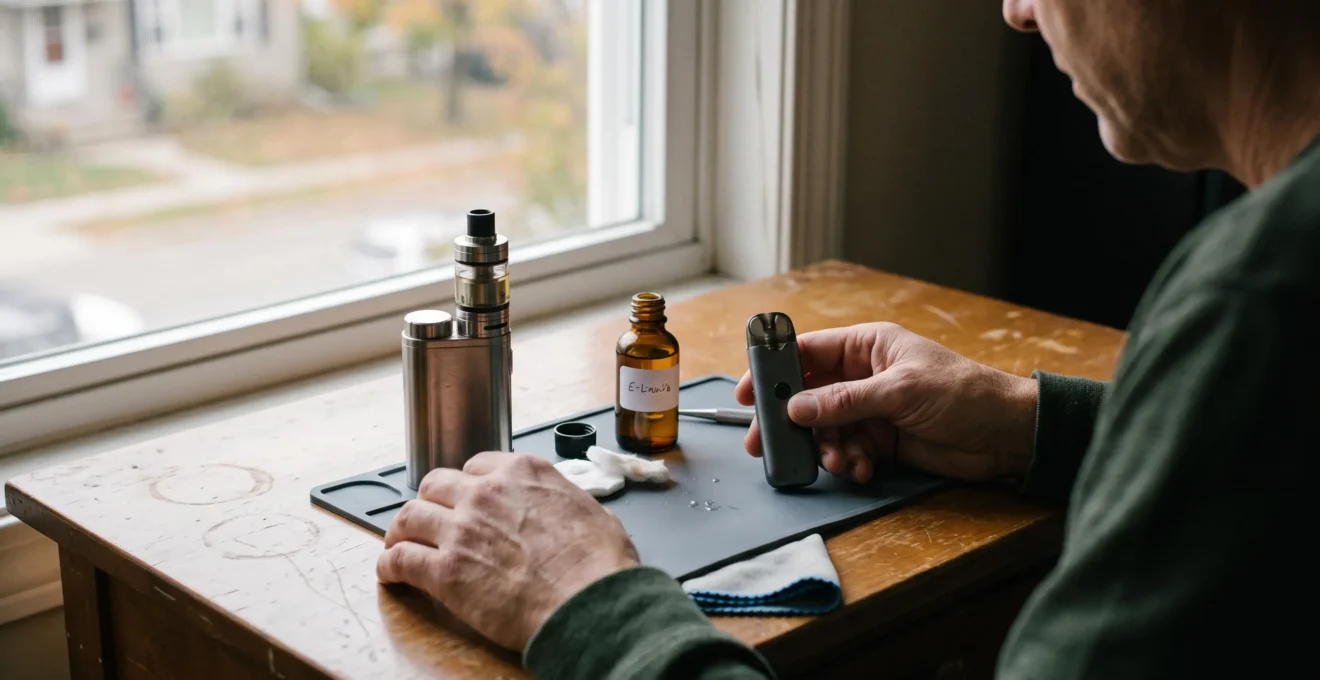
For adults who regularly use e-liquid, choosing between a refillable tank and a refillable pod affects more than how often a bottle needs opening. The two systems differ in coil options, airflow adjustment, liquid consumption, cleaning requirements and the components that must eventually be replaced.
Refillable pods generally suit people who prioritise portability and straightforward upkeep, while tanks suit those who value adjustable hardware and replaceable components. Neither design automatically delivers better flavour, lower operating costs or longer coil life. Those outcomes depend on the particular device, its settings, the e-liquid and individual usage patterns.
A compact pod can require frequent refilling but little disassembly. A larger tank may hold more liquid yet demand closer attention to coils, seals and threaded connections. Understanding those trade-offs helps avoid recurring leaks, burnt wicks and unnecessary replacement purchases.
The useful comparison is therefore not simply pod versus tank. It is the amount and type of maintenance each system requires during an ordinary week of use.
Refillable Tanks vs Pods: Essential Differences
- Flavour and control: Tanks often provide more coil and airflow adjustments, while pods typically favour simpler, device-specific settings.
- Consumption and refilling: Power, resistance, liquid compatibility and puffing habits matter more than reservoir size alone.
- Maintenance: Pods generally simplify component replacement; tanks often allow more individual parts to be cleaned or replaced.
- How Does a Refillable Tank Affect Flavour, Airflow and Everyday Maintenance?
- Why Can the Same E-Liquid Last Longer in One Refillable Device Than Another?
- What Happens When a Vape Wick Gets Too Wet or Too Dry?
- How Can You Refill a Pod or Tank Without Flooding the Coil?
- What Problems Can Occur When You Mix Old and New E-Liquids in a Refillable Pod?
- When Should You Replace a Refillable Pod Even If It Still Holds Liquid?
- Refillable Pod or Tank: Which Requires Less Daily Maintenance?
- Refillable or Prefilled Pod: Which Better Fits a Simple Daily Routine?
How Does a Refillable Tank Affect Flavour, Airflow and Everyday Maintenance?
A refillable tank affects flavour through the interaction of its heating coil, wick, airflow and operating power. Adjustable airflow and replaceable coils can provide more control over the vaping experience, but they also introduce maintenance tasks. Consistent performance depends on compatible settings, sound seals and regular inspection rather than the tank’s capacity alone.
Inside the atomiser, e-liquid travels through the wick towards a heated coil. The coil’s resistance and operating power influence heating, while the wick must deliver liquid quickly enough to replenish what evaporates. If these elements are poorly matched, flavour can become muted or harsh even when the e-liquid itself has not changed.
Airflow adds another variable. Restricting airflow generally produces a tighter draw and can change perceived warmth and flavour concentration. Opening it increases incoming air and can cool the aerosol. The same liquid may therefore taste noticeably different at two airflow settings on the same tank.
However, a more restricted draw is not automatically more flavourful. Coil geometry, power and personal preference also matter. A setting that works with one coil may perform poorly with another.
According to Innokin’s explanation of tank and pod components, tanks commonly use standard 510 connections and glass-and-metal construction, whereas pods often rely on proprietary connections and plastic cartridges. These are typical design differences, not universal rules.
That construction influences maintenance. Many tanks allow users to remove the glass, unscrew the base, exchange the coil and inspect individual sealing rings. Those operations provide repair options unavailable with some integrated pods, but every additional connection can become a potential leak point.
A sensible weekly inspection includes checking for residue around the base, damaged O-rings, loose components and obstructed airflow. Cleaning frequency should reflect actual use and the manufacturer’s instructions; there is no universally established weekly cleaning interval.
Tank ownership therefore involves managing several interacting variables rather than simply filling a larger reservoir.
Once these hardware relationships are clear, the next question is why two refillable devices can consume very different amounts of the same e-liquid.
Why Can the Same E-Liquid Last Longer in One Refillable Device Than Another?
The same e-liquid can last longer in one device because consumption depends on heating power, coil resistance, airflow and puffing behaviour. Higher-power configurations may vaporise more liquid during use, while device compatibility and leakage influence waste. Reservoir size determines how much liquid a device holds, not necessarily how efficiently it uses that liquid.
A useful distinction is between liquid consumed during vaping and liquid lost through leaks or discarded during maintenance.
Experimental evidence illustrates why comparing bottles or reservoir capacities alone is misleading. In a PubMed-indexed study on coil resistance and e-liquid consumption, 32 experienced electronic cigarette users completed sessions with different device and nicotine conditions.
40.5 W versus 13.5 W
Two configurations examined in the study used a 0.5-ohm coil at 40.5 W and a 1.5-ohm coil at 13.5 W. Higher-power, lower-resistance conditions consumed more e-liquid in the experiment. The result does not establish a universal tank-versus-pod consumption ratio.
Original experimental research involving 32 experienced electronic cigarette users, indexed in PubMed.
The study also found that nicotine concentration affected puffing behaviour. Under the tested conditions, lower nicotine concentration was associated with longer, larger or more frequent puffs. Consumption therefore reflects the interaction between device settings and user behaviour.
Liquid composition matters too. Vegetable glycerine (VG) and propylene glycol (PG) affect viscosity. A thick, high-VG liquid may replenish a narrow wick too slowly, especially when the coil is heated repeatedly. A thinner liquid may pass too readily through an incompatible wicking or sealing arrangement, contributing to flooding.
Neither problem can be diagnosed from VG/PG ratio alone. Manufacturers may specify compatible liquid characteristics, and coil design varies substantially.
For an everyday comparison, record three observations over a representative period:
- How much e-liquid is added to each device.
- Whether refills are accompanied by visible leaks or wasted liquid.
- How frequently coils or complete pods require replacement.
For example, if two devices use the same liquid but one requires more frequent refilling, that difference might reflect higher consumption, a smaller reservoir or both. Logging approximate liquid volume and usage frequency helps separate these explanations.
A tank with replaceable coils could be less expensive to maintain in a particular usage pattern, but that cannot be assumed without considering liquid consumed, coil costs and replacement frequency. Similarly, a small pod is not inherently more economical just because it operates at lower power.
If consumption becomes inconsistent despite unchanged habits, inspect the wick and coil before assuming the liquid or reservoir is responsible.
What Happens When a Vape Wick Gets Too Wet or Too Dry?
A vape wick that becomes excessively saturated can contribute to gurgling, spitting and liquid flooding the airflow path. A wick that cannot replenish liquid fast enough may overheat, producing a dry hit or burnt taste. Both conditions disrupt normal operation, but they require different responses because insufficient saturation and excess liquid have different causes.
A wick transports liquid towards the coil through capillary action. As the liquid heats and evaporates, additional liquid must move through the porous material to replace it. When supply and evaporation remain appropriately balanced, the coil can operate within its intended conditions.
Research described in a Scientific Reports study of capillary evaporation in vape wicks examined how power, liquid composition and wick porosity affect this process. Its model focused on low-power devices operating at no more than 10 W, so its specific findings should not be applied directly to every modern high-power tank.
Excess liquid can cause bubbling or gurgling, droplets entering the mouthpiece and liquid collecting near airflow openings. Possible contributors include overfilling, a damaged seal, incorrect coil installation or an incompatible liquid.
When these symptoms occur, stop using the device while checking for visible leakage. Follow the manufacturer’s instructions for removing excess liquid, cleaning accessible airflow passages and inspecting the pod or coil installation. Dry external contacts before reconnecting components.
Insufficient liquid produces a different pattern. Harshness, unusually hot vapour or a burnt cotton taste may indicate that evaporation is outpacing liquid supply. Possible causes include inadequate priming, an unsuitable power setting, incompatible liquid viscosity or rapid repeated puffs.
If the wick is merely under-saturated and has not been scorched, allowing time for liquid absorption and checking the manufacturer’s settings may help. A permanently burnt wick or coil generally requires replacement; adding more liquid does not reverse damaged cotton.
Priming a replacement coil is particularly important. The waiting period varies by design and liquid characteristics. Manufacturer-specific instructions take precedence over any general rule.
Persistent gurgling should not be treated by increasing power indiscriminately, and a burnt taste should not be addressed by continuing to fire the device. Both approaches can worsen the underlying condition.
Because incorrect filling can disturb this liquid balance, refill technique is the next practical factor to examine.
How Can You Refill a Pod or Tank Without Flooding the Coil?
To refill a pod or tank without flooding its coil, use the designated filling port, keep liquid out of the central airflow channel and respect the reservoir’s fill limit. Close the seal correctly, inspect for leakage and follow the device’s priming instructions before use. The exact procedure differs between top-fill tanks and side- or bottom-fill pods.
For a top-fill tank, allow the atomiser to cool if it is hot, open the manufacturer’s designated filling mechanism and direct the bottle nozzle into the reservoir opening rather than the central chimney. Avoid filling beyond the stated limit or into areas intended for airflow.
For a side-fill pod, remove it from the device if required, open the silicone plug and fill through the designated port. Keep the pod in the orientation recommended by its manufacturer, then reseat the plug securely without damaging it.
Bottom-fill systems may require the reservoir to be inverted or disconnected. Their seals and filling openings differ, so assumptions based on another model can lead to spills.
Innokin’s technical troubleshooting instructions identify overfilling, damaged seals and incorrectly installed coils among potential causes of tank leakage. The manufacturer also advises allowing a hot atomiser to cool before refilling and keeping electrical connectors clean and dry.
Several apparently minor mistakes can undermine an otherwise correct refill. For example, forcing a cap or overtightening a component can damage seals or threads. Filling immediately after intensive use may also be unwise when the atomiser remains hot.
After replacing a coil, give the wick enough time to absorb liquid according to the manufacturer’s instructions. Some devices require a specific priming procedure. Unfired draws are sometimes suggested as a technique, but they are not universally necessary or proven to prevent flooding; excessive suction may also introduce unwanted liquid into the airflow path.
Five Checks for a Cleaner Refill
- Identify the filling port: Locate the correct opening in the device instructions before opening the reservoir; confirm that the airflow channel remains separate.
- Inspect the reservoir: Check the gasket, plug or O-ring for visible damage; the result should be an intact seal ready for refilling.
- Fill within the indicated limit: Keep the nozzle in the correct port and stop before exceeding the specified level; verify that no liquid entered the central channel.
- Close and inspect: Reseat the closure as instructed and wipe accessible external surfaces; check for visible seepage around the seal.
- Check readiness: Follow the device-specific priming or waiting instructions and inspect the airflow path and contacts for leakage before normal use.
Liquid reaching electrical contacts or an airflow sensor can interfere with device operation. If liquid appears inside the battery compartment or the device behaves abnormally, discontinue use and follow the manufacturer’s safety guidance rather than attempting to operate it while wet.
Even careful refilling can leave another source of inconsistency: residue from an earlier liquid mixing with the next bottle.
What Problems Can Occur When You Mix Old and New E-Liquids in a Refillable Pod?
Mixing old and new e-liquids in a refillable pod can change flavour, nicotine concentration and liquid viscosity. Residual flavour compounds may remain noticeable after a refill, while combining different VG/PG ratios can alter how the mixture reaches the coil. The practical consequences depend on the liquids involved, the amount remaining and the condition of the pod.
The most immediately noticeable effect is often flavour carryover, sometimes called flavour ghosting. Strong menthol, cooling agents, tobacco-style flavourings or rich dessert notes can remain in the wick after most of the original liquid has been consumed.
Adding a different liquid does not instantly replace what has already saturated the cotton. Instead, the new flavour initially combines with residues still held in the wick and reservoir.
Mixing liquids with different nicotine concentrations also changes the resulting concentration. The final value depends on their respective volumes and concentrations. Without measuring those quantities, users cannot reliably determine the concentration of the mixture.
Combining freebase nicotine and nicotine-salt liquids adds uncertainty about the resulting formulation and sensory characteristics. The fact that two products are individually intended for vaping does not establish that an arbitrary mixture is appropriate for a particular device.
Colour changes require a similarly cautious interpretation. Some e-liquids darken during storage or use, and nicotine oxidation can contribute to discoloration. However, darker liquid alone does not identify the cause or establish whether a mixture is suitable for continued use.
Viscosity presents another practical concern. Mixing liquids with different VG/PG proportions changes their combined composition, which may influence wicking. The result is not automatically flooding or a dry hit, but an incompatible mixture may contribute to either symptom depending on hardware conditions.
Before topping up, consider three factors:
- Remaining volume: Is the old liquid merely coating the reservoir, or does a substantial amount remain?
- Flavour compatibility: Are the two flavour profiles similar, or is noticeable carryover likely?
- Component condition: Does the pod already show burnt flavour, persistent residue or leakage?
If the old liquid is in good condition and the refill is identical, topping up is generally a simpler decision than introducing an unfamiliar formulation. When switching flavours, emptying and cleaning reusable components may help, provided the manufacturer permits it and the parts are dried appropriately.
Integrated-coil pods may be unsuitable for rinsing because water can remain trapped inside the wick. In those cases, replacing the pod may be more appropriate than attempting a deep clean.
If the liquid appears contaminated, has an unexplained abnormal smell or contains visible foreign material, do not try to restore it by dilution with fresh e-liquid.
When unwanted flavour or leakage persists after an appropriate refill, the pod itself may have reached the end of its useful life.
When Should You Replace a Refillable Pod Even If It Still Holds Liquid?
A refillable pod should be replaced when it develops persistent burnt or distorted flavour, recurring leaks, damaged seals or airflow problems that ordinary cleaning cannot resolve. Remaining liquid capacity does not indicate component health. Replacement decisions should reflect the condition of the coil, wick, reservoir and connections rather than a fixed refill count alone.
In an integrated-coil pod, the heating element and wicking material are built into the cartridge. Over time, residue can accumulate around the coil, and the wick may no longer deliver liquid consistently. These changes can affect flavour or vapour production even when the reservoir remains intact.
Some refillable pods instead use removable coils. With these designs, a burnt or worn coil may be replaceable without discarding the entire pod, provided the cartridge, seals and connections remain functional.
Visible signs that justify inspection include:
- Persistent burnt, stale or noticeably altered flavour.
- Recurring gurgling despite correct filling and accessible cleaning.
- Liquid escaping around the filling plug or base seal.
- Reduced performance after checking compatible settings and, where applicable, fitting a functioning replacement coil.
- Residue or physical deterioration that cannot be addressed through manufacturer-approved cleaning.
Some deterioration is difficult to see. A gasket may lose its ability to seal reliably, while wick contamination can remain hidden inside the cartridge. A clear reservoir therefore does not guarantee that its internal components remain in good condition.
Tracking the date a pod entered service and approximately how many refills it has received can reveal patterns. For example, if repeated cartridges begin leaking after a similar period, the record provides a useful troubleshooting clue.
However, there is no universal refill count at which every pod must be discarded. Liquid formulation, device construction, power and frequency of use all influence component life.
Replacing a functional pod unnecessarily increases consumable costs and waste. Keeping a damaged pod in service may instead lead to liquid loss, unreliable operation and additional cleaning. The appropriate decision balances both outcomes.
Where a removable coil is available, first determine whether the problem belongs to that consumable or to the cartridge itself. If the reservoir is cracked or its seal no longer functions, changing the coil alone will not resolve the defect.
The ease of recognising and replacing worn components is a major part of the broader maintenance comparison between pods and tanks.
Refillable Pod or Tank: Which Requires Less Daily Maintenance?
A refillable pod generally requires less complicated routine maintenance because its cartridge is easier to remove and may incorporate the coil. A tank usually involves more individual components, including replaceable coils, seals and glass. However, maintenance frequency depends on liquid consumption and device design, so simpler replacement does not necessarily mean fewer interventions or lower long-term costs.
For everyday use, the most meaningful distinction is between frequent, simple tasks and occasional, more involved tasks.
Both devices need refilling, leak checks and appropriate handling of worn heating components. The difference lies in how those tasks are completed and how much hardware can be serviced individually.
The following comparison describes typical designs rather than guaranteed features of every product.
| Maintenance factor | Refillable pod | Refillable tank |
|---|---|---|
| Refilling | Often uses a small side or top filling port | Often uses a larger top-fill or removable filling assembly |
| Coil replacement | Integrated into the cartridge or individually replaceable, depending on model | Often individually replaceable |
| Cleaning | Usually limited to accessible cartridge surfaces, contacts and permitted components | Often allows greater disassembly and cleaning of separate parts |
| Seal inspection | Focuses on the filling plug, cartridge body and connection areas | May involve multiple O-rings, glass seals and threaded joints |
| Repairability | Frequently restricted by proprietary cartridge design | Often offers more separately replaceable components |
| Replacement waste | May require disposal of the complete pod | May allow replacement of only the worn coil or seal |
| Spare-part compatibility | Usually specific to the device family | Depends on the tank, coil family and connection design |
A pod can be particularly convenient when a user wants a straightforward refill-and-replace routine. Integrated cartridges remove the need to handle separate coils, though the complete cartridge becomes a recurring consumable.
A tank places more responsibility on the user. Coil replacement, checking the glass and inspecting seals may take additional effort, but these tasks can preserve otherwise serviceable components.
Replacement costs also need to be considered at the component level. A complete pod replacement and a tank coil replacement are different purchases. Comparing their prices alone is insufficient unless the number of replacements required over a similar period is known.
Parts availability can matter just as much as price. A proprietary pod system depends on continued access to compatible cartridges. Tanks with replaceable components may provide greater flexibility, although individual coils and glass sections can also be model-specific.
Neither system eliminates routine checks. Condensation, liquid residue and worn heating components are possible with both designs.
People who dislike dismantling equipment may prefer a cartridge-based routine. People comfortable cleaning seals and replacing individual parts may consider tank upkeep a reasonable trade-off for greater serviceability.
Those factors narrow the decision considerably, but convenience also depends on where and how a device is used throughout the day.
Key Takeaways Before Choosing
- Assess your routine: A system that is easy to manage at home may be less convenient when frequent refills are needed away from home.
- Consider the complete upkeep cost: Include liquid consumption, cartridge or coil replacement and any recurring leakage rather than comparing device prices alone.
- Choose the maintenance pattern: Decide whether replacing cartridges or maintaining individual components better matches your preferences and available time.
Refillable or Prefilled Pod: Which Better Fits a Simple Daily Routine?
A prefilled pod generally offers the simplest liquid-handling routine because it arrives filled and is replaced when empty. A refillable pod requires filling and occasional cleaning or component replacement, but allows compatible e-liquids to be selected independently. For adults who regularly use bottled e-liquid, a refillable pod often provides a practical middle ground between cartridge convenience and tank maintenance.
The difference becomes clearer when viewed through an ordinary day rather than hardware specifications alone.
Someone who regularly refills at home may find a refillable pod easy to manage. Refilling becomes a short, predictable task, and carrying a bottle may rarely be necessary.
Someone who cannot conveniently handle an e-liquid bottle during the day may value a sealed prefilled cartridge. Its convenience comes from avoiding the refill procedure rather than from any inherent guarantee of better performance or lower consumption.
Prefilled cartridges also restrict the choice of liquid to compatible supplied options. With refillable pods, users can select from liquids suitable for their device, although cartridge design and manufacturer recommendations still limit compatibility.
Long-term expenditure cannot be determined from the system category alone. Prefilled pods may have a higher cost per millilitre than separately bottled liquid, but a meaningful comparison requires actual local prices, cartridge volume, replacement frequency and any liquid wasted during use.
Waste is another consideration. Frequently replacing complete cartridges can generate more discarded components, while refillable pods still eventually require replacement. The relative environmental impact depends on manufacturing, materials, usage and disposal arrangements; no universal ranking follows from refillability alone.
Four questions help translate those differences into a practical choice:
- Where will refilling happen? At home, at a desk or somewhere with limited space for handling bottles?
- How often does the reservoir run low? Would a smaller capacity create interruptions during ordinary use?
- How important is liquid flexibility? Is there a need to switch between compatible flavour profiles or formulations?
- How much component upkeep is acceptable? Is replacing a cartridge preferable to cleaning a tank and handling a separate coil?
A refillable pod can offer much of the uncomplicated handling associated with a pod system while retaining the ability to use separately purchased compatible liquid. For someone already using bottled e-liquid regularly, that combination may make it the more practical option.
A tank remains a reasonable alternative when airflow adjustment, coil choice and component serviceability matter more than compactness or ease of replacement. Prefilled pods prioritise avoiding the refill process, usually with less freedom to choose liquid.
Whichever system is selected, follow its compatibility and maintenance instructions. E-cigarette aerosol is not harmless, and nicotine-containing liquids can be addictive and toxic if swallowed or mishandled. Store e-liquids and devices securely away from children and pets.
Choose the option that fits the actual refill schedule, preferred level of maintenance and access to compatible replacement parts. Before committing to a device, check its supported liquids, coil or cartridge availability and filling instructions rather than relying solely on advertised convenience.
Can a refillable pod use the same e-liquid as a tank?
Sometimes, but compatibility depends on the device and coil design. Liquid viscosity, supported operating settings and manufacturer guidance matter more than whether the reservoir is called a pod or tank. A liquid suitable for one setup may perform poorly in another.
Does a larger tank always need refilling less often?
Not necessarily. A larger reservoir holds more liquid, but operating power and puffing habits influence how quickly it is consumed. A high-consumption tank may need refilling as frequently as a smaller, lower-power pod.
Should a refillable pod be emptied before changing flavours?
Emptying residual liquid can reduce flavour mixing, but the wick may retain traces of the previous flavour. Follow the manufacturer’s instructions for cleaning reusable parts. Integrated-coil pods should not be rinsed unless the manufacturer specifically permits it.
Is condensation around a pod connection always a leak?
No. Small amounts of condensation can collect around some device connections. Persistent pooled liquid, repeated seepage after cleaning or liquid entering electrical contacts requires further inspection. Stop using a device if liquid ingress or abnormal electrical behaviour is suspected.
Can the same refillable device work with different coil resistances?
Only when the manufacturer supports those coil options. Some tanks accommodate multiple compatible resistance variants, while certain pods use a fixed integrated coil. Check the specific device’s resistance compatibility and operating instructions rather than assuming coils are interchangeable.