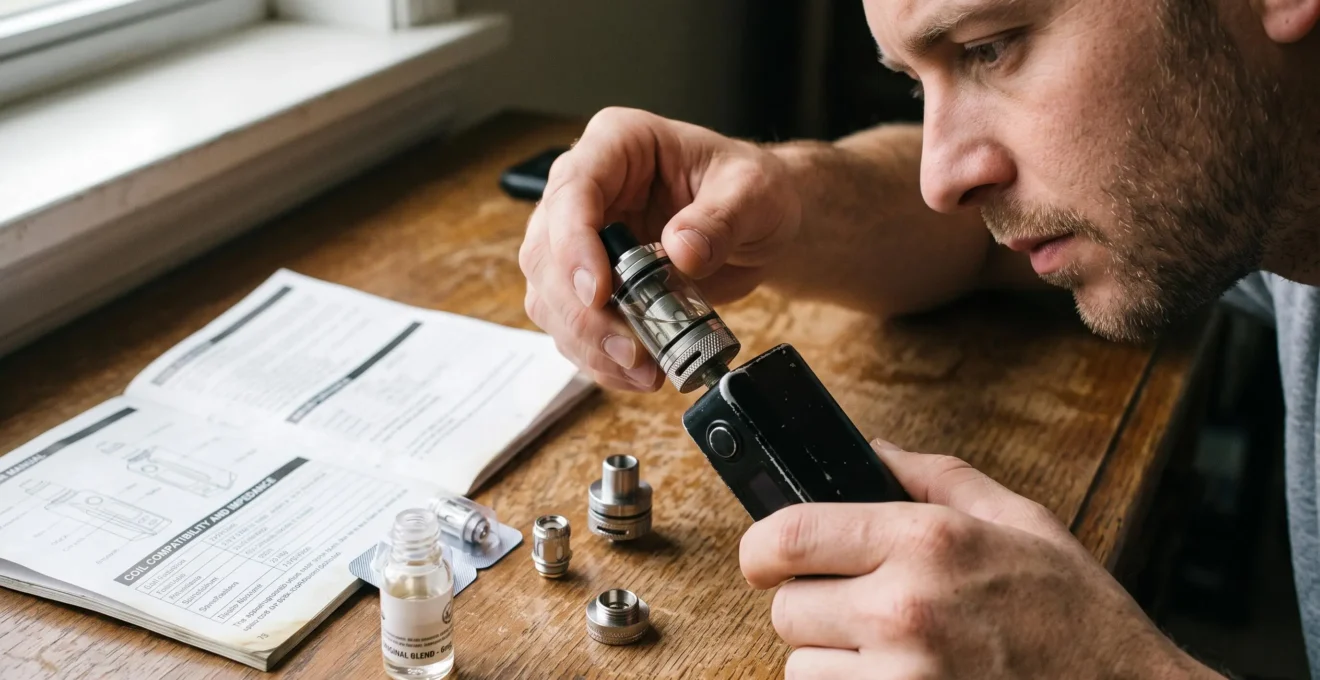
A vape tank can screw onto a battery mod perfectly while containing a coil the device cannot operate safely. Similarly, two replacement coils can look almost identical but belong to different hardware families. Checking vape compatibility therefore requires more than confirming that individual components physically connect.
Before assembling or replacing hardware, identify the exact device and component models, consult the manufacturer’s compatibility information, compare the supported resistance and operating-power specifications, and inspect the relevant connectors. Charging equipment and removable batteries require separate checks.
This matters particularly when combining tanks, coils, mods or accessories from different product ranges. Modern electronic protection circuits can detect certain electrical faults, but they do not make every physically interchangeable component suitable for use.
The most reliable approach is to treat compatibility as a documented relationship between specific parts rather than an assumption based on appearance, connector type or brand familiarity.
Vape compatibility: the essential checks
- Verify the exact models: Match the tank, coil and device against manufacturer documentation, not appearance alone.
- Compare electrical specifications: Confirm supported coil resistance, recommended wattage and battery requirements before assembly.
- Check again after changes: Inspect connections, charging equipment and device behaviour whenever a component is replaced.
- Why Can Vape Components Fit Together but Still Be Incompatible?
- How Should You Check Vape Compatibility Before Fitting a New Part?
- Original or Third-Party Vape Parts: Which Is Easier to Match Correctly?
- What Can Go Wrong When a Vape Battery and Coil Are Poorly Matched?
- When Should You Recheck Vape Compatibility After Changing Hardware?
- Why Is Physical Fit Not Enough to Make a Battery Charger Compatible?
- Integrated or Replaceable Atomizer: Which Is Easier to Maintain?
- Which Vape Device Type Best Fits Your Experience and Daily Routine?
Why Can Vape Components Fit Together but Still Be Incompatible?
Vape components can fit together yet remain incompatible because mechanical compatibility and electrical compatibility are different requirements. A matching thread, magnetic attachment or push-fit connection establishes that parts can join physically. It does not establish that the battery circuitry supports the installed coil, that the recommended power is available or that the complete assembly is suitable for use.
Mechanical connections include the widely used 510 threaded interface, proprietary pod fittings, magnetic contacts and bayonet-style attachments. Each describes a connection mechanism rather than a complete compatibility specification.
For example, two atomizers may share a 510 connection while differing in diameter, weight, connector geometry and electrical requirements. An oversized tank can overhang a narrow battery mod, making the assembly unstable or exposing it to knocks. Poorly matched or damaged contacts may also cause intermittent operation.
Electrical compatibility introduces another set of conditions. A regulated device supports a defined operating range, while an individual coil has its own resistance and recommended wattage. Matching the connector does not override either limit.
Consider a hypothetical device that cannot support the resistance of a particular sub-ohm coil. Even if the tank attaches securely, the device may reject the coil or fail to operate as intended. Attempting to bypass its protections would create an unnecessary safety risk.
Compatibility also extends to the relationship between the battery, coil and e-liquid. A thick, high-VG liquid may wick poorly through a coil designed with relatively small liquid-feed openings, particularly during repeated activation. This can contribute to insufficient liquid reaching the heated wick and an unpleasant burnt taste.
Conversely, a coil’s resistance value alone cannot establish how well it handles a particular liquid. Wick material, feed-port design, airflow and the manufacturer’s instructions also matter.
A secure connection is therefore only preliminary evidence. The next step is to verify the device and component specifications before applying power.
How Should You Check Vape Compatibility Before Fitting a New Part?
Check vape compatibility by identifying the exact device model, confirming its supported resistance and output specifications, verifying the replacement coil or atomizer against the manufacturer’s compatibility list, and inspecting the connection. All four checks must agree before a replacement part can be considered suitable. If documentation is missing or contradictory, do not assume that the component is compatible.
Start with the model designation printed on the device, original packaging or manual. Record the complete reference, including any relevant version or product-range identifier. A shared brand name is not sufficient because manufacturers may use different coil platforms across their devices.
Next, compare the electronic specifications. Look for the device’s supported resistance range, output-power range and any restrictions on compatible atomizers. The coil packaging or manufacturer documentation should identify its resistance and recommended operating wattage.
A useful example comes from Innokin Zyon technical support documentation. Innokin specifies a device output range of 6–25 W and compatibility with PZP coils. Its listed recommendations include 18–24 W for the 0.6-ohm PZP coil and 9–13 W for the 1.0-ohm version.
These values demonstrate why the exact coil reference matters: two coils within the same supported family can require different operating settings. They are Zyon-specific specifications, not general wattage recommendations for coils of those resistance values.
Use the following decision rules before installation:
- If the coil resistance falls below the device’s supported minimum, reject the combination.
- If the coil’s recommended wattage range does not overlap the device’s available output, choose a different supported combination.
- If the coil or tank is absent from a proprietary system’s documented compatibility list, obtain manufacturer confirmation before using it.
- If the connector is damaged, unusually loose or dimensionally unsuitable, do not attempt to force the parts together.
On modular hardware, also check tank diameter, mounting clearance and the condition of the positive contact. Rebuildable atomizers can introduce connector-design considerations that are not apparent from thread size alone. Do not modify connector pins to obtain a fit unless the manufacturer explicitly supports that adjustment.
Five checks to complete before installing a replacement part
- Record the device reference. Write down the complete manufacturer, model and relevant version from the label or documentation.
- Copy the electrical limits. Note the supported resistance and output-power ranges exactly as published.
- Identify the new component. Record its coil-family reference, resistance and recommended wattage from its packaging or technical sheet.
- Confirm the complete match. Check the manufacturer’s compatibility information and document whether the mechanical connection, coil family and electrical specifications agree.
- Inspect before operation. Check for damaged contacts, unsuitable dimensions or leakage, and record a clear install-or-reject decision before activating the device.
If any required specification cannot be confirmed, the appropriate next step is to consult the manufacturer rather than testing an uncertain assembly.
Original or Third-Party Vape Parts: Which Is Easier to Match Correctly?
Original manufacturer parts are generally easier to match because compatibility information can be checked against the intended device and component range. Third-party parts may offer additional options, but their suitability needs explicit verification. Neither shared appearance nor a familiar resistance value establishes interchangeability, and an original part is not automatically compatible with every device from the same brand.
The practical difference is the amount of checking required. A manufacturer-listed replacement coil provides an identifiable reference that can be compared with the device’s support information. With a third-party alternative, the user must establish whether that specific product is actually designed for the equipment in question.
This matters because coils with similar dimensions or nominal resistance can differ in contact design, heating structure, airflow requirements and recommended power. A coil that appears to seat correctly may fail to register, heat inconsistently or operate outside its intended conditions.
Manufacturer compatibility lists illustrate the value of checking individual product families. In its Innokin EZ Tube compatibility and support page, Innokin identifies the Zlide, Zenith, Zenith PRO, Zenith II and Zenith Minimal tanks as compatible with the EZ Tube. The documentation also provides distinct wattage recommendations for individual Z coils.
That list is specific to the EZ Tube and the documented components. It does not establish that similarly shaped third-party tanks or coils will function correctly.
| Criterion | Original manufacturer part | Third-party part |
|---|---|---|
| Compatibility verification | Check the official model-specific compatibility list. | Confirm the exact intended device and obtain reliable component specifications. |
| Electrical requirements | Use the listed resistance and wattage specifications. | Independently verify resistance, recommended power and device support. |
| Connection requirements | Check the specified device and component versions. | Check connector dimensions, contact arrangement and fit. |
| Documentation | Usually available through the device manufacturer’s product-support materials. | Depends on the third-party manufacturer and the particular product. |
| Warranty considerations | Assess under the manufacturer’s stated warranty conditions. | Check whether damage associated with an unsupported accessory is excluded. |
For someone unfamiliar with electrical specifications, choosing the exact manufacturer-listed replacement reduces uncertainty. Experienced users of adjustable regulated mods may be able to evaluate compatible third-party atomizers, provided they have reliable specifications for the entire assembly.
Warranty treatment depends on the applicable terms, jurisdiction and cause of damage. Using a third-party accessory does not necessarily cancel an entire warranty, but damage attributable to an unsuitable accessory may be treated differently.
Whatever the replacement source, retain the original part reference and packaging information so future compatibility checks can be traced to the correct hardware.
What Can Go Wrong When a Vape Battery and Coil Are Poorly Matched?
A poorly matched battery and coil can cause device errors, inadequate vapor production, overheating or potentially dangerous electrical conditions. A coil outside the supported resistance range may be rejected by a regulated mod, while an unsuitable power setting can produce weak performance or excessive heating. The consequences depend on the device design, its protection circuitry and the nature of the mismatch.
Electrical resistance influences the relationship between voltage and current. In an unregulated electrical circuit, a lower resistance draws more current at a given voltage. This makes unsuitable low-resistance loads particularly concerning where the battery and circuit cannot safely support the demand.
Regulated devices operate differently because electronic controls manage output and may prevent activation under unsupported conditions. These protections reduce certain risks but are not grounds for disregarding published limits.
An incorrectly matched coil can produce several recognizable symptoms:
- Atomizer errors: Messages such as “Check Atomizer” or an unreadable resistance value may indicate a connection, coil or electrical fault.
- Weak vapor production: Insufficient usable power or poor liquid delivery can prevent expected performance.
- Immediate burnt taste: Excessive power, inadequate coil priming or insufficient liquid reaching the wick may cause overheating.
- Unusual heating: Abnormal warmth in the device body or battery compartment requires immediate attention.
- Unexpected activation: A device that activates without user input must be treated as malfunctioning.
- Abnormally rapid discharge: A sudden change may indicate battery deterioration, a fault or another operating problem requiring investigation.
The distinction between a performance problem and a safety-critical fault matters. A weak puff does not establish that a battery is electrically overloaded. Likewise, a burnt taste can result from inadequate wicking even when the resistance and power specifications nominally match.
Battery-related hazards deserve particular attention. The FDA guidance on vape battery fires and explosions states that such incidents can cause serious injuries, although they appear uncommon. The agency also acknowledges that their precise causes are not fully established.
For a device that displays an atomizer error, switch it off and follow the manufacturer’s troubleshooting instructions. A faulty connection or coil may require replacement. Do not defeat protective circuitry to make the device operate.
If the device becomes abnormally hot, stop using it immediately. If it activates unexpectedly, avoid continued operation and follow the manufacturer’s emergency or troubleshooting guidance. A damaged, swollen, leaking or overheating battery should not be charged or reused.
Removable lithium-ion cells introduce additional considerations, including battery condition, orientation, supported discharge capability and suitability for the device. Mechanical mods and older devices without comprehensive electronic protections require particular caution and should not be treated as equivalent to regulated equipment.
A device that has overheated, activated unexpectedly or shown signs of battery damage should not be put back into service merely because changing the coil makes an error disappear.
When Should You Recheck Vape Compatibility After Changing Hardware?
Recheck compatibility whenever a coil, pod, tank, battery or charging accessory changes, and when a different e-liquid alters the device’s wicking requirements. The same applies after unusual errors, connector damage or changes in battery performance. Even a replacement marketed under a familiar product name deserves a reference check before installation.
The most obvious trigger is fitting a coil with a different resistance or design. Its recommended power may differ from the previous coil, even when both belong to the same product family. A new tank may also require a different coil range or introduce physical mounting limitations.
Replacing a pod or battery can change the relevant compatibility requirements. Before reusing existing components, confirm that the new device supports their exact references rather than assuming compatibility across successive product generations.
Liquid changes deserve attention as well. Moving to a substantially different viscosity can affect how quickly liquid reaches the coil’s wick. A combination that previously performed adequately may produce dry hits or excessive liquid accumulation under different conditions.
After fitting a documented compatible replacement, follow the manufacturer’s installation and priming instructions. Where the device offers adjustable power and the manufacturer permits it, begin at the lower end of the coil’s recommended range and adjust gradually without exceeding its stated maximum.
A short post-replacement inspection should establish whether the device recognizes the coil, whether the connection remains dry and secure, and whether any error or unusual heat develops. Do not repeatedly activate a device to investigate a persistent fault.
Age can also affect an assembly that was previously reliable. Repeated charging cycles can reduce battery capacity, while residue, liquid contamination or contact wear can interfere with electrical connections. Such symptoms justify inspecting the equipment and revisiting its documentation, rather than automatically assuming that the replacement coil is defective.
For visually similar revisions, compare the full product code, not just the family name. If the manufacturer has changed its supported-component list, use the instructions applicable to the exact device and component versions.
Once the operating components have been confirmed, apply the same disciplined approach to charging equipment, which presents a separate set of electrical requirements.
Why Is Physical Fit Not Enough to Make a Battery Charger Compatible?
A charger is not necessarily compatible with a vape battery simply because its plug or battery slot fits. Safe charging also depends on the device’s charging circuitry, permitted input characteristics and, for removable cells, the charger’s support for the battery’s chemistry and format. The manufacturer’s charging specifications take priority over connector appearance.
USB-C and micro-USB identify connector types, not a complete charging specification. A suitable combination must use the correct electrical interface and charging arrangements, including any relevant voltage, current and charging-protocol requirements.
Importantly, a power supply’s advertised maximum current capacity is not automatically the current delivered to the battery. In properly designed USB-powered equipment, the device’s charging circuitry determines or negotiates the power it draws. The practical concern is whether the complete charger-and-device combination meets the manufacturer’s requirements, not simply whether the charger’s printed current rating is high.
For a device-specific illustration, Innokin lists a maximum charging rate of 5 V and 0.75 A for the Zyon. Its EZ Tube documentation specifies 5 V and 1.7 A. These are different manufacturer-stated charging specifications and should not be converted into universal limits for other vaping products.
Removable cylindrical cells require a different check. A charger that physically accepts an 18650 or 21700 cell must also support the relevant lithium-ion chemistry and appropriate charging characteristics. Verify polarity, cell condition and compatibility with the charger manufacturer’s instructions.
Battery dimensions alone do not establish suitability for a vape mod. The device may have additional requirements concerning its battery configuration, electrical capability or protective features. Never bypass built-in safeguards or improvise connections to accommodate an unsuitable cell.
The UK’s Office for Product Safety and Standards provides practical guidance in its UK government advice on e-cigarette battery safety. It recommends using the supplied charger, avoiding overnight charging, keeping the device under observation and charging on a clean, flat surface away from combustible materials.
Before charging, inspect the cable, port, contacts and battery for visible damage. Follow the device’s specified charging instructions, keep the equipment away from flammable surfaces and disconnect it when charging is complete. If the original charging instructions are unavailable, contact the manufacturer for an approved replacement arrangement.
Charging safety is a separate part of hardware compatibility and remains important even when the tank and coil are correctly matched.
Integrated or Replaceable Atomizer: Which Is Easier to Maintain?
An integrated-coil pod is generally simpler to maintain because the user replaces a compatible pod assembly rather than handling a separate coil. A tank with replaceable coils requires more attention to component references, installation and priming, but allows the heating element to be changed independently. The better option depends on the user’s willingness to manage compatibility and maintenance.
In an integrated-coil system, the coil is built into the replaceable pod or cartridge. Once the coil reaches the end of its useful life, the appropriate maintenance action is usually to replace that entire component.
This reduces the number of individual parts the user must match, although it does not eliminate compatibility checks. Pods from different generations or product variants may look alike without being interchangeable.
Replaceable-coil tanks operate differently. The user retains the tank and installs a new coil from the supported family. Depending on the design, maintenance may include cleaning the tank, inspecting seals, replacing the coil and following the prescribed priming procedure before operation.
| Maintenance factor | Integrated-coil pod | Replaceable-coil tank |
|---|---|---|
| Replacement unit | Complete compatible pod or cartridge | Compatible coil installed in the existing tank |
| Compatibility decisions | Match the complete pod reference | Match the tank, coil family, resistance and operating power |
| Routine care | Inspect and clean accessible pod contacts and connection areas | Clean the tank, inspect seals and replace or prime coils as instructed |
| Replacement materials | More of the pod assembly is discarded when the coil wears out | The tank can remain in use while the coil is replaced |
| Typical maintenance complexity | Fewer separate replacement operations | More hands-on component handling |
Replaceable coils may lower recurring consumable costs because the tank can be retained, but this depends on actual product prices, replacement frequency and the equipment used. Similarly, replacing an entire integrated pod generally discards more components per coil replacement, but the total environmental impact cannot be established without product-specific lifecycle information.
Integrated systems suit users who prefer straightforward replacement and minimal adjustments. Replaceable-coil systems may appeal to users comfortable following coil specifications and performing routine maintenance.
Neither system is maintenance-free. Condensation, residue, worn seals and damaged contacts can affect both. A burnt taste, reduced vapor production or persistent leakage should prompt inspection and the appropriate manufacturer-recommended maintenance action.
The most manageable system is the one whose replacement requirements the user can identify and follow consistently, rather than the one offering the largest number of interchangeable accessories.
Key takeaways before choosing a device
- Prioritize manageable compatibility: A simpler, manufacturer-defined system reduces the number of parts that need independent verification.
- Consider the complete operating setup: Replacement coils, battery requirements and charging equipment matter alongside the initial device.
- Choose flexibility deliberately: More modular hardware brings additional checks, maintenance and responsibility rather than automatically improving suitability.
Which Vape Device Type Best Fits Your Experience and Daily Routine?
The most suitable vape device is one whose compatibility requirements match the user’s technical knowledge, maintenance preferences and daily routine. Compact integrated-coil pods generally involve fewer component-matching decisions, while adjustable box mods and modular tank systems require closer attention to coils, power settings, batteries and connectors. Greater flexibility is useful only when those additional requirements can be managed safely.
For a user prioritizing portability and straightforward maintenance, a manufacturer-defined pod system limits the range of replacement decisions. Its compact design can be convenient for travel or daily carrying, although battery capacity and charging requirements still need consideration.
A box mod with a separately replaceable tank offers more flexibility. Compatible atomizers and coils can provide different airflow and operating characteristics, but the user must verify electrical specifications every time the hardware combination changes.
Devices using removable batteries introduce another maintenance layer. Battery selection, condition, transport and external charging may all require attention. More battery flexibility does not remove the need to use the exact cell types and arrangements supported by the device.
Advanced rebuildable setups demand further understanding of resistance, electrical contacts, coil construction and battery limits. An adjustable wattage setting alone does not make an unsupported atomizer or unsafe battery configuration acceptable.
A useful way to select a device is to evaluate the practical work it requires:
- Minimal maintenance: Choose a documented compatible integrated-coil pod system if reducing component changes is the main priority.
- Regular coil replacement: Consider a tank with a clearly documented replacement-coil family and straightforward maintenance instructions.
- Adjustable operation: Use a regulated device only when its power controls, resistance limits and supported tank combinations are understood.
- Removable battery management: Select this arrangement only when suitable battery handling, inspection and charging practices can be followed.
- Advanced customization: Approach rebuildable equipment only with the knowledge required to assess the complete electrical and mechanical assembly.
Experience should influence progression. Familiarity with replacing pods does not automatically translate into knowledge of lithium-ion battery limits or rebuildable atomizer safety. Moving to a more modular system is better treated as a deliberate increase in technical responsibility.
For adults who already vape, the practical objective is not to maximize power or customization. It is to select equipment whose documented components, operating requirements and maintenance demands can be checked reliably.
Keep the device model, supported component references and charging instructions accessible. Before purchasing or installing another part, compare its full reference with that documentation; if the match cannot be established, seek manufacturer clarification rather than assembling an uncertain combination.
Can two vape coils with the same resistance be interchangeable?
Not necessarily. Two coils can share the same resistance while having different dimensions, contacts, heating structures or recommended wattage ranges. Interchangeability must be established through the exact supported coil family and device documentation, not the ohm rating alone.
Does a 510 connection mean any tank will work with my vape mod?
No. A 510 connection describes a mechanical interface. Tank diameter, connector condition, contact geometry, supported resistance and operating power still need verification. A mechanically attached tank may be unsuitable or electrically unsupported.
What should I do if my vape displays “Check Atomizer” after replacing a coil?
Stop activating the device and consult its troubleshooting instructions. Confirm that the installed coil is an approved model, inspect accessible contacts for residue or damage and check that the component is correctly fitted. If the error persists, do not bypass the protection system; contact the manufacturer or an appropriately qualified service provider.
Can I use a USB-C charger from another electronic device?
A matching USB-C plug does not by itself prove compatibility. The power supply, cable and device charging circuitry must support the required electrical characteristics. Follow the vape manufacturer’s charging instructions, use its supplied or explicitly approved equipment where specified, and obtain clarification if suitable alternatives are not documented.
Should I replace a coil if the device suddenly becomes unusually hot?
Do not assume the coil is responsible. Stop using the device immediately and follow the manufacturer’s safety guidance. Unusual heating may involve the battery, electronics, connections or atomizer. A device showing battery damage or persistent abnormal heating should not be charged or returned to service without appropriate assessment.