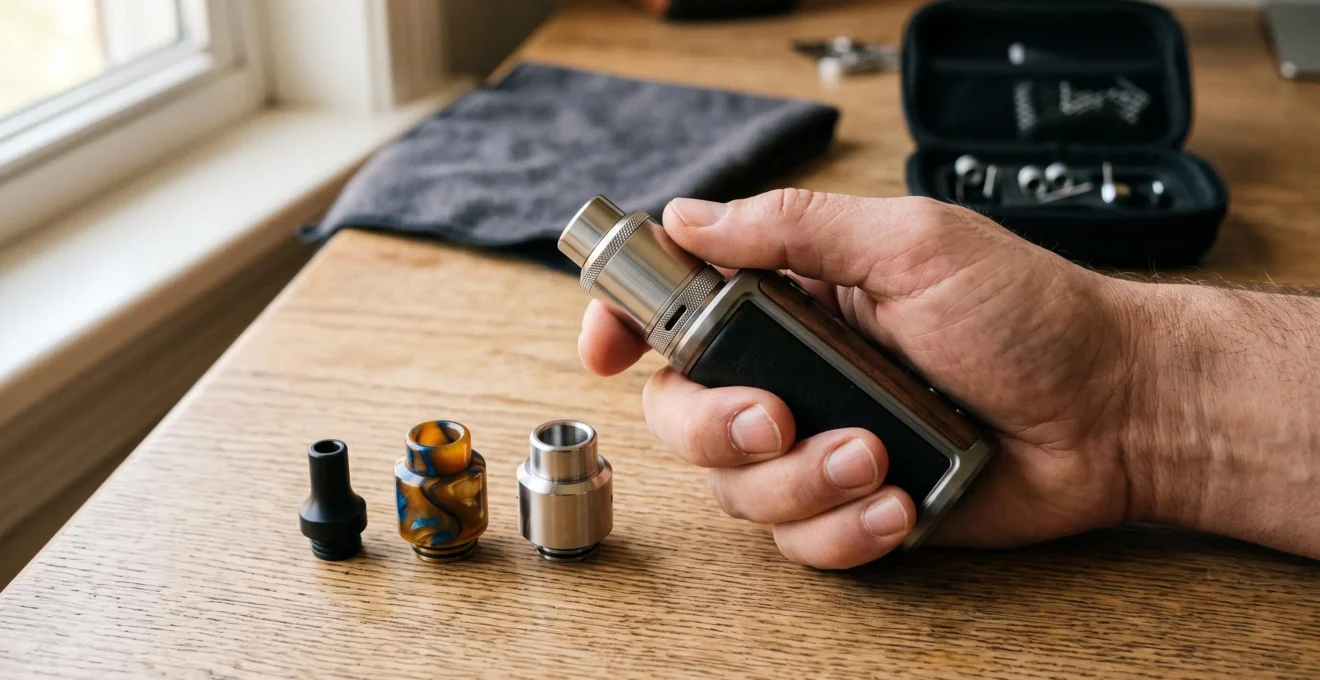
A vape drip tip may be a small, removable component, but its internal diameter, shape and material can noticeably change how a device feels during use. A narrow mouthpiece generally adds draw resistance, while a wider opening allows aerosol to pass with less restriction. The material also influences how much heat reaches the lips and how comfortable the mouthpiece feels over repeated puffs.
These differences matter because the drip tip sits at the final point of the aerosol pathway. Its geometry works alongside the tank’s airflow system, coil and power settings rather than replacing their functions. Changing the mouthpiece cannot automatically transform a mouth-to-lung device into a direct-to-lung setup, but it can make an otherwise familiar draw feel different.
For adults maintaining an existing vaping device, understanding these distinctions helps identify whether an uncomfortable draw, loose fitting or persistent residue comes from the mouthpiece or another component. It also makes replacement and cleaning decisions more straightforward, without unnecessary changes to power or nicotine concentration.
Vape drip tip essentials
- Bore and shape affect resistance: wider openings generally feel less restrictive, but they do not necessarily introduce additional air into the device.
- Material affects contact comfort: metal transfers heat readily, while suitable engineering plastics offer greater thermal insulation.
- Fit and condition matter: damaged tips, worn O-rings and trapped condensation can cause discomfort or fitting problems that cleaning alone may not resolve.
- Why Can a Wider Drip Tip Make the Same Vape Feel More Airy?
- How Can You Replace and Clean a Vape Drip Tip Without Damaging the O-Rings?
- Metal, Resin or Plastic Drip Tip: Which Feels Best During Regular Use?
- What Problems Can a Cracked or Loose Drip Tip Cause?
- When Should You Replace a Vape Drip Tip Instead of Cleaning It?
- Why Does MTL Vaping Usually Use a Tighter Airflow?
- Why Does DTL Vaping Need More Airflow Than Mouth-to-Lung Vaping?
- Which Vaping Accessories Are Actually Useful for Everyday Device Care?
Why Can a Wider Drip Tip Make the Same Vape Feel More Airy?
A wider drip tip can make the same vape feel airier because its larger internal opening usually creates less resistance as aerosol passes toward the mouth. The device’s airflow control may remain unchanged, yet the overall draw feels looser. This difference comes primarily from mouthpiece geometry and flow resistance, not necessarily from additional air entering the tank.
The bore is the internal channel through the drip tip. A narrow bore constrains the passage available to the moving aerosol, while a wider one provides a larger flow area. Because the mouthpiece is part of the complete airflow pathway, changing its dimensions can alter the pressure needed to draw through the device.
However, a wider bore does not automatically dilute aerosol with extra air. Unless the mouthpiece includes dedicated ventilation openings, outside air generally enters through the device’s designed intake system. A larger mouthpiece opening changes flow conditions downstream rather than independently increasing external air intake.
The distinction is reflected in Armerah‘s drip-tip material and bore-size guide, which describes narrower mouthpieces as offering a more restricted draw and wider ones as producing a more open sensation. The retailer also notes that bore categories are not standardized across the industry.
For example, Armerah’s own classification defines narrow bores as under 5.5 mm, medium bores as 5.5 mm to under 7.5 mm, and big bores as 7.5 mm to under 9.5 mm. These are retailer-specific categories, not universal compatibility or performance specifications.
Bore shape matters alongside diameter. Round openings generally allow the mouthpiece to be used without a particular rotational orientation. Flat or oval shapes introduce a different contact surface and may change how naturally the lips seal around the tip. Individual perceptions can vary, and there is insufficient evidence to claim that a flat bore consistently redistributes flavour across the tongue in a predictable way.
A wider opening may also change perceived aerosol concentration or flavour intensity, depending on the device and inhalation pattern. It does not follow that the user needs higher wattage or stronger nicotine. Such adjustments can increase exposure and are not established remedies for an unsuitable mouthpiece.
To compare two compatible tips, keep the airflow setting, coil and operating conditions unchanged. Assess draw resistance and lip comfort separately. This is more informative than partly blocking the mouthpiece with a finger during use, which could disturb airflow or allow contact with hot aerosol.
Once the preferred opening is identified, the next priority is keeping the mouthpiece and its sealing components in suitable condition.
How Can You Replace and Clean a Vape Drip Tip Without Damaging the O-Rings?
To replace or clean a vape drip tip without damaging its O-rings, switch off the device, allow it to cool and follow the manufacturer’s removal instructions. On compatible push-fit designs, gentle movement can help release the mouthpiece without excessive force. Clean the detached parts appropriately, inspect the seals and reinstall the tip without forcing the connection.
O-rings are small seals fitted around certain drip-tip connectors or within the receiving socket. They help maintain a secure fit and, depending on the device construction, may contribute to sealing the connection. A torn, displaced or incorrectly sized O-ring can leave the mouthpiece unstable even when the tip itself is undamaged.
Removal technique depends on the connector. Some friction-fit tips can be eased out with a light twisting movement, while other designs have different attachment requirements. Do not assume twisting is correct for every mouthpiece, particularly if its construction requires another removal method.
For cleaning, use the procedure specified for the particular tank and mouthpiece material. Suitable removable components can often be rinsed with warm water, but water should not reach electrical parts. Avoid harsh chemicals unless their compatibility is explicitly confirmed. Alcohol-based cleaners and lubricants should not be assumed safe for every seal or plastic.
Manufacturer-specific guidance is particularly useful here. Innokin‘s T18 II tank maintenance instructions recommend inspecting O-rings, noting their original positions and avoiding excessive force during installation. The guidance also identifies condensation removal as part of routine care.
Five-step drip tip maintenance checklist
- Confirm the connector design: check the device manual and identify the correct removal method before applying force.
- Inspect the removed mouthpiece: record any cracks, deformation or visible residue around its base and bore.
- Check the O-rings: verify that each seal is present, correctly positioned and free from tears or frayed edges.
- Clean and dry compatible components: follow the manufacturer’s instructions and confirm that no visible residue or moisture remains before reassembly.
- Verify the fit: reinstall the mouthpiece and check that it sits securely without unusual movement, resistance or visible seal displacement.
If a seal appears dry or difficult to fit, check the manufacturer’s approved installation procedure. A small amount of compatible liquid may be recommended for some connectors, but silicone lubricant or e-liquid should not be applied universally without confirming material compatibility.
After reassembly, inspect the physical fit before operating the device. A non-powered draw may help identify an obvious change in resistance, but it cannot reliably diagnose every seal problem. Unexpected gurgling, leaking or unstable airflow should be investigated using the device’s troubleshooting instructions.
With the connection secure and clean, the remaining comfort differences often come from the material touching the lips.
Metal, Resin or Plastic Drip Tip: Which Feels Best During Regular Use?
Plastic and suitable engineering-polymer drip tips generally provide better thermal insulation at the lips, while metal offers durability but transfers heat more readily. Resin mouthpieces can feel comfortable and offer varied shapes and finishes, although their properties depend on the specific formulation. The best everyday option therefore depends on operating temperature, surface condition, durability and personal contact preferences.
Thermal behaviour is especially relevant during repeated use. Metal conducts heat efficiently, so a metal drip tip may feel cold in a cool environment and warmer as heat builds near the mouthpiece. Engineering plastics such as POM and PEI generally transfer heat less readily, which can reduce rapid temperature changes at the contact surface.
The word resin requires care. Epoxy resin, acrylic-based materials and engineering thermoplastics are not identical substances. Their heat resistance, surface finish and susceptibility to cracking differ, so a mouthpiece’s actual material specification is more useful than a broad commercial label.
The following comparison highlights practical differences without treating every product in a material category as equivalent.
| Criterion | Metal | Resin | Plastic / POM / PEI |
|---|---|---|---|
| Heat transfer | Relatively high; can feel hot or cold | Varies by formulation | Generally lower with suitable engineering polymers |
| Durability | Usually resistant to ordinary surface wear | Some formulations may chip or crack | Depends on polymer and construction |
| Lip contact | Hard, rigid surface | Varies with shape and finish | Typically lightweight and insulating |
| Cleaning | Smooth surfaces are often straightforward to wipe | Follow material-specific guidance | Check compatibility with liquids and cleaners |
| Main consideration | Temperature and hardness | Formulation and surface integrity | Heat tolerance and chemical compatibility |
A scientific illustration of mouthpiece heating comes from the 2022 experimental study on mouthpiece heating during vaping. Researchers examined temperatures under defined power settings and repeated-puff conditions.
69.6 °C
Maximum exterior mouthpiece temperature reported after ten puffs at 80 W in the tested laboratory configuration. This is a device-specific measurement, not a typical temperature for all drip tips.
Ko and Kim, 2022, Effect of Heating on Physicochemical Property of Aerosols during Vaping.
At 60 W, the same research reported a maximum exterior mouthpiece temperature of 39.3 °C under its test conditions. The study demonstrates that power and repeated use can substantially affect mouthpiece temperatures, but it did not compare interchangeable metal, resin and polymer drip tips. It therefore cannot establish a universal ranking of lip comfort between those materials.
Surface finish also influences maintenance. A smooth, undamaged mouthpiece may be easier to inspect and wipe than one with deep texture or surface damage. However, it would be inaccurate to assume that all resin is porous or that all plastic retains more flavour than metal. Cleaning performance depends on the precise material and its condition.
For frequent outdoor use, contact temperature and impact resistance may deserve particular attention. For repeated high-power use, thermal insulation becomes more relevant. For users concerned about lingering flavour, a smooth, compatible mouthpiece that tolerates the manufacturer’s cleaning method is a sensible criterion.
Regardless of material, visible cracking or an unstable connection changes the question from comfort preference to component condition.
What Problems Can a Cracked or Loose Drip Tip Cause?
A cracked or loose vape drip tip can cause an unstable mouthpiece fit, uncomfortable contact, residue accumulation and, on some designs, an unintended change in airflow. A crack may create a difficult-to-clean gap, while a loose tip may indicate either an incompatible connector or a damaged O-ring. These problems should be checked before adjusting wattage or replacing the coil.
Small cracks can develop around the bore, lip-contact area or connector base. Even a hairline fracture may leave an uneven edge or a narrow opening where condensation collects. If the material begins to chip, it also creates a physical contact concern that ordinary cleaning cannot resolve.
Loose fitting has several possible causes. The drip tip’s connector may be the wrong size, the mouthpiece may have become deformed, or the retaining O-ring may be missing, worn or incorrectly seated. These faults can produce similar wobbling even though they require different replacements.
Not every loose mouthpiece creates an external air leak. Some designs allow movement at the connection without opening an additional pathway into the tank’s airflow system. Others may permit unwanted air entry through a damaged junction. The actual consequence depends on how the mouthpiece and atomizer are constructed.
Unusual gurgling, condensation near the junction or liquid reaching the lips may accompany a mouthpiece problem, but they are not conclusive evidence of one. Condensation can accumulate during normal operation, and coil flooding or other tank faults may produce similar symptoms.
A useful diagnostic sequence is to examine the mouthpiece and connector separately:
- Visible crack or sharp edge: treat the drip tip as damaged and replace it with a compatible part.
- Intact tip that wobbles: inspect the O-ring condition, position and connector compatibility.
- Condensation without structural damage: clean the appropriate surfaces and reassess the fit.
- Persistent leaking or gurgling: check the tank, coil and seals according to the manufacturer’s troubleshooting guidance.
Increasing wattage to compensate for an unusual draw does not repair a mechanical defect. On some devices, excessive power or insufficient liquid replenishment can contribute to coil overheating and burnt-tasting aerosol. The underlying fitting problem should be identified instead.
If the mouthpiece remains structurally sound, cleaning or seal replacement may be sufficient; otherwise, the part itself needs attention.
When Should You Replace a Vape Drip Tip Instead of Cleaning It?
Replace a vape drip tip rather than cleaning it again when it has a structural crack, sharp damage, a deformed connector or contamination that cannot be removed using a material-compatible cleaning method. An intact tip with ordinary condensation or removable residue usually needs cleaning, not replacement. The condition of its O-rings should be assessed separately.
The clearest replacement criteria are physical. A crack can remain after washing, a damaged rim may continue to feel rough, and a distorted connector may no longer hold securely. Repeated cleaning cannot restore the original dimensions or structural integrity of these parts.
Discoloration alone requires more interpretation. Some changes may be superficial, while others may accompany material deterioration. Persistent odour or unwanted flavour after appropriate cleaning also warrants closer inspection, particularly where an e-liquid ingredient may have affected the plastic.
Some susceptible plastic mouthpieces can deteriorate following contact with particular flavouring ingredients, including certain cinnamon, citrus or mint-related formulations. The extent of this effect depends on the polymer and liquid composition; it should not be generalized to all plastic or resin products.
For routine decisions, distinguish the main conditions rather than replacing the entire assembly automatically.
| Observed condition | Appropriate response |
|---|---|
| Removable residue or condensation | Clean using the approved method |
| Intact tip with a torn or missing O-ring | Replace the correctly sized seal if supported by the design |
| Cracked, chipped or sharp lip-contact surface | Replace the drip tip |
| Deformed connector or O-ring groove | Replace the damaged mouthpiece component |
| Persistent residue or off-taste after proper cleaning | Investigate the material, coil and tank; replace the tip if it remains the cause |
Metal and glass mouthpieces may tolerate repeated cleaning well when intact, but neither is immune to physical damage. Plastic and resin products vary widely in chemical resistance. Material-specific compatibility remains more reliable than an assumed fixed replacement interval.
It is also worth separating mouthpiece-related flavour changes from coil deterioration. A worn coil may generate an unpleasant taste even when the drip tip is clean and undamaged. Replacing an otherwise serviceable mouthpiece would not correct that problem.
Because drip tips are separate, replaceable components on many refillable devices, targeted replacement may avoid unnecessary changes to the rest of the hardware. Compatibility must still be checked rather than assumed from appearance alone.
Once the mouthpiece is in good condition, its bore can be considered in relation to the inhalation style for which the device was designed.
Why Does MTL Vaping Usually Use a Tighter Airflow?
Mouth-to-lung (MTL) vaping generally uses tighter airflow because its inhalation pattern involves drawing aerosol into the mouth before inhaling it into the lungs. A restricted airflow pathway provides the resistance associated with this technique. MTL equipment is therefore commonly designed with narrower air passages, compatible mouthpieces and coils intended for relatively low operating power.
The draw is often compared with that of a conventional cigarette because both involve an initial mouth draw. This comparison describes inhalation mechanics, not equivalent health effects or nicotine delivery.
In an MTL device, the airflow system and coil work together to support a relatively restricted draw. A narrower drip tip may complement that configuration by contributing additional resistance at the mouthpiece. However, the effect depends on the full airflow pathway, not simply the internal diameter of one part.
A narrower opening does not inherently slow aerosol velocity everywhere in the system. At a given volumetric flow rate, reducing cross-sectional area can increase local velocity, while the added resistance may reduce the total flow achieved by the user. These effects should not be confused.
The practical result is that a mouthpiece matched to the intended inhalation style is more likely to preserve the draw characteristics established by the manufacturer.
A wide-bore tip fitted to a restricted MTL tank may feel less focused at the lips, even if the tank’s airflow intake remains unchanged. It may also alter the contact shape sufficiently to make the draw feel unfamiliar. That does not necessarily indicate a defective coil or unsuitable e-liquid.
Conversely, installing a very narrow tip cannot reliably convert an open-airflow tank into a properly engineered MTL setup. Coil design, airflow channels and power requirements still determine much of the device’s operating behaviour.
MTL devices are also commonly associated with higher nicotine concentrations than DTL devices, not lower ones. This is a description of hardware categories and product use patterns, not a recommendation to increase nicotine intake.
For a user troubleshooting an MTL device, checking the intended mouthpiece specification and airflow setting is preferable to changing power or liquid strength in response to a different draw sensation.
The contrast becomes clearer when considering direct-to-lung equipment, where the airflow pathway is designed around a different inhalation pattern.
Why Does DTL Vaping Need More Airflow Than Mouth-to-Lung Vaping?
Direct-to-lung (DTL) vaping generally needs more open airflow because aerosol is drawn directly toward the lungs rather than first collected in the mouth. DTL equipment commonly uses coils designed for higher power and greater aerosol output. A less restrictive airflow pathway, including an appropriately sized drip tip, supports that configuration and helps manage heat during operation.
Higher-power coils can generate greater aerosol quantities and more heat under suitable operating conditions. Airflow interacts with this thermal process by moving through the atomizer and carrying generated aerosol toward the mouthpiece.
That is why DTL tanks often feature larger intake openings and wider mouthpieces. A narrow drip tip can add an unwanted restriction to a system designed for relatively high flow, making the draw uncomfortable or inconsistent with the coil’s intended operating conditions.
Airflow also participates in cooling, but a wider drip tip alone cannot guarantee adequate coil cooling. Cooling depends on intake geometry, air velocity, coil construction, liquid supply, operating power and puff behaviour. Opening the mouthpiece does not compensate for an overheated or incorrectly operated coil.
Manufacturer guidance on Innokin’s explanation of MTL, DTL and RDL vaping styles describes MTL systems as generally tighter and lower-powered, while DTL configurations use more open airflow and typically higher operating power.
Restricted-direct-lung (RDL) equipment occupies an intermediate category. This is useful when interpreting mouthpiece choices because not every device fits neatly into the narrowest MTL or widest DTL arrangement.
The differences can be summarized as follows:
| Characteristic | MTL | DTL | RDL |
|---|---|---|---|
| Inhalation pattern | Mouth first, then lungs | Directly toward lungs | Restricted direct inhalation |
| Airflow | Relatively tight | More open | Intermediate |
| Typical power configuration | Lower | Higher | Depends on device |
| Common bore preference | Narrower | Wider | Intermediate or device-specific |
| Primary compatibility check | Restricted system design | Open-flow system design | Manufacturer’s intended configuration |
DTL mouthpieces are often relatively wide, and some are short, but length is not a universal requirement. MTL tips can be taller or narrower, yet neither characteristic is compulsory. Product geometry varies, and compatibility with the actual tank takes priority over visual conventions.
Similarly, the distinction between 510 and 810 mouthpiece fittings concerns connector dimensions and construction rather than the battery connection. The fitting type should be verified from the device specification; bore width alone does not establish compatibility.
For any inhalation style, an unusually hot mouthpiece, burnt taste or unstable draw should prompt inspection of the equipment and its operating conditions rather than an assumption that a wider opening will solve the problem.
With airflow compatibility established, routine care becomes a matter of protecting a small number of components rather than accumulating unnecessary accessories.
Key takeaways before choosing maintenance accessories
- Check the mouthpiece connector and O-ring dimensions before keeping replacement parts; similar-looking tips are not automatically interchangeable.
- Prioritize accessories that address actual maintenance needs, such as visible residue, damaged seals or contamination during storage.
- Keep comfort preferences separate from component faults: a different bore is a preference, while a crack or deformed fitting is a replacement issue.
Which Vaping Accessories Are Actually Useful for Everyday Device Care?
The most useful everyday vaping accessories are those that help keep existing equipment clean, intact and correctly fitted. A compatible spare drip tip, correctly sized O-rings, a lint-free cleaning cloth and a protective case each address a practical maintenance need. Decorative additions may change appearance, but they should not be confused with tools that preserve component condition.
The drip tip deserves attention because it is both a contact surface and part of the aerosol pathway. It is also removable on many refillable devices, making inspection and replacement comparatively straightforward.
A spare mouthpiece can be useful when the original becomes cracked, lost or unsuitable. Keeping a different bore width may also allow a comparison of draw feel, provided both tips are compatible with the same atomizer and intended configuration.
Spare O-rings are more specific. Their size, material and position must match the device requirements. A generic assortment should not be assumed suitable merely because a ring appears to fit the connector.
Cleaning accessories help with different kinds of residue. A lint-free cloth is useful for wiping accessible surfaces, while a soft brush or suitable swab may help reach an appropriate removable component’s interior. Care is needed to avoid leaving fibres behind or dislodging small seals.
A protective case can help keep a detached mouthpiece away from loose dust and debris during storage. The benefit comes from physical protection and separation, rather than any special treatment of the aerosol or liquid.
For a compact kit, the following items cover common maintenance situations without adding unnecessary complexity:
- One compatible spare drip tip: replacement for a damaged or missing mouthpiece, with an alternative bore only when the device supports it.
- Correctly specified spare O-rings: replacement for torn or worn retaining seals.
- One lint-free cloth: removal of accessible condensation and surface residue.
- A small protective case: clean storage for detachable accessories.
- A suitable soft cleaning tool, when needed: access to components that the manufacturer permits users to clean.
These items address the main maintenance issues discussed throughout the article: fitting integrity, residue removal, surface protection and replacement compatibility. None requires changing the device’s electrical components or modifying its designed airflow channels.
A useful purchasing test is whether an accessory solves an identifiable problem involving cleanliness, comfort, physical protection or component lifespan. An item that only changes appearance may still be a personal preference, but it is not essential to everyday care.
For an existing device, start by inspecting the current mouthpiece, confirming its connector specification and replacing only components that are damaged or no longer fit correctly. A clean, compatible drip tip should provide the intended draw without compensatory changes to wattage or nicotine strength.
Are 510 and 810 drip tips interchangeable?
Not directly in every device. The terms identify different mouthpiece connector formats, and compatibility depends on the tank’s receiving socket and the particular tip construction. Some equipment supports a suitable adapter, but the manufacturer’s specifications should be checked before fitting a different connector size.
Can changing a drip tip fix a burnt taste?
Only if the unpleasant taste originates from residue or deterioration in the mouthpiece itself. A burnt taste can also indicate a coil or liquid-supply problem. Inspecting the drip tip may help eliminate one possible cause, but replacement cannot repair a damaged coil or incorrect operating conditions.
Can a drip tip change airflow without changing the tank settings?
Yes. A different bore can change resistance along the complete airflow pathway even when the tank’s adjustable intake remains in the same position. This affects the perceived draw, but it does not necessarily introduce additional outside air or change the coil’s operating requirements.
Is a warm drip tip always a sign that something is wrong?
Some temperature increase can occur because heat is transferred from the atomizer and aerosol to the mouthpiece. However, a tip that becomes uncomfortably hot, especially alongside burnt taste or unusual operation, warrants stopping use and checking the device against its manufacturer’s guidance. Material, power and usage pattern all affect surface temperature.
How often should a reusable vape drip tip be replaced?
There is no universal replacement interval established by the supplied technical sources. Replacement should be based on the actual condition of the component, including cracks, deformation, persistent contamination and secure fitting. An undamaged mouthpiece may remain serviceable through repeated appropriate cleaning, while damaged O-rings may need separate replacement.