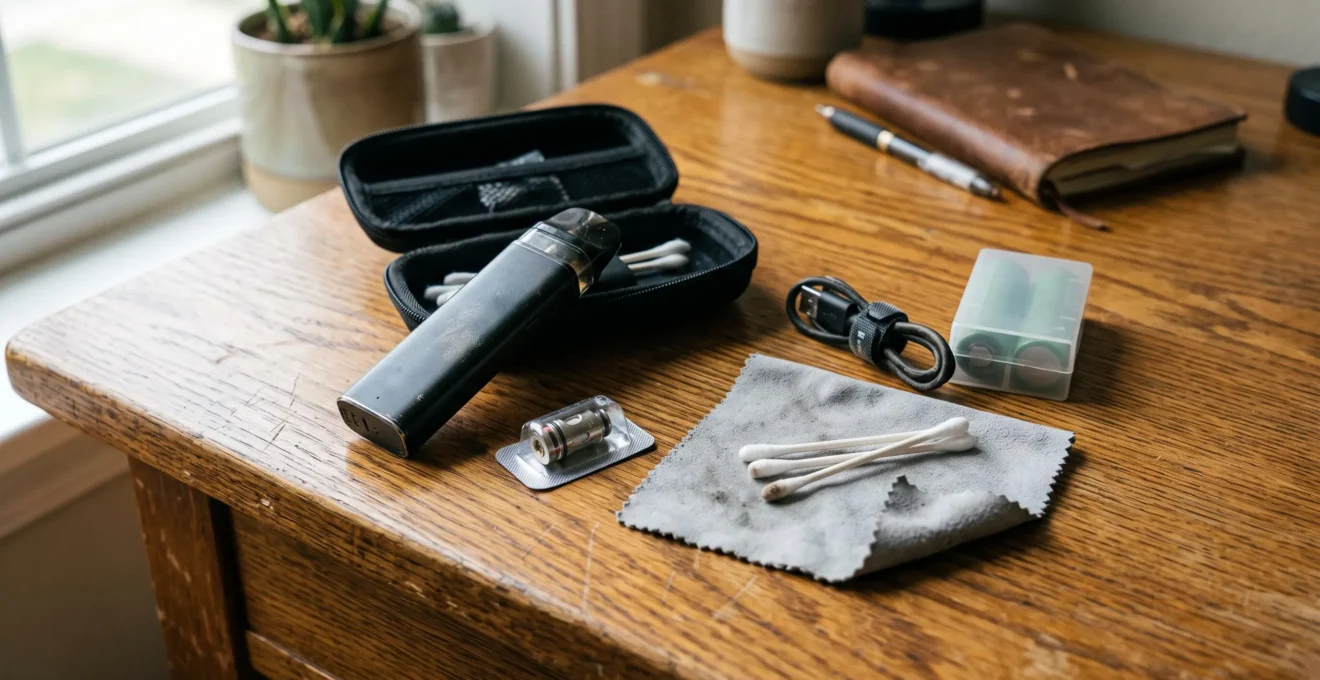
The most useful vaping accessories are usually the least complicated: suitable cleaning materials, compatible replacement parts, protective storage, and a charging solution that meets the device manufacturer’s requirements. These items address identifiable maintenance problems rather than simply changing how a device looks.
For adult users who already own a vaping device, the challenge is deciding which accessories deserve space in a pocket, bag, or drawer. A spare coil may be practical for a replaceable-coil tank but useless for a sealed pod system. A protective case can help prevent damage, yet a poorly fitted case may obstruct controls or retain moisture. Similarly, a charging connector that physically fits does not establish that the complete charging arrangement is suitable.
The objective is not to assemble the largest possible accessory collection. It is to maintain a small, compatible setup, recognise deterioration before it becomes a larger problem, and avoid purchases that add little functional value. Device-specific instructions remain essential because maintenance requirements differ between models.
Everyday vape accessories: what matters most
- Prioritise compatible replacement parts, appropriate cleaning materials, safe charging, and protective storage over cosmetic additions.
- Build a carry kit around realistic failures, your device type, and how long you will be away from reliable supplies.
- Check exact model compatibility and replace damaged or deteriorating components based on observable condition rather than arbitrary schedules.
- Why Are Simple Vape Care Accessories Often More Useful Than Decorative Add-Ons?
- How Can You Build a Small Vape Maintenance Kit for Daily Carry?
- Spare Coil or Full Backup Kit: Which Makes More Sense for a Day Out?
- Which Vape Accessories Should You Avoid Buying Without Checking Compatibility?
- When Should You Replace Vape Accessories Before They Damage the Main Device?
- When Should You Replace a Protective Vape Case?
- Why Is Physical Fit Not Enough to Make a Battery Charger Compatible?
- How Can You Check Whether Vape Components Are Actually Compatible?
Why Are Simple Vape Care Accessories Often More Useful Than Decorative Add-Ons?
Simple maintenance accessories are generally more useful because they address problems that can interfere with normal device operation. A suitable replacement coil restores a worn heating component, cleaning materials help remove accessible residue, and protective storage reduces avoidable exposure to impacts or loose objects. Decorative accessories, by contrast, may offer no functional benefit and should be evaluated for possible interference with the device.
The distinction is between preserving an existing function and adding something that the device does not require. A coil designed for a compatible tank is a consumable with an identifiable purpose. A cloth suitable for cleaning accessible exterior surfaces has a straightforward maintenance role. A decorative wrap, coloured attachment, or ornamental sleeve usually serves a different purpose.
That does not make every cosmetic accessory harmful. A properly designed accessory that leaves ventilation, controls, charging connections, and inspection points unobstructed may have little operational effect. However, poorly positioned stickers or adhesive skins can make seams harder to inspect, leave residue during removal, or conceal warning signs such as surface damage. Thick covers can also obstruct access to buttons or openings if they were not designed for the specific model.
A useful purchasing filter consists of three questions:
- What actual problem does it solve? Identify a cleaning, storage, protection, replacement, or charging need rather than a vague convenience claim.
- Could it interfere with operation? Examine whether it contacts ventilation openings, controls, connectors, removable parts, or surfaces that need regular inspection.
- What happens without it? Determine whether omitting the accessory creates a practical maintenance problem or merely leaves the device looking unchanged.
The third question deserves careful interpretation. A device can operate without a protective case, but a case may still be worthwhile for someone who regularly carries it alongside other belongings. Conversely, an elaborate accessory that solves no recurring problem does not become necessary simply because it is sold as part of a maintenance bundle.
The FDA guidance on preventing vape battery fires and explosions recommends following manufacturer instructions, using recommended batteries, and adopting appropriate charging and storage precautions. These basic operating practices have clearer safety relevance than optional cosmetic additions.
Once an accessory has a defensible purpose, the next question is whether it needs to travel with the device or can remain at home.
How Can You Build a Small Vape Maintenance Kit for Daily Carry?
A small daily vape maintenance kit should contain only the compatible supplies needed to address realistic problems away from home. Depending on the device, this might include a lint-free cloth, a correctly matched spare coil or pod, a compact protective case, and a suitable charging cable. Carrying every maintenance tool is unnecessary when most tasks can be completed safely at home.
Start by distinguishing quick external care from maintenance that requires disassembly. A cloth can remove accessible exterior residue, while cotton swabs may help clean suitable exposed areas when the manufacturer permits it. Cleaning materials should not be used to push liquid into ports, openings, or electronic components.
The kit can be organised by the failure each item addresses:
- Cleaning: A small lint-free cloth, with cotton swabs if appropriate, for accessible surfaces and minor exterior residue.
- Replacement: One correctly matched coil or replaceable pod, provided the device uses user-replaceable components.
- Storage: A protective pouch or compact case that prevents unnecessary movement and protects spare components from damage.
- Charging: A manufacturer-approved or otherwise demonstrably compatible charging solution, where charging away from home is necessary.
A dedicated insulating battery case is also essential when carrying loose removable cells. Batteries should never be transported unprotected alongside keys, coins, or other conductive objects. Spare coils are better kept in their packaging or a dedicated compartment to prevent physical damage, although the specific short-circuit concern applies to exposed battery terminals rather than ordinary coil storage.
The UK government advice on e-cigarette battery safety recommends protective plastic cases for removable and spare batteries, regular battery inspection, and appropriate charging precautions. It also advises replacing batteries that are damaged, leaking, or malfunctioning.
The size of the kit should reflect everyday circumstances. A commuter with access to a safe charging location may need fewer backup items than someone travelling for an extended period. A person using a sealed rechargeable pod system will have different replacement requirements from someone using a removable-coil tank.
A useful rule is to carry an item only when the failure it addresses is reasonably relevant to the journey and cannot conveniently wait until returning home. Larger cleaning supplies, replacement seals, and tools needed for substantial disassembly can normally remain in a separate home maintenance area.
Review the contents when your device, routine, or travel conditions change. For example, a cable suitable for an earlier device should not automatically be retained when moving to a different model.
A compact kit is effective because each item has a defined purpose, not because it includes an emergency replacement for every possible component.
Spare Coil or Full Backup Kit: Which Makes More Sense for a Day Out?
A spare coil is generally the smaller solution when the main concern is a worn replaceable heating element. A more complete backup setup becomes relevant when several independent failures could interrupt use and replacement supplies will be unavailable. The decision should consider journey length, access to compatible parts, charging opportunities, and the consequences of each failure rather than assuming more equipment is always better.
First identify the component likely to limit the current device under the planned conditions. A worn coil can produce an unpleasant burnt taste or reduced flavour, but carrying a replacement will not resolve an exhausted battery, an empty reservoir, a damaged device, or a charging problem.
Likewise, carrying a second device may provide redundancy, but it introduces additional storage, compatibility, charging, and maintenance responsibilities. For some users, the extra equipment will have little practical value on an ordinary outing.
The comparison below provides a decision framework. The scenarios are illustrative rather than measured failure predictions.
| Decision factor | Spare coil and suitable charging access | More complete backup setup |
|---|---|---|
| Short local outing | May be sufficient when replacement needs are limited and supplies remain accessible. | Usually adds more equipment than the situation requires. |
| Long day away | Useful when the primary device is reliable and compatible charging is available. | More relevant when several independent interruptions would be difficult to resolve. |
| Access to shops or supplies | Practical when an appropriate replacement can be obtained if needed. | Worth considering when no compatible replacement options are available. |
| Possible coil failure | Addresses the specific problem if the coil is user-replaceable. | May address it, depending on the spare equipment carried. |
| Battery or device failure | Cannot repair a failed battery or damaged device. | A separate, working device may provide an alternative, but must be maintained safely. |
| Storage and expense | Requires comparatively little space. | Creates additional storage, maintenance, and purchase requirements. |
There is no reliable basis in the supplied safety and maintenance guidance for claiming that burnt coils are the most common cause of mid-day failure. The relevant probability depends on device design, component condition, operating habits, and the specific journey.
A more useful approach is to ask which single failure would be hardest to manage. If the device’s battery is already near the end of its usable charge, a spare coil offers no solution. If charging is readily available but the installed coil has shown deterioration, a correctly matched replacement may be more relevant.
For a hypothetical day trip with reliable access to compatible charging facilities and nearby replacement supplies, one protected spare component may be enough. For an extended journey without those facilities, broader contingency planning becomes more reasonable. Neither scenario establishes a universal need to carry a second vaping device.
Consumables also need suitable storage. A replacement coil carried loosely where its packaging can be crushed may be damaged before it is needed. Removable batteries require their own insulating protective cases, regardless of the other items in the pouch.
Whichever approach is chosen, redundancy has value only when every spare component is compatible, undamaged, and ready for its intended purpose.
Which Vape Accessories Should You Avoid Buying Without Checking Compatibility?
Chargers, replacement coils, tanks, pods, and removable batteries should never be selected solely by appearance or a generic compatibility claim. These components interact with electrical systems, mechanical connections, or both. A part may appear to fit while having unsuitable operating specifications, so the exact device model and manufacturer’s documented requirements must be checked before purchase.
Accessories sold as universal deserve particular scrutiny. The word may describe a common connector or broad product category rather than confirmed compatibility with every device that uses a similar-looking part.
Four categories require specific checks:
- Chargers and cables: Verify the device’s supported charging input, connector, and relevant charging requirements. Mechanical connection alone does not establish electrical suitability.
- Replacement coils: Match the coil family and model, physical fitment, resistance, and permitted operating power. Similar-looking coils may use different connections.
- Tanks and pods: Confirm the intended device platform, connection geometry, contacts, and any manufacturer-defined restrictions.
- Removable batteries: Use only the battery types recommended for the device, with appropriate dimensions, chemistry, and electrical ratings.
The risks differ between categories. An incorrect coil may fail to connect, operate improperly, or be exposed to unsuitable power settings. An incompatible tank or pod may not seat correctly, and a poor seal can produce leakage. An incorrect battery selection presents a more serious safety concern because battery suitability involves more than physical dimensions.
Charging compatibility also requires nuance. A correctly designed device may safely negotiate or limit power from a standards-compliant USB supply. Therefore, a charger advertising a higher maximum output is not automatically incompatible. The correct assessment depends on the device’s specified input requirements and charging design, not a simplistic comparison of advertised maximum wattage.
Marketplace descriptions often provide incomplete technical identifiers. Phrases such as « fits most devices » or « compatible with many models » should prompt a manual check rather than substitute for one.
Before ordering, locate the complete product reference on the existing component, its packaging, or the device documentation. Compare it with the manufacturer’s compatibility information. For devices sharing a family name across multiple generations, check the precise version rather than the family name alone.
If compatibility cannot be established, the lowest-risk response is to postpone the purchase and obtain clarification from the manufacturer or an authorised retailer. A seller’s unsupported assurance that a component « should work » is not equivalent to documented approval.
Correct compatibility reduces avoidable uncertainty at purchase, while regular inspection determines whether an existing accessory remains suitable for continued use.
When Should You Replace Vape Accessories Before They Damage the Main Device?
Replace a vape accessory when observable wear compromises its intended function, safe connection, sealing, or protective ability. A coil with persistent burnt flavour, a leaking seal, a damaged charging cable, or a visibly deteriorating tank requires attention. Replacement should follow the type and severity of damage rather than an arbitrary number of days, since components age at different rates.
Not all wear has the same consequences. Coils and some seals are consumables designed to be replaced during normal ownership. Storage cases, charging cables, and other durable accessories should ordinarily remain usable until condition or compatibility justifies replacement.
The important principle is to distinguish isolated accessory wear from damage that can affect surrounding components. For example, a worn gasket may allow e-liquid to escape from a tank. If leakage reaches device openings or electrical contacts, continued use can create additional problems beyond the original seal.
Similarly, a damaged cable connector may produce intermittent charging or unreliable electrical contact. A cable that no longer fits securely should not be forced into position, especially when the device’s charging port may also be damaged.
Useful warning signs include:
- Coils: Persistent burnt taste, reduced flavour, or other performance deterioration after appropriate routine checks.
- Seals and tanks: Cracking, deformation, persistent leakage, or evidence that parts no longer seat correctly.
- Charging equipment: Frayed insulation, bent connectors, unusual heating, intermittent charging, or damaged contacts.
- Protective cases: Failed closures, broken attachment points, damaged internal padding, or insecure retention.
- Removable batteries: Physical damage, leakage, malfunction, or damaged insulating wraps that require appropriate safety action.
Manufacturer documentation provides useful examples of component-specific wear. Innokin‘s technical explanation of vape coils identifies operating power, e-liquid selection, and usage frequency as factors affecting coil lifespan. It also identifies reduced flavour and burnt taste as possible replacement indicators.
These observations support condition-based decisions rather than fixed coil replacement intervals. They do not establish that every burnt-tasting coil has damaged the device or that replacing parts unusually early always produces a financial benefit.
The distinction matters for cost and waste. Replacing a visibly damaged sealing component can be sensible when continued leakage threatens other parts. Replacing an intact case merely because its colour has faded offers no comparable functional advantage.
If a charging port, internal battery, or electronic component appears damaged, replacing an external accessory alone may not address the problem. Stop using or charging a device showing electrical damage or malfunction and consult the manufacturer or a qualified service provider where appropriate.
Protective accessories are subject to the same principle: their condition matters more than their age or appearance.
When Should You Replace a Protective Vape Case?
Replace a protective vape case when it can no longer retain the device securely, cushion foreseeable impacts, or remain clean and dry around sensitive areas. Cracked structural sections, failed closures, stretched retention points, and deteriorated internal lining are functional warning signs. Surface scratches or faded colour alone do not justify replacement when the case still performs its protective role.
A case should fit the specific device without excessive pressure or unnecessary movement. The device should not slide out during ordinary handling, and any closure should remain securely fastened. A visibly cracked clip or weakened seam can make the case unreliable even when the rest of its exterior looks intact.
Protection also depends on material condition. Interior lining that has become flattened, detached, or torn may offer less cushioning than intended. However, there is no universal visual rule that proves a particular damaged case will fail during a drop; the practical concern is that its designed protective features are no longer intact.
Moisture and e-liquid residue deserve separate attention. A case contaminated by a leak can retain liquid against the device’s exterior, including around seams or charging openings. Sticky residue, persistent odour, staining, or damp lining indicates that cleaning is needed and may make continued use unsuitable.
Cleaning must follow the case material’s care instructions. If absorbent lining remains contaminated, cannot dry properly, or has begun to deteriorate, replacement is generally more sensible than repeatedly placing a clean device into a compromised case.
A simple functional inspection can help:
- Remove the device and inspect the case for cracks, broken stitching, damaged clips, and loose lining.
- Check whether the case is clean, dry, and free from persistent liquid residue.
- Reinsert the device and close the case normally without forcing it.
- While holding the case securely over a soft surface, move it gently to check for excessive internal movement.
- Confirm that openings and controls remain appropriately accessible and unobstructed according to the case and device designs.
A case should not encourage operation or charging in a manner prohibited by the device manufacturer. If the device must be removed for safe charging, a convenient opening in the case does not override that requirement.
These checks evaluate visible condition and basic retention; they are not a certified impact-protection test. A case with only superficial wear can remain suitable, while one with a broken fastener warrants attention even if it still looks nearly new.
Physical protection is only one aspect of everyday care. The charging equipment used alongside the case requires a separate electrical compatibility assessment.
Why Is Physical Fit Not Enough to Make a Battery Charger Compatible?
A charging connector that fits a vaping device establishes only that the connector can be inserted. Safe charging also depends on the power supply, supported voltage and current arrangements, charging protocol, and the device’s internal charging circuitry. A physically compatible cable or plug should therefore be checked against manufacturer requirements rather than treated as automatically suitable.
USB-A, USB-C, and micro-USB describe connector formats, not complete charging specifications. Devices using the same connector can support different input power levels, charging arrangements, and communication capabilities.
There is also an important distinction between the maximum power a supply can provide and the power a device actually draws. With properly implemented charging standards and compatible equipment, a device’s charging electronics control or negotiate the applicable input. A higher advertised maximum output does not, by itself, mean that the supply will force excessive current into the device.
Problems arise when equipment is defective, non-compliant, damaged, or incompatible with the device’s charging requirements. Poor contacts, unsuitable voltage arrangements, or failed protection circuitry can create hazards even if a connector appears mechanically correct.
Conversely, the fact that an unfamiliar charger has functioned for several previous charging sessions is not definitive evidence that it meets all specified requirements. Some electrical or mechanical problems may not produce an immediate visible symptom.
The safest practical approach is to verify the device’s documented charging specifications and use the supplied equipment or a suitable replacement that satisfies those requirements. When the manual does not establish support for a particular charging arrangement, clarification from the manufacturer is preferable to experimentation.
Charging conditions matter alongside equipment selection. Place the device on a suitable stable, clear surface away from combustible materials, avoid exposure to extreme temperatures, and follow instructions on supervision and disconnecting the charger. Do not charge a device showing battery damage, abnormal heating, or other malfunction.
Charging a device inside a case should not be assumed safe merely because the cable can reach its port. The manufacturer’s requirements concerning ventilation, coverings, and charging conditions take precedence over the convenience of a protective accessory.
If a cable becomes loose, a connector is bent, or charging becomes intermittent, discontinue use of the suspect equipment. Repeatedly manipulating the connector to maintain contact is not an appropriate substitute for inspection.
Once the charging arrangement is understood, the same documentation-first approach can be applied to coils, pods, tanks, and replacement batteries.
Key takeaways before choosing replacement parts
- Record the complete model and generation before comparing accessories; a shared product-family name does not confirm interchangeability.
- Check both mechanical connections and electrical specifications where relevant, since matching one characteristic does not establish full compatibility.
- Treat incomplete seller descriptions as unresolved questions and obtain manufacturer confirmation before purchasing uncertain components.
How Can You Check Whether Vape Components Are Actually Compatible?
To verify vape component compatibility, identify the exact device model and generation, find the manufacturer’s specifications, and compare the intended accessory against the documented requirements. For coils, check the supported component family and operating ratings; for tanks or pods, verify the intended connection; for charging equipment and batteries, confirm the relevant electrical specifications. If evidence is incomplete, seek manufacturer clarification before use.
Begin with the most specific device identifier available. A model name printed on the device may need to be supplemented by a version number, generation designation, or product reference from the packaging or manual.
This matters because successive products can share branding while using different coil systems, pods, contacts, or charging arrangements. A component intended for one generation should not be assumed compatible with another simply because their exterior shapes look alike.
Technical identifiers should be interpreted together. Coil resistance is relevant to electrical operation, but matching resistance does not guarantee that two coils share the same mechanical mounting, electrical contacts, wick design, or supported power range. A tank connection may look familiar but still differ in fit or manufacturer-defined suitability.
Charging specifications require a separate comparison. Locate the stated input information in the device documentation, then check the intended charging arrangement. For removable cells, follow the manufacturer’s battery recommendations rather than choosing a replacement solely by dimensions or an advertised capacity.
The most reliable order is to establish the device identity first, verify official compatibility information second, and evaluate third-party claims only after both steps are complete.
Five checks before buying or installing a vape accessory
- Identify the device. Record its exact model and generation from the device, packaging, or manual. Deliverable: a complete device reference.
- Identify the accessory. Record the replacement part number or product reference, including any version designation. Deliverable: an unambiguous accessory identifier.
- Compare mechanical requirements. Check the documented coil family, pod fitting, tank connection, or physical battery format as applicable. Deliverable: a confirmed mechanical compatibility match.
- Compare electrical requirements. Check relevant resistance and power ratings, battery specifications, or charging input requirements. Deliverable: a list of matching specifications or clearly identified unresolved differences.
- Confirm the final decision. Check the manufacturer documentation or obtain clarification from the manufacturer or an authorised retailer before installation. Deliverable: a documented compatibility confirmation or a decision not to use the component.
When a device requires a coil replacement, maintenance instructions matter as much as part selection. Manufacturer guidance may specify how to prepare a new coil, when cleaning is appropriate, and which components can safely be washed.
For example, Innokin’s atomiser maintenance instructions describe cleaning appropriate disassembled atomiser components while excluding the coil from the rinsing procedure, allowing washed parts to dry, and preparing a replacement coil before operation. Those directions should not be generalised to sealed electronics or devices with different maintenance requirements.
Third-party accessories may be suitable when their compatibility is sufficiently documented, but a marketplace photograph or a vague « universal » label is not adequate confirmation. If reliable information is unavailable, choosing an explicitly supported component reduces uncertainty.
Compatibility should also be checked again after a device upgrade. An accessory purchased for an earlier device should not be transferred automatically to a newer model, even when the connector appears unchanged.
Before the next accessory purchase, identify one real maintenance problem, confirm the exact device model, and check the proposed solution against its instructions. Keep only the equipment that serves a clear purpose and remains safe, compatible, and in suitable condition.
Can you clean a vape device with ordinary household cleaning products?
Do not assume household cleaners are suitable for vaping equipment. Cleaning requirements depend on the component, its materials, and the manufacturer’s instructions. A soft lint-free cloth may be appropriate for accessible exterior surfaces, while some removable atomiser components have specific washing procedures. Avoid introducing liquid into electronics, batteries, or charging ports, and do not wash components unless the manufacturer permits it.
Should a spare vape coil remain in its original packaging?
Keeping an unused coil in its original packaging is a practical way to protect it from contamination and physical damage while preserving its identifying information. If the packaging is unavailable, a clean dedicated compartment can provide separation from loose objects. The replacement must still match the device, and any required installation or preparation instructions should be followed.
Is a scratched vape tank always unsafe to use?
A superficial mark does not necessarily affect function, but a crack, developing fracture, deformation, or damaged sealing surface warrants attention. Inspect the tank for leakage, loose connections, and changes in structural condition. If damage may compromise containment or safe operation, stop using the component and replace it with a compatible part rather than attempting an improvised repair.
Can a USB-C vape use any USB-C charging cable?
No universal compatibility conclusion follows from the connector alone. USB-C cables and power supplies can have different capabilities, and the device must support the applicable charging arrangement. A properly specified cable and compliant power supply may be suitable, but the device manufacturer’s charging requirements should be checked first. Do not use visibly damaged cables or connectors.
What should happen to damaged vape batteries and unusable accessories?
Damaged or malfunctioning batteries should be taken out of service and handled according to the manufacturer’s safety instructions. Do not place loose batteries where their terminals can contact metal objects, and do not attempt to repair damaged battery cells. Use an appropriate local battery or electronic-waste collection route. Disposal requirements vary by jurisdiction and by whether the battery is removable or built into the device.