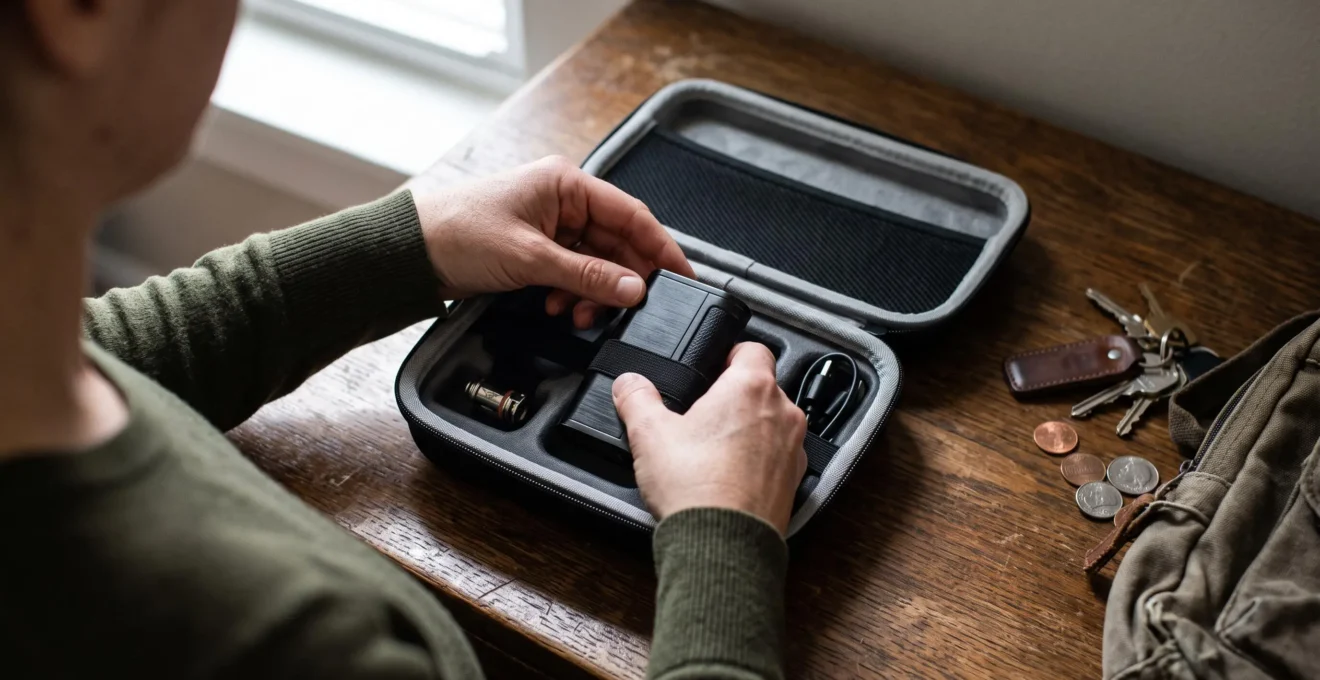
A protective vape case reduces everyday transport damage by keeping the device away from hard objects, limiting movement and helping prevent accidental pressure on its controls. Whether a vape travels in a trouser pocket, commuter backpack or suitcase, the way it is stored affects its exposure to impacts, scratches, contamination and unwanted activation.
The most useful case is not necessarily the largest or most expensive. It is one that fits the device securely, separates vulnerable accessories and suits the conditions in which the equipment is carried. A compact soft pouch may be sufficient for light pocket use, while a padded hard-shell case offers more protection against compression inside a crowded bag.
Protective storage also has limits. It cannot reliably prevent pressure-related e-liquid leaks during flights, repair damaged batteries or compensate for a malfunctioning device. Effective protection combines appropriate storage with switching the device off, inspecting its components and carrying spare batteries separately.
Protecting Vape Equipment During Travel: Essential Points
- A fitted case reduces contact with keys, coins and other hard objects while limiting impacts and unintended button presses.
- Store the device switched off or locked, separate liquids and accessories, and keep removable spare batteries in dedicated insulating holders.
- Choose a case according to actual carrying conditions and replace it when its closure, shell or internal retention no longer provides reliable protection.
- Why Can Carrying a Vape Loose in a Bag Damage the Device?
- How Should You Pack Vape Gear in a Case for Commuting or Travel?
- Hard or Soft Vape Case: Which Better Protects Your Device on the Move?
- Why Should Loose Vape Batteries Never Be Carried with Keys or Coins?
- When Should You Replace a Protective Vape Case?
- How Can You Carry Spare Vape Batteries Safely Outside the Home?
- What Problems Can Occur When a Small Pod Is Carried Loose in a Pocket?
- Which Vaping Accessories Are Actually Useful for Everyday Device Care?
Why Can Carrying a Vape Loose in a Bag Damage the Device?
Carrying a vape loose in a bag exposes it to three main risks: physical impacts, accidental activation and e-liquid leakage. Keys and other objects can scratch or press against the device, while repeated movement may damage vulnerable components. A protective case reduces these exposures by separating the equipment and restricting unnecessary movement.
Impact damage is particularly relevant to devices with glass tanks, exposed mouthpieces or protruding components. When a backpack is put down abruptly, its contents can shift and strike one another. A metal key or charger plug creates a concentrated contact point that may scratch a finish or stress a glass surface.
Refillable pod systems have their own vulnerable areas. Pressure against the mouthpiece may loosen a pod, while repeated movement can disturb a magnetic connection. Even without visible cracking, the equipment may need inspection before its next use.
Accidental activation presents a different hazard. An unlocked fire button can be pressed against another object inside a bag. If the heating element operates unintentionally, the device may become hot, and prolonged heating can damage the coil or wick under certain conditions.
The US Federal Aviation Administration recognises this risk in its FAA guidance on travelling with electronic cigarettes. It identifies protective cases, locking mechanisms and battery separation among measures that can help prevent unintended activation during transport.
Movement can also aggravate leakage from inadequately sealed or poorly positioned tanks. E-liquid may spread around electrical contacts, leaving residue that interferes with connections. However, leakage and connection faults have multiple possible causes; transport alone should not automatically be blamed.
After repeated loose carrying, inspect:
- The 510 connector or pod contacts for debris, moisture and residue.
- The fire button for sticking, damage or abnormal movement.
- The tank glass, seals and mouthpiece for visible damage or leakage.
- The pod connection for looseness or intermittent contact.
A case cannot reverse existing damage, but preventing repeated contact and movement can reduce avoidable wear. Once these risks are understood, the next step is organising the equipment so that the case provides meaningful protection.
How Should You Pack Vape Gear in a Case for Commuting or Travel?
Pack vape equipment by separating the device, e-liquid, spare pods and charging accessories into secure compartments. Switch off or lock the device before storing it, keep bottles upright where practical and prevent hard objects from touching vulnerable parts. For longer journeys, allow additional space for protected spare batteries and travel-specific requirements.
The guiding principle is controlled separation. A case works best when its contents cannot slide into each other during walking, commuting or baggage handling.
Start with the device body. Place it in a fitted compartment or secure it with an elastic retention strap, ensuring the strap does not press the fire button. Use the manufacturer’s transport lock or power-off procedure when available. If a device can still activate despite being locked, it should not be treated as safely prepared for transport.
Keep e-liquid bottles securely closed and upright when possible. A separate liquid-resistant bag can provide secondary containment if a cap loosens, although it does not guarantee leak prevention. Spare pods should have their protective caps fitted and can be placed in individual sealed bags to contain possible leakage and keep debris away from their contacts.
Charging cables belong in a separate mesh pocket or compartment. Metal connector ends should not rub directly against a glass tank or plastic pod.
For everyday commuting, a minimal kit usually needs only the device, its fitted case and any essential replacement pod or accessory. The objective is to maintain protection without creating unnecessary bulk.
Longer journeys call for additional planning. Travellers may need compatible charging accessories, secured liquids, separately protected spare batteries and enough space for equipment to remain stable during baggage handling.
Air travel introduces another factor: cabin pressure changes. Changes in external pressure can contribute to flooding or leaking from some tanks and pods. Depending on the device manufacturer’s guidance, travelling with a tank empty or partially filled may help manage leakage. A protective case can contain minor spills but cannot eliminate the pressure difference that causes them.
Airline rules, airport security requirements and liquid restrictions also vary by jurisdiction and itinerary. Check the applicable rules before departure rather than assuming that procedures in one English-speaking country apply everywhere.
Five-Point Vape Travel Packing Check
- Deactivate the device: switch it off or engage its transport lock and confirm that the controls are not activated by case pressure.
- Secure the device: position it in its fitted compartment and confirm that it does not slide or strike other contents when the closed case is gently moved.
- Contain liquids: check bottle caps and tank seals, then place bottles and spare pods in their designated holders or containment bags.
- Separate accessories: move cables and hard objects away from glass, mouthpieces and contacts, leaving a visibly organised interior.
- Check travel requirements: verify the applicable airline or transport operator’s battery, device and liquid rules before departure.
Once the contents are organised, protection depends on whether the case itself can resist the pressures and impacts expected during the journey.
Hard or Soft Vape Case: Which Better Protects Your Device on the Move?
A hard vape case generally provides better resistance to crushing and external impacts, while a soft case offers lighter, more flexible protection against scratches and minor bumps. Neither design is automatically superior for every journey. The best choice depends on carrying conditions, internal padding and how securely the case holds the device.
Hard-shell models commonly use moulded materials such as EVA, often with a fabric covering and padded interior. Their semi-rigid or rigid construction helps distribute pressure and limits direct compression of the contents.
However, a hard shell with an oversized interior may allow a device to rattle against bottles or accessories. External rigidity is not enough if the contents remain unsecured.
Soft cases, including padded fabric and neoprene designs, are often easier to carry in pockets or small bags. Their flexibility can cushion minor contact and reduce surface scratching, but they provide less structural resistance when squeezed beneath books, laptops or other heavy items.
The following comparison focuses on typical design characteristics rather than laboratory-tested performance.
| Protection criterion | Hard case | Soft case |
|---|---|---|
| Crushing pressure | Generally better resistance with a sufficiently rigid shell | Limited protection under concentrated weight |
| Minor knocks | Good potential protection with adequate internal padding | Can cushion light impacts when properly padded |
| Scratches | Effective when contents are secured | Effective with a suitable lining and fit |
| Portability | Usually bulkier | Usually lighter and more flexible |
| Internal stability | Depends on moulded slots, padding and straps | Depends on pouch dimensions and retention |
| Typical use | Backpacks, luggage and crowded bags | Pockets and lighter daily carrying |
For a device carried alongside a laptop, books or heavier belongings, a padded hard case is generally the more appropriate starting point. For a compact pod system transported in a dedicated jacket pocket, a fitted soft sleeve may provide sufficient everyday separation.
Frequent travellers should give particular attention to closures and internal dividers. EVA shells can retain their shape under ordinary handling, while neoprene provides flexible cushioning but can stretch or wear. Either design can become ineffective if seams, zippers or retention straps deteriorate.
Internal fit matters more than appearance. A case should hold the device without pressing its controls, bending components or forcing accessories together.
Before choosing, check the manufacturer’s dimensions against the actual device, including its tank or mouthpiece. Where possible, test whether the device remains securely positioned when the case is closed and gently moved.
The shell protects the outside, but internal organisation protects individual components. This distinction becomes particularly important when removable lithium-ion batteries are included in the equipment being carried.
Why Should Loose Vape Batteries Never Be Carried with Keys or Coins?
Loose vape batteries must not be carried with keys or coins because conductive metal objects can bridge exposed electrical surfaces and create a short circuit. This can generate intense heat and potentially cause a battery to vent or enter thermal runaway. Every removable spare cell needs appropriate insulation and protection during transport.
Many removable-battery vaping devices use cylindrical lithium-ion cells, including 18650 and 21700 formats. In these batteries, the positive terminal is located at one end, while the metal casing is electrically connected to the negative side.
If a coin or key simultaneously contacts the positive terminal and an exposed part of the casing, an external electrical path may form. The resulting short circuit can release energy rapidly, potentially without sufficient warning to remove the battery safely.
The plastic insulating wrap around a cell is therefore a safety component, not simply a decorative label. A torn wrap can expose conductive casing, increasing the potential for unintended contact with metal objects.
Inspect removable cells for damaged wraps, compromised insulating rings, dents and other visible damage. Do not carry or use a cell with a damaged casing or other signs of unsafe condition. A damaged wrap also requires the cell to be taken out of service until it has been safely assessed and repaired or replaced as appropriate.
For carrying spare cells, use a dedicated non-conductive holder designed for their size. Plastic cases with individual fitted slots are one practical option. Suitable silicone holders may also provide protection when designed to keep the contacts isolated and the batteries securely enclosed.
The FAA’s lithium battery transport guidance specifically requires protection against short circuits during air travel and identifies protective battery cases and appropriate insulating packaging as acceptable methods.
« Battery terminals (usually the ends) must be protected from short circuit (i.e., the terminals must not come in contact with other metal). »
It is important to distinguish loose spare batteries from installed batteries. A battery correctly installed inside a compatible device is not exposed to keys and coins in the same way as a bare cylindrical cell. Nevertheless, an installed battery can still present hazards if its device is damaged or unintentionally activated.
The protective holder must also remain intact and securely closed. Like the main vape case, its ability to provide protection depends on its physical condition.
When Should You Replace a Protective Vape Case?
Replace a protective vape case when its shell, closure, padding or internal restraints no longer keep the device securely protected. Cracks, broken zippers, flattened foam and stretched retention straps are practical warning signs. A damaged spare-battery holder requires particular attention because compromised insulation can create an immediate short-circuit risk.
There is no universal replacement interval established for protective vape cases in the supplied safety and manufacturer guidance. Their useful life depends on construction, carrying frequency, loading conditions and the type of wear they experience.
Regular visual inspection is therefore more useful than replacing a case solely because it has reached a particular age.
Begin with the closure. A zipper that jams, separates after fastening or has missing teeth may allow the case to open unexpectedly. Frayed seams can also weaken the structure, particularly around corners and handles.
Next, inspect the outer shell. A cracked hard case or permanently deformed protective panel may no longer distribute external pressure as intended. Soft cases should be checked for tears, thinning material and damaged stitching.
Inside the case, look for compressed padding or elastic straps that no longer grip the device. A case that allows its contents to move freely can recreate the original loose-carry problem, even when its exterior appears undamaged.
One practical check is to close the case with the device correctly positioned and gently change its orientation. Noticeable internal movement, clicking or pressure against controls indicates that the fit needs correction. Do not deliberately drop or crush a device to test the case.
Visible marks or damage appearing on the equipment after an ordinary handling incident are another reason to reassess the case, although they do not establish which part of the protection failed.
For spare-battery holders, the threshold should be stricter. Replace a cracked, broken or deformed holder immediately if it can no longer isolate terminals or securely retain the cells. Do not continue using it while waiting for further deterioration.
A case that still performs its protective function need not be replaced for cosmetic wear alone. Once its condition has been checked, removable spare batteries require their own transport routine.
How Can You Carry Spare Vape Batteries Safely Outside the Home?
Carry spare vape batteries in a secure, non-conductive holder that protects each cell from metal contact, movement and physical damage. Inspect the batteries before packing them, keep their terminals isolated and avoid carrying bare cells in pockets or bags. Air travellers must also follow the applicable cabin-baggage and airline restrictions.
A suitable battery case should provide four essential characteristics:
- Non-conductive construction: material intended to prevent contact between exposed battery surfaces and external metal objects.
- Individual cell protection: fitted slots or equivalent separation that stops cells and their terminals from contacting one another.
- Secure closure: a lid or retention system that remains closed during normal movement.
- Appropriate fit: dimensions matched to the cell format without squeezing, deforming or damaging the battery wrap.
Before leaving home, inspect each removable cell’s casing, wrap and insulating ring. Keep batteries with visible damage out of use, and follow the manufacturer’s guidance on assessment, replacement and safe disposal.
A battery case should be positioned where it will not be crushed or repeatedly struck by heavy accessories. Even when protected, cells should be kept away from excessive heat, moisture and other conditions outside their specified operating or storage limits.
For organisation, use clearly labelled compartments or separate holders to distinguish charged cells from used ones. This reduces confusion when replacing a battery during the day. Do not rely on reversing battery orientation as a status marker unless the holder manufacturer’s instructions explicitly support that arrangement.
Air travel requires additional precautions. Under US FAA rules, spare lithium-ion batteries must travel in carry-on baggage rather than checked baggage, with protection against short circuits. Electronic smoking devices must also be carried on the passenger or in cabin baggage, protected against accidental activation, and must not be recharged on board.
These are US aviation requirements, not a single worldwide standard. Other aviation authorities and airlines may impose different or additional restrictions. Travellers should verify the rules for their itinerary, including restrictions concerning battery capacity, quantities and device carriage.
A general-purpose vape storage case may accommodate an individually protected battery holder, but its ordinary fabric pockets should not automatically be considered adequate insulation for loose cylindrical cells.
Devices with built-in batteries do not require the same separate-cell arrangement, but they still need protection from pressure, contamination and unintended operation, especially when carried in clothing.
What Problems Can Occur When a Small Pod Is Carried Loose in a Pocket?
A small pod carried loose in a pocket can collect lint, develop leaks, suffer pressure damage or activate unintentionally. Tight clothing and sitting can place force on the device, while pocket debris may contaminate the mouthpiece and electrical contacts. Compact protective storage reduces these exposures without necessarily requiring a large case.
Pod systems are convenient partly because they fit into small spaces. However, a pocket exposes them to different conditions from those encountered on a desk or in a fitted holder.
Body heat and repeated pressure can aggravate leakage in some pods, depending on their design, seals and filling condition. Movement or compression may force e-liquid toward an airflow channel or mouthpiece, particularly if the pod is already leaking or improperly sealed.
Pocket lint introduces a separate maintenance issue. Fibres and dust can accumulate around the mouthpiece or contact area, potentially interfering with cleanliness and electrical connection.
Manufacturer troubleshooting documentation supports the importance of checking contacts rather than immediately assuming that the device has failed. The Innokin Adept Zlide troubleshooting documentation recommends inspecting connectors for debris, e-liquid, condensation and physical damage when connection problems occur.
These instructions relate to a specific vaping system, so they should not be treated as proof that pocket lint causes every connection error. Damaged coils, improperly installed components and other electrical faults can produce similar symptoms.
Unintended activation is another concern. On a button-operated pod, pressure from tight clothing can potentially depress the firing control if the device remains unlocked. Draw-activated systems use a different mechanism, but contamination or component malfunction may contribute to unexpected operation in some designs.
If a pod becomes abnormally hot or activates unexpectedly, stop using it and follow the manufacturer’s safety instructions. Do not continue carrying an overheating device in a pocket.
A compact silicone sleeve, fitted pod pouch or individual holder can provide a lower-bulk alternative to a large organiser. Choose a design that keeps debris away from vulnerable areas without obstructing required ventilation, pressing controls or trapping a malfunctioning device.
For many small-device users, cleanliness, secure fit and deactivation during transport matter more than carrying numerous accessories. The same principle applies when selecting an everyday maintenance kit.
Key Takeaways Before Choosing Accessories
- Prioritise protection against the hazards your actual carrying routine creates, rather than choosing accessories by appearance alone.
- Keep removable battery protection separate from ordinary device storage: one does not automatically replace the other.
- Choose accessories that are compatible, easy to inspect and simple enough to use consistently.
Which Vaping Accessories Are Actually Useful for Everyday Device Care?
The most useful everyday vaping accessories are those that prevent avoidable damage or support safe maintenance: a fitted device case, a dedicated holder for removable batteries and appropriate storage for spare pods. Contact-cleaning supplies and secure liquid containers can also be useful. Decorative accessories generally provide less direct protection during transport.
Accessory choices should begin with the device’s design and carrying environment. A compact pod carried alone in a pocket does not require the same storage system as a removable-battery mod transported with several bottles and replacement components.
Protective accessories should take priority when they address a clear hazard. A fitted case helps separate equipment from hard objects, while a properly designed battery holder isolates removable spare cells. A sleeve or individual pod container helps reduce contact with debris and other belongings.
Maintenance supplies serve a different function. Clean, dry cotton swabs or manufacturer-approved contact-cleaning materials can help remove accessible residue from connectors and threads. Always switch the device off before cleaning and follow its instructions. Avoid introducing liquid into electrical openings or using unsuitable cleaning products.
Small sealed bags or suitable leak-resistant containers can help organise replacement pods and e-liquid bottles. They provide secondary containment rather than a guarantee that a bottle or pod will never leak.
Other accessories, such as decorative skins, lanyards and replacement drip tips, may improve personal comfort, handling or appearance. Their protective benefit depends on the specific design and should not be assumed to equal that of a fitted storage case.
A practical way to prioritise purchases is to compare each accessory with a real carrying risk.
| Accessory | Primary benefit | When it is useful |
|---|---|---|
| Fitted protective case | Limits scratches, impacts and contact with other objects | Regular pocket or bag transport |
| Dedicated battery holder | Isolates removable spare-cell terminals | Whenever spare removable batteries are carried |
| Spare pod container | Limits debris exposure and provides organised storage | Carrying replacement pods |
| Contact-cleaning supplies | Helps remove accessible residue and contamination | Routine maintenance according to manufacturer guidance |
| Sealed liquid storage | Provides secondary containment for possible leaks | Carrying spare e-liquid or filled pods |
| Decorative skin or lanyard | Primarily changes appearance or carrying convenience | Optional personal preference |
Accessory redundancy is worth avoiding. A large multi-compartment organiser may be unnecessary if a compact fitted case and a separate battery holder already meet the user’s needs. Conversely, someone carrying multiple accessories may benefit from organised compartments instead of several loose pouches.
Before buying, check device compatibility, internal dimensions, closure quality and whether vulnerable components will remain separated. A simple, well-fitting setup is often more useful than a larger collection of poorly matched accessories.
Review the equipment currently carried each day, remove unnecessary items and check whether every remaining component has a secure place. That small adjustment can make everyday transport safer and reduce avoidable damage without adding unnecessary bulk.
Can a protective vape case stop all e-liquid leaks?
No. A protective case can reduce movement and provide secondary containment, but it cannot guarantee leak prevention. Damaged seals, incorrect filling, changes in temperature and cabin pressure differences may still cause e-liquid to escape. Secure bottles and follow the device manufacturer’s storage instructions.
Should a vape be switched off even when stored inside a padded case?
Yes, switching off or locking the device is an important precaution whenever the manufacturer’s instructions provide that option. Padding alone does not guarantee that a firing button cannot be pressed. Check that the case does not apply pressure to the controls and that the device cannot activate unintentionally.
Can a regular vape case replace a dedicated battery holder?
Not unless the case has a purpose-designed compartment that securely isolates the spare batteries and their terminals. Ordinary fabric pockets and elastic loops do not necessarily prevent electrical contact. Use a suitable insulating battery holder for removable spare cells.
Is a protective vape case waterproof?
Not necessarily. A rigid or padded case may resist everyday splashes without being waterproof. Water resistance depends on its materials, seals and construction. Unless the manufacturer specifies an appropriate water-protection rating, keep the case and its contents away from rain exposure and immersion.
What should you do if a vape becomes hot inside its case?
Stop using or charging the device. If it can be handled safely, keep it away from combustible materials and follow the manufacturer’s emergency instructions. Do not place an overheating or visibly damaged lithium-ion device back into a closed case. If it is smoking, venting or presenting an immediate fire risk, move away and contact emergency services.