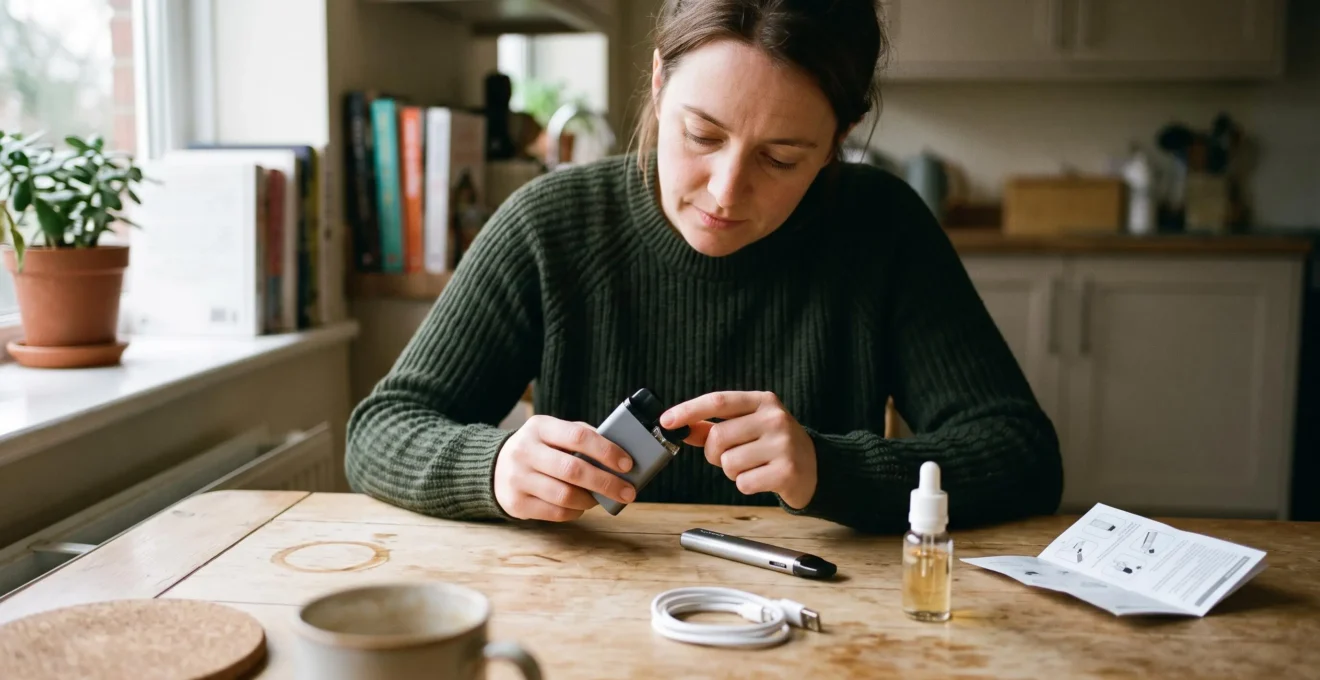
The most useful beginner vape kit features are straightforward controls, manageable maintenance, dependable charging, visible e-liquid levels and compatible replacement parts. For an adult smoker considering switching from cigarettes, these practical qualities generally matter more than adjustable power, elaborate displays or extensive customisation.
A first device needs to be easy to understand during ordinary use. That means knowing how to refill it, when its coil or pod needs attention and what to check when something stops working. A compact pod kit or a simple vape pen can meet those requirements, although neither format is automatically the best choice for everyone.
The NHS guidance on vaping to quit smoking identifies both pod devices and vape pens as options for adults switching from cigarettes. It also explains that more customisable vape mods require greater operating knowledge and maintenance.
Vaping is less harmful than smoking but is not risk-free. This guide concerns adult smokers considering vaping as an alternative to cigarettes, not people who have never smoked. The practical principles apply across English-speaking countries, but product availability and legal requirements vary by location.
Beginner vape kit essentials at a glance
- Prioritise simple controls, clear liquid visibility and replacement parts that are easy to identify.
- Prepare a new pod or coil according to its manufacturer’s instructions before activating the device.
- Choose equipment that suits your current needs, rather than paying for adjustments you do not yet understand.
- Why Simple Controls Often Beat Advanced Features for First-Time Users
- How to Set Up a Beginner Vape Kit Before the First Use
- Pod Kit or Vape Pen: Which Is Easier for a Beginner to Manage?
- Which First-Week Vape Mistakes Can Damage a Beginner Kit?
- When Does It Make Sense to Move Beyond a Starter Vape Kit?
- What Problems Can Come from Choosing a Vape Device That Is Too Advanced?
- How Can You Set Up a Pod System Without Causing Leaks or Dry Hits?
- When Does an All-in-One Vape Kit Make More Sense Than Separate Components?
Why Simple Controls Often Beat Advanced Features for First-Time Users
Simple vape controls are often more suitable for first-time adult users because they reduce the number of settings that must be understood before ordinary operation. A device with fixed output and uncomplicated activation lets a beginner concentrate on refilling, charging and basic maintenance rather than balancing wattage, airflow and operating modes.
A variable-wattage device allows its user to change the electrical power delivered to the heating coil. This can be useful when the user understands the coil’s recommended operating range. However, an unsuitable setting can overheat the coil, producing an unpleasant burnt taste and potentially shortening its useful life.
Adjustable airflow adds another decision. A beginner may not know whether an unsatisfactory draw comes from airflow, the selected power setting, the coil or an unsuitable liquid. Changing several settings simultaneously makes the cause harder to identify.
Importantly, simplicity has two separate dimensions:
- Operational simplicity: Few controls, predictable activation and minimal settings to adjust.
- Maintenance simplicity: Straightforward filling, easy access to consumables and fewer removable parts.
A device can perform well in one dimension without excelling in the other. For example, a single-button vape pen may be straightforward to operate but still require several steps to replace its coil. A refillable pod with automatic activation may eliminate most operating decisions while allowing the entire pod to be replaced when necessary.
Technical descriptions can also be misleading. Fixed low-power operation may sound like an engineering feature, but its practical purpose is often to remove the need for manual power adjustments. Such a feature can make a device easier to operate, provided it is designed for the supplied coil.
A useful buying test is to ask whether each adjustable feature has a clear purpose for the intended user. If operating the device requires learning several unfamiliar settings before its first use, a simpler option may be more appropriate.
Once the essential controls are understood, the next priority is preparing the device correctly. Even the simplest kit needs an appropriate setup before its heating coil is used.
How to Set Up a Beginner Vape Kit Before the First Use
Set up a beginner vape kit by checking its instructions, preparing the battery, filling the pod or tank correctly, allowing the wick to absorb e-liquid and confirming that every component is properly seated. The most important precaution is to avoid heating a new coil before its wick has become adequately saturated.
Inside a typical refillable vaping device, a heating coil works alongside an absorbent wick. Liquid must reach the wick before the coil is activated. Otherwise, the heated wick material can become damaged and produce a burnt taste from the beginning.
The correct waiting period depends on the specific device. For example, Aspire‘s Cyber X pod filling instructions specify waiting five minutes after filling to allow e-liquid to saturate the coil. That is a product-specific instruction, not a universal waiting time for every vape.
Before preparing the pod, inspect the device and confirm that its charging connection, seals and removable components appear undamaged. Charge the battery as directed by the manufacturer. A completely full charge is not necessarily required before filling a pod, and charging and liquid preparation do not need to happen in a particular universal order.
When filling, identify the correct opening and avoid introducing liquid into the central airflow channel. Close the filling seal securely and check that the pod or tank fits its housing properly. Depending on the model, electrical contacts, magnetic fittings or a threaded connection keep the components in position.
If the device does not activate afterwards, the problem is not necessarily a depleted battery. A loosely fitted pod, protective contact film left in place or dirty electrical contacts can also prevent operation. An indicator light or error blink may help identify the issue, although its meaning varies by manufacturer.
Check the instructions before interpreting a particular light pattern. Do not force components together or repeatedly activate a device that appears faulty.
Five checks before your first use
- Check the instructions and device: Identify the filling port, charging method and required coil preparation. Result: the necessary setup points are confirmed.
- Prepare the battery: Charge as instructed, using compatible charging equipment. Result: the device indicates an appropriate battery charge.
- Fill the reservoir: Open the correct port, add compatible liquid within the permitted level and close the seal. Result: the fill port is closed and the liquid level is visible.
- Allow the wick to saturate: Follow the manufacturer’s specified preparation and waiting time. Result: the required priming period is complete.
- Check the assembled device: Confirm that the pod or tank sits securely and that no visible leakage or error condition remains. Result: the equipment is ready for use according to its instructions.
Correct preparation reduces avoidable operating problems, but it does not make every device equally convenient. The next choice concerns how much maintenance the hardware requires during everyday use.
Pod Kit or Vape Pen: Which Is Easier for a Beginner to Manage?
A pod kit is often easier for a complete beginner to maintain when its worn heating element is replaced by changing one complete pod. A vape pen can be equally straightforward to operate, but models with separate tanks and coils introduce additional maintenance steps. The better choice depends on the specific design, not its shape alone.
Pod systems are generally compact devices built around removable liquid cartridges. Some pods contain integrated coils and are replaced as a complete unit. Others are refillable and use separate replaceable coils.
Many traditional vape pens combine a cylindrical battery with a refillable tank. When the coil wears out, the user may need to open the tank, remove the old coil, install a compatible replacement and prepare it before use.
These differences affect what the user must do repeatedly, not simply how the equipment looks.
| Criterion | Pod kit | Vape pen |
|---|---|---|
| Refilling | Often through a small pod filling port | Commonly through a refillable tank |
| Coil maintenance | Whole-pod replacement or separate coils, depending on design | Often involves replacing a coil inside the tank |
| Charging | Typically rechargeable through a device charging port | Typically rechargeable through a device charging port |
| Portability | Frequently compact and pocket-friendly | Often slim, although dimensions vary |
| Liquid visibility | Depends on pod transparency and viewing-window placement | Depends on tank design and visibility |
| Replacement parts | Requires compatible pods or coils | Requires compatible coils and possibly tank components |
Neither category has a guaranteed advantage in battery endurance or vapour production. Those characteristics depend on battery capacity, power output, coil design and other model-specific factors. Some pens are built for greater output, while some modern pod systems offer substantial flexibility.
For someone who has never maintained vaping equipment, the most practical comparison is the number of separate parts involved in a routine replacement. Fewer components can mean fewer opportunities to fit something incorrectly.
However, replacing an integrated-coil pod means discarding the pod rather than just the coil. That may affect ongoing consumable costs and waste, so replacement-part availability deserves attention before purchasing.
Once the preferred format is clear, understanding common early maintenance mistakes becomes the best way to avoid unnecessary replacement parts.
Which First-Week Vape Mistakes Can Damage a Beginner Kit?
The most important first-week mistakes include activating a coil before its wick is saturated, allowing the liquid level to become too low, using unsuitable charging equipment and exposing the device to extreme temperatures. Excessive power and repeated operation without adequate liquid replenishment can also contribute to unpleasant performance or coil damage.
A burnt hit occurs when the heating element operates without sufficient e-liquid reaching the wick. Heat can damage the wick material, leaving a burnt taste that may persist after the reservoir has been refilled. A badly damaged coil or integrated-coil pod may need replacing.
The liquid level is therefore a routine maintenance check, not merely an indication of when to buy more e-liquid. Before continuing to use a device that tastes unusually dry or burnt, stop and check the reservoir.
Taking many successive puffs can sometimes consume liquid faster than the wick replenishes it, depending on the device and operating conditions. A sudden weakening of flavour may be a reason to pause and inspect the device, but it is not proof of wick starvation: coil wear, liquid composition and other factors can produce similar symptoms.
Charging errors create a different category of risk. The FDA guidance on preventing vape battery fires and explosions recommends following manufacturer charging instructions, keeping devices visible while charging and avoiding extreme temperatures. Battery incidents can cause serious injuries, even though their precise causes are not always established.
For routine troubleshooting, distinguish the symptom from its possible cause:
| Symptom | Possible explanation | First check |
|---|---|---|
| Burnt or dry taste | Insufficient wick saturation, excessive power or worn coil | Stop use; inspect liquid level and coil preparation |
| Less vapour than usual | Low battery, poor connection or ageing coil | Check battery indication and pod seating |
| Gurgling or spitting | Excess liquid in the airflow or coil area | Inspect the fill port, seals and possible flooding |
| No activation | Battery, electrical connection or device fault | Follow the device-specific indicator and connection checks |
| Visible leakage | Overfilling, damaged seals or an incorrectly fitted component | Inspect the reservoir and seals before reuse |
These are initial checks rather than definitive diagnoses. If a battery becomes unusually hot, swollen, damaged or otherwise unsafe, stop using and charging the device. Do not attempt to repair a damaged lithium-ion battery.
Likewise, do not continue activating a device repeatedly to test whether a burnt taste disappears. Inspect the appropriate components first and follow the manufacturer’s replacement guidance.
Once these basic checks become familiar, equipment preferences may become clearer. That is a more useful basis for considering additional features than simply reaching a particular number of weeks of use.
When Does It Make Sense to Move Beyond a Starter Vape Kit?
Moving beyond a starter vape kit makes sense when an adult user can identify a specific, recurring limitation that a different device would address. Examples include wanting a different draw resistance, more convenient maintenance or greater battery endurance. Upgrading merely because a device is labelled beginner-level rarely provides a clear practical benefit.
The strongest indication is the ability to describe what needs changing. Someone who consistently finds a particular draw too tight has a clearer equipment requirement than someone who simply assumes a more powerful device must perform better.
Likewise, a person who frequently needs to recharge might benefit from considering battery capacity and charging convenience. This does not automatically require buying an advanced variable-power device.
Upgrading can be gradual. An adult smoker who currently uses a basic integrated-coil pod could consider a refillable system with replaceable coils if lower replacement-part costs or greater maintenance control are important. A model with adjustable airflow introduces another option without necessarily adding multiple power settings.
A hypothetical example illustrates the difference. Consider two adult smokers using simple refillable kits. The first wants an easier way to replace worn components. The second is dissatisfied but cannot determine whether the issue is draw resistance, liquid choice or coil condition. The first has a defined equipment requirement; the second would benefit from diagnosing the current setup before shopping.
Liquid choice and nicotine strength also influence whether a vaping setup is suitable for someone switching from cigarettes. A change in hardware is not always the right response to dissatisfaction. The NHS advises that finding an appropriate device and nicotine strength can take adjustment and recommends seeking support when needed.
Cost deserves a broader view than the device’s initial price. Compare the price and availability of compatible consumables, likely maintenance requirements and whether the desired improvement justifies replacing functioning equipment. There is no reliable universal rule that a more advanced device will be cheaper or more satisfying.
Upgrading should also not become a reason to delay abandoning cigarettes. For adult smokers using vaping to quit, establishing a workable alternative to smoking is more important than constantly experimenting with equipment.
A device that remains dependable and suits the user’s needs does not become obsolete simply because more configurable equipment is available. More settings can introduce avoidable difficulties when their purpose is unclear.
What Problems Can Come from Choosing a Vape Device That Is Too Advanced?
An overly advanced vape device can create unnecessary setup errors, inconsistent operation and more demanding maintenance for a first-time user. Incorrect wattage, unfamiliar airflow adjustments and complicated tank assemblies can make problems harder to identify. Such equipment is not inherently defective, but its additional flexibility may be unhelpful before the user understands the basics.
The clearest example involves coil power. Heating coils are designed to operate within specified conditions. Selecting excessively high wattage can overheat a coil and cause an unpleasant burnt taste or shorten its service life.
A manufacturer-published troubleshooting article from Aspire identifies inadequate wick saturation, worn coils and excessive wattage among possible causes of burnt taste. These explanations are relevant to understanding device operation, although they do not establish how frequently beginners make particular mistakes.
Complexity can also make fault-finding less efficient. If a user changes wattage, airflow and operating mode during the same session, the cause of a poor result becomes difficult to isolate. With fixed-output equipment, one major source of variation is removed.
Separately assembled tanks introduce another possible complication. Seals, coil fittings and threaded parts must be compatible and correctly installed. Depending on their design, incorrect assembly can contribute to leakage, poor electrical contact or inconsistent operation.
The financial downside is mainly a risk of avoidable waste. A damaged coil requires replacement, and a leaking reservoir can waste e-liquid. More complicated equipment may therefore create additional consumable expenses when used incorrectly, though there is no basis for assuming every advanced device costs more to maintain than every beginner kit.
A frustrating first device may also undermine a smoker’s confidence in their chosen switching method. This is a practical concern, not evidence that complexity alone causes failed quit attempts. Device suitability, nicotine strength, support and individual circumstances all matter.
Before buying a heavily adjustable device, ask: Can I explain what each setting changes and why I would need it? If the answer is no, consider whether a simpler model would meet the same immediate requirements.
Keeping a device manageable does not eliminate all maintenance problems. Even simple pod systems require attention to liquid flow, sealing and proper coil preparation.
How Can You Set Up a Pod System Without Causing Leaks or Dry Hits?
To reduce leaks and dry hits, fill a pod through its designated port, respect its permitted liquid level, close the seal correctly and allow a new wick to saturate before use. Check that the pod is properly seated and avoid exposing the device to extreme temperatures. Manufacturer-specific instructions should always take priority.
Leaks and dry hits can appear to be opposite problems. Leakage involves liquid escaping where it should remain contained, while a dry hit occurs when insufficient liquid reaches the heated wick. Both can relate to liquid movement through the pod, but they do not necessarily share the same fault.
Overfilling can cause liquid to enter areas intended for airflow, particularly when the filling opening or internal design allows it. This may produce gurgling, spitting or visible leakage.
A separate problem arises from damaged or improperly seated seals. A silicone plug that has not been closed correctly, a worn gasket or an incorrectly fitted pod can allow liquid to escape even when the reservoir is not overfilled.
Dry hits require a different response. If the wick has not absorbed enough e-liquid, activating the coil may overheat the wick material. Before first use, follow the specified preparation procedure. During ordinary operation, maintain an appropriate liquid level and stop if the device develops an unusual dry or burnt taste.
For a pod that gurgles or leaks, use a simple inspection sequence:
- Stop using the device and check the visible liquid level for possible overfilling or insufficient liquid.
- Inspect the filling port and confirm that its closure is secure.
- Check whether the pod is fitted correctly and whether liquid is present around its connection area.
- Examine accessible seals for visible damage or displacement.
- Follow the manufacturer’s cleaning or replacement instructions if the issue persists.
Keeping a pod upright where practical and away from direct heat may help reduce avoidable handling problems, although no storage position guarantees that every pod will remain leak-free. Temperature changes, component wear and individual pod designs can influence leakage.
A flooded pod should not automatically be treated like a dry coil. Similarly, adding more e-liquid will not repair damaged seals. Matching the response to the symptom helps avoid unnecessary component replacement.
If e-liquid leaks into electrical areas, stop using the equipment until it has been checked and handled according to the manufacturer’s instructions. Replace damaged parts rather than improvising repairs.
For first-time buyers who would prefer not to select and match multiple components themselves, an integrated kit can simplify the equipment decision further.
Key takeaways before choosing your hardware
- Decide which maintenance tasks you are comfortable carrying out, including whether you prefer replacing an entire pod or a separate coil.
- Check the availability of compatible replacement parts before judging a kit by its purchase price.
- Only choose component-level customisation when you have a clear reason to change an individual part.
When Does an All-in-One Vape Kit Make More Sense Than Separate Components?
An all-in-one vape kit makes more sense when an adult beginner wants a complete, manufacturer-matched device without selecting a battery, tank and coil independently. Integrated equipment reduces compatibility decisions and can simplify setup and maintenance. Separate components become more useful when the user understands which characteristics they want to customise.
In practical terms, an all-in-one kit combines components designed to work together as a system. The battery, liquid reservoir and heating arrangement are supplied or specified as a compatible configuration. Depending on the design, the kit may still allow refilling, pod replacement or coil replacement.
This does not mean every component is permanently built into a single sealed unit. Rather, the manufacturer has made important compatibility choices before the customer begins using the equipment.
Separate-component equipment introduces more questions. A buyer may need to verify connection compatibility, the battery or power unit’s operating capabilities, the coil’s permitted wattage range and the availability of suitable replacement parts.
An apparently compatible physical connection does not necessarily establish that the complete combination is appropriate. Electrical and operating requirements also matter. Improperly matched components can lead to poor performance or potentially unsafe operation.
The main trade-off is straightforward:
| Decision factor | All-in-one kit | Separate components |
|---|---|---|
| Initial compatibility | Core parts selected as a matched system | Requires checking component compatibility |
| Setup decisions | Usually fewer | Potentially more |
| Customisation | Limited to supported options | Greater potential choice where compatible |
| Maintenance | Defined by the kit’s design | Depends on the selected parts |
| Replacement availability | May depend on proprietary pods or coils | Depends on the components and their compatibility |
| Best practical fit | Users who want fewer equipment decisions | Users who understand their component requirements |
All-in-one convenience has limitations. Some kits depend on proprietary consumables, and those components may not be interchangeable with products from other ranges. Before buying, confirm that replacement pods or coils are available and that the reservoir can be maintained as intended.
For an adult smoker switching from cigarettes, the simplest suitable kit is often one that can be operated and maintained confidently without repeated equipment research. That does not guarantee success in stopping smoking, but it removes some unnecessary hardware decisions.
The core criterion is whether the user wants the main equipment choices already made or has enough experience to make those choices independently. Separate components reward informed preferences; an all-in-one kit prioritises a defined, compatible setup.
Before purchasing, compare the instructions, charging requirements, replacement consumables and everyday maintenance routine of the specific kit. Adult smokers who need help choosing suitable equipment or nicotine strength can also consult a qualified smoking cessation service or an appropriately trained specialist retailer.
Does a beginner vape kit need an adjustable wattage setting?
No. Many beginner devices operate at a fixed or automatically managed power level. Adjustable wattage is mainly useful when the user understands coil requirements and has a particular reason to change power output. A compatible fixed-output system avoids the need to manage that setting manually.
How can a beginner check whether replacement pods are compatible?
Check the exact manufacturer and model identification, then compare it with the replacement pod’s stated compatibility. Similar-looking pods are not necessarily interchangeable. Where a system uses replaceable coils, confirm compatibility for the coil as well as the pod or tank.
Should a rechargeable vape be left charging overnight?
No. UK NHS advice recommends using the correct charger and avoiding unattended or overnight charging. Follow the manufacturer’s instructions, use an appropriate charging surface and keep the device away from flammable materials and extreme temperatures.
Does a larger battery always make a better starter kit?
No. Battery capacity is one consideration, but actual endurance also depends on power consumption and individual use. Size, charging convenience, operating simplicity and the availability of replacement parts may be equally important. Compare complete device specifications rather than battery capacity alone.
Is vaping appropriate for someone who has never smoked?
No. NHS public-health guidance states that children and non-smokers should not vape. Although vaping is less harmful than smoking, it is not risk-free. The equipment considerations in this guide are intended for adults who already smoke and are considering switching away from cigarettes.