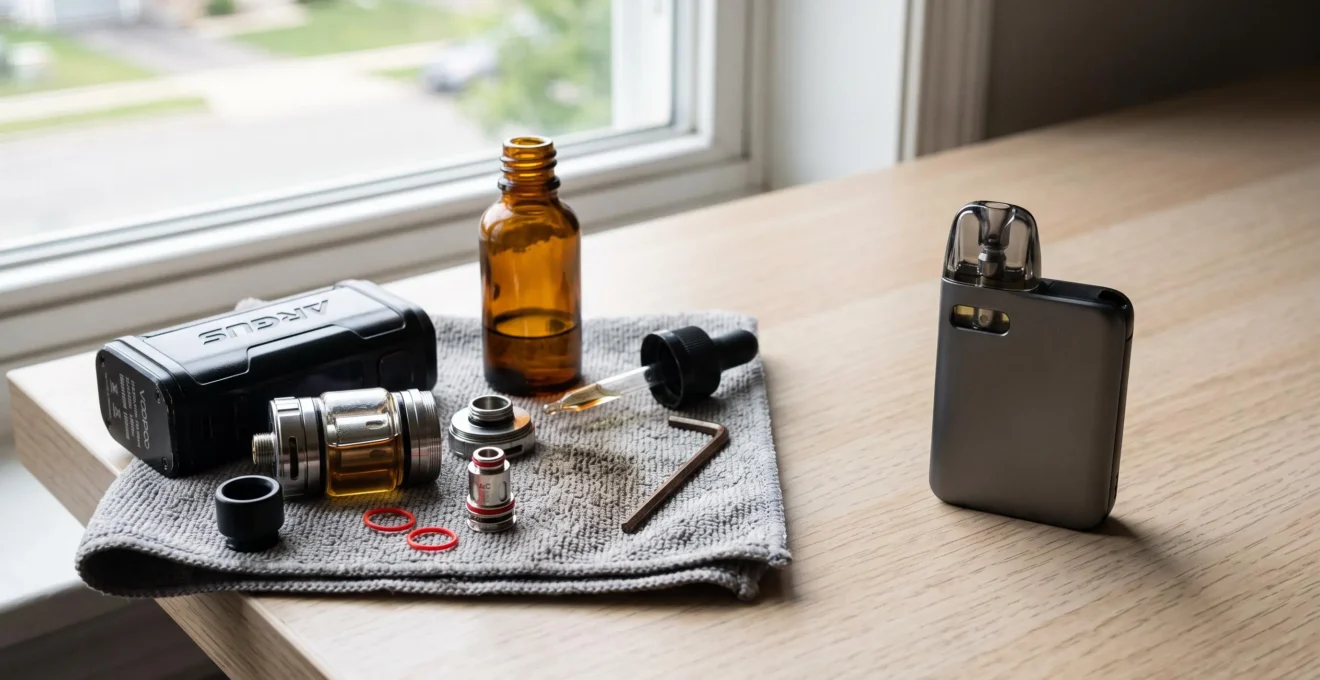
A vape tank offers control over e-liquid choice, coil replacement and airflow, but it also adds cleaning and maintenance to your routine. A cartridge-based device generally reduces that effort, especially when cartridges come pre-filled or use integrated coils. The better choice depends on how much time you want to spend maintaining your equipment and where you typically use it.
These formats are not completely separate categories. Some cartridges are refillable, some pods use replaceable coils, and certain tanks are designed for simple everyday operation. Comparing specific designs is therefore more useful than assuming every tank is complicated or every cartridge is disposable.
Capacity, leak prevention, portability and ongoing replacement costs can all influence your experience. A larger reservoir may reduce refill frequency, while a compact cartridge can make unexpected changes easier to manage away from home. Understanding these trade-offs helps you choose equipment that fits an existing routine rather than forcing that routine to accommodate the device.
Tank vs cartridge: the essentials
- Choose a tank for greater flexibility: replaceable components and broader e-liquid options can justify the extra maintenance.
- Choose a cartridge for simpler handling: compatible pre-filled or integrated-coil cartridges reduce cleaning and component replacement tasks.
- Match the format to your routine: consider refill frequency, travel, leak management and total replacement costs, not just device size.
- Why Do Vape Tanks Need More Maintenance Than Most Cartridges?
- How Can You Refill a Vape Tank or Fit a Cartridge Without Causing Leaks?
- Tank or Cartridge: Which Is More Convenient for Vaping Away from Home?
- What Causes a Vape Tank or Cartridge to Leak into the Device?
- When Should You Replace a Vape Cartridge Instead of Refilling It Again?
- Why Do Pod Systems Feel Different from Larger Vape Tanks?
- Why Does a Vape Tank Sometimes Leak Even When Nothing Looks Broken?
- Which Vape Device Type Best Fits Your Experience and Daily Routine?
Why Do Vape Tanks Need More Maintenance Than Most Cartridges?
Vape tanks generally require more maintenance because their coils, seals and other components can be removed, cleaned or replaced individually. Many cartridge systems simplify these tasks by combining the reservoir and heating element into one replaceable unit. Instead of servicing separate parts, users replace the cartridge when its performance deteriorates. The difference depends on the specific hardware design.
A conventional refillable tank contains several components that must work together: a reservoir, an atomizer coil, a wick, sealing rings and an airflow pathway. Some designs also have removable glass sections. Every connection introduces a point that may need attention over time.
For example, Innokin‘s Prism T18E tank user manual describes a replaceable coil and a filling mechanism that requires careful positioning of the e-liquid bottle. The manufacturer identifies reduced vapor production, weaker flavor and burnt taste as reasons to consider coil replacement.
Tank maintenance normally involves several recurring tasks:
- Coil replacement: removing a deteriorated heating element and installing a compatible replacement.
- Residue removal: cleaning washable tank components according to the manufacturer’s instructions.
- Seal inspection: checking accessible O-rings for displacement, wear or damage.
- Coil priming: allowing e-liquid to saturate a new wick before activating the device.
How often these tasks become necessary depends on the coil, e-liquid and individual usage. Liquids that leave substantial deposits on heating surfaces may require more frequent attention. Readers who regularly switch flavors may also prefer cleaning a reusable tank between liquids, particularly when residual flavor affects the next refill.
Cartridges simplify maintenance when their coils are built in. However, refillable pods still require correct filling, clean contact surfaces and periodic replacement. Systems with removable pod coils introduce some of the same tasks found in tanks.
The practical distinction is serviceability versus replacement. A tank lets users address some problems by changing an individual component. An integrated-coil cartridge makes the process simpler but may require discarding parts that are still functional.
Once the maintenance burden is clear, the next consideration is how reliably each format can be refilled or installed without introducing leaks.
How Can You Refill a Vape Tank or Fit a Cartridge Without Causing Leaks?
To refill a vape tank without causing leaks, use its designated filling opening, keep liquid out of the central airflow channel and respect the manufacturer’s fill limit. For refillable cartridges, open the correct stopper, fill the reservoir and close it completely before installation. Both formats require correctly seated components and sufficient wick saturation before use.
Most filling mistakes happen when liquid reaches an airflow passage rather than the reservoir. Incorrectly fitted seals, loose closures and incompatible components can cause similar problems even when the fill level looks correct.
For a tank with a conventional top-fill arrangement, follow this sequence where supported by its manual:
- Switch off or lock the device and position it securely before opening the tank.
- Open the designated filling port or remove the specified cap.
- Introduce e-liquid along the correct filling channel, avoiding the central airflow chimney.
- Stop at the marked maximum or the manufacturer’s recommended level, leaving any required air space.
- Close the tank securely without excessive tightening. If the coil is new or its wick is dry, allow the specified saturation period before activation.
Some tanks have different filling mechanisms, so these steps should not override product-specific instructions. On the Prism T18E, for example, Innokin instructs users to wait five minutes after refilling. That is guidance for the particular tank, not a universal waiting period for every device.
Refillable cartridges follow a similar principle but often have a smaller filling opening. Remove the cartridge if required, open its silicone plug gently, add liquid through the filling port rather than the air tube, then reseal it fully. Wipe away any spilled liquid before putting the cartridge back into the device.
Snap-in cartridges should sit firmly within their compatible housing. Screw-on components must engage correctly without cross-threading. Never force a connection that feels misaligned.
Airflow arrangements vary. Close adjustable airflow during filling only when the manufacturer’s procedure recommends it. Otherwise, maintaining the device in the instructed orientation is more important than applying a universal airflow rule.
Five checks before the first puff
- Confirm the filling point: identify the correct port using the device instructions, with the airflow channel visibly separate.
- Check the fill level: verify that liquid stays within the reservoir’s specified limit.
- Inspect the closure: confirm that the cap or silicone plug is fully seated and there is no visible gap.
- Check the connection: verify that the cartridge or tank is properly fitted and its accessible contacts are dry.
- Allow wick saturation: complete the manufacturer’s recommended priming period before activation, with no persistent burnt taste during initial use.
A new coil may need a short settling period before its performance becomes consistent, but a dry or burnt taste should never be dismissed as normal break-in. Stop using the device and inspect the wick, liquid level and compatible power setting.
Both formats can be manageable at home. Their differences become more noticeable when refilling, troubleshooting or carrying accessories is inconvenient.
Tank or Cartridge: Which Is More Convenient for Vaping Away from Home?
Cartridge-based devices are often more convenient for commuting and short outings because compatible spare cartridges are compact and can be exchanged without handling an open liquid bottle. Tanks may suit longer periods away from home when their larger capacity reduces refill frequency. Actual convenience depends on reservoir size, battery life, spare-part availability and how easily the device can recover from a malfunction.
Portability involves more than the size of the device. A tank user may carry e-liquid, tissues and replacement coils, whereas someone using pre-filled cartridges may only need a protected spare. A refillable pod can fall between these arrangements.
The comparison changes with the length and nature of the trip.
| Practical factor | Refillable tank | Cartridge-based device |
|---|---|---|
| Accessories | May require a refill bottle and coil supplies | Compatible spare cartridges may be sufficient |
| Liquid capacity | Often larger, depending on model and local rules | Often smaller, with exceptions |
| Changing liquid | Requires a refill or tank change | Cartridge swapping can be quicker |
| Leak management | More removable components to inspect | Fewer serviceable parts, but leaks remain possible |
| Discretion when carrying | Varies, with larger mod-and-tank combinations | Compact pod designs are often easier to store |
| Unexpected failure | A spare coil can sometimes restore operation | A compatible spare cartridge can sometimes restore operation |
For a short commute, a cartridge may be practical because replacement requires fewer steps. For someone who spends long periods away from home and prefers one e-liquid, a sufficiently large tank may reduce interruptions.
The ability to recover from problems matters too. A flooded tank may require disassembly and cleaning, which is inconvenient without a suitable workspace. An integrated-coil cartridge can sometimes be exchanged immediately. However, if a proprietary cartridge is unavailable or the device battery has failed, replacing the cartridge will not solve the problem.
When traveling by air, battery transportation rules become particularly important. Under United States aviation requirements, FAA guidance on carrying vaping devices aboard aircraft requires electronic smoking devices to travel on the passenger or in carry-on baggage, with precautions against accidental activation. Spare lithium batteries also need short-circuit protection, and recharging these devices during the flight is prohibited.
These are US aviation requirements, not a complete statement of worldwide rules. Travelers should separately check airline policies, destination restrictions and applicable cabin-liquid limits. Neither a tank nor a cartridge is immune to leakage during pressure changes.
Because mobility exposes devices to movement and changing temperatures, leak resistance deserves attention alongside size and convenience.
What Causes a Vape Tank or Cartridge to Leak into the Device?
A tank or cartridge leaks into its device when e-liquid escapes the reservoir or reaches an airflow or connection pathway that is not designed to hold liquid. Common causes include displaced seals, incorrectly installed coils, overfilling, unsuitable e-liquid viscosity and temperature changes. The resulting liquid may collect near the mouthpiece, cartridge socket or battery contacts.
A typical leak develops through a sequence. Liquid first passes an imperfect seal or enters an airflow channel. It then accumulates in a passage or underneath the cartridge. Depending on the hardware design and orientation, the liquid can reach the device’s electrical contacts.
Tracing that path helps distinguish an isolated filling mistake from a recurring hardware problem.
VAPORESSO‘s device troubleshooting FAQ identifies incorrectly seated coils, missing or damaged O-rings, loose tank caps and high temperatures as potential leak causes. It also notes that e-liquid viscosity can contribute to leakage with certain coils.
| Possible cause | Typical indication | Recommended response |
|---|---|---|
| Misplaced or deteriorated seal | Repeated seepage around a joint | Inspect and replace the seal with a compatible part |
| Improper coil installation | Liquid collecting around the tank base | Remove and reinstall the coil according to the manual |
| Overfilled reservoir | Liquid escaping after filling or closing | Restore the specified fill level and clean affected surfaces |
| Unsuitable VG/PG ratio | Recurring flooding despite correct assembly | Check the manufacturer’s liquid compatibility guidance |
| Heat or pressure changes | Leakage following travel or exposure to heat | Inspect the device and avoid extreme storage conditions |
| Cracked cartridge housing | Liquid appearing at a visible fracture | Replace the damaged cartridge |
The balance between vegetable glycerin (VG) and propylene glycol (PG) affects e-liquid viscosity. Higher-PG formulations are generally thinner, while higher-VG formulations are more viscous. A liquid that flows too freely for a particular coil and airflow arrangement can contribute to flooding.
There is no single VG/PG ratio suitable for every tank or cartridge. Compatibility should be checked against the specific device and coil rather than inferred from the format alone.
Inhalation technique can also matter. Drawing harder than intended for a particular airflow design may encourage liquid to enter the air pathway, though this is not a universal explanation for leaks.
Liquid on electrical components requires a different response from liquid on the outside of the tank. Switch off the device when possible, disconnect it from charging, and follow the manufacturer’s cleaning instructions. Accessible external contacts may be cleaned carefully where the manual permits, but liquid suspected inside the battery compartment or charging port requires particular caution.
Do not charge or activate a device with suspected internal liquid contamination. If safe operation cannot be confirmed, obtain manufacturer guidance or replace the affected device.
When a leak persists despite correct filling and assembly, the age and condition of the cartridge or tank components become the next considerations.
When Should You Replace a Vape Cartridge Instead of Refilling It Again?
Replace a refillable vape cartridge when its coil produces persistent burnt or muted flavor, its housing or seals are damaged, or it continues leaking despite correct filling and installation. A cartridge should also be replaced when its wick no longer saturates properly. There is no reliable universal refill count: replacement depends on the cartridge design, manufacturer instructions and actual condition.
Refillable does not mean indefinitely reusable. Even when the plastic reservoir remains intact, integrated heating components and wick materials can deteriorate during normal use.
The following signs suggest that continued refilling may no longer be worthwhile:
- Persistent burnt taste: a possible sign of coil or wick deterioration, especially after correct priming and compatible operation.
- Noticeably muted flavor: performance remains poor despite sufficient liquid and battery charge.
- Repeated leaking: liquid escapes after the filling plug and cartridge seating have been checked.
- Visible physical damage: cracks, deformation or damaged sealing surfaces compromise the housing.
- Unusual residue or liquid discoloration: the liquid or cartridge condition has changed in a way that warrants inspection rather than another routine refill.
Discoloration alone does not establish that a cartridge is unsafe or that its coil has failed. Liquid composition, age and operating conditions can influence appearance. However, unexpected discoloration combined with off-flavors, visible contamination or poor wicking is a reasonable reason to discontinue use and inspect the cartridge.
A useful cost comparison separates the cartridge’s purchase price from the number of satisfactory uses it delivers.
Consider a hypothetical comparison: one refillable cartridge costs more initially than a single pre-filled cartridge but supports several satisfactory refills before replacement. Its hardware cost per refill may become lower, although e-liquid must still be purchased separately. Conversely, a pre-filled cartridge may have a higher ongoing cost while avoiding manual filling and coil maintenance.
This example illustrates the decision, not a verified market price or guaranteed cartridge lifespan. Real costs depend on local prices, compatible liquids, usage and replacement frequency.
Hygiene also matters. Residue can accumulate around filling ports and mouthpieces. Repeatedly opening and closing a refillable cartridge may wear its stopper over time. Clean only those surfaces the manufacturer identifies as safe to maintain, and do not attempt to refill a cartridge described as non-refillable.
Replacing a cartridge at the appropriate time avoids relying on damaged seals or deteriorated heating components merely to extend the apparent value of the original purchase.
Cartridge maintenance and replacement costs also influence the appeal of pod systems, whose airflow and heating characteristics often feel different from larger tanks.
Why Do Pod Systems Feel Different from Larger Vape Tanks?
Pod systems often feel different from larger vape tanks because they commonly use lower power, smaller heating elements and more restricted airflow. Many are designed for a mouth-to-lung draw, while larger sub-ohm tanks often favor direct-to-lung inhalation. Coil resistance, power settings, airflow and e-liquid formulation all influence vapor production, throat sensation and nicotine delivery.
In mouth-to-lung (MTL) vaping, vapor is drawn into the mouth before being inhaled. Devices designed for this style typically have relatively restricted airflow. This can create a draw sensation closer to that of a conventional cigarette, although the experience varies by device.
Direct-to-lung (DTL) equipment generally allows a larger volume of air to pass through the atomizer. Larger sub-ohm tanks commonly support this approach and may generate more vapor at suitable power settings.
These characteristics are tendencies rather than fixed rules. Some tanks support MTL operation, and some pod systems are designed for relatively open airflow and higher output.
Liquid formulation introduces another distinction. Nicotine salts and freebase nicotine can produce different delivery profiles, but their effects cannot be attributed solely to the cartridge or tank format.
20 participants
An original randomized crossover study compared nicotine salt and freebase formulations using a refillable pod system. Peak serum nicotine concentrations differed between the tested formulations, but the experiment did not directly compare pods with larger tanks.
Randomized study comparing nicotine salt and free-base delivery, published in 2024.
At the same tested nicotine concentration of 20 mg/mL, the study reported a median baseline-adjusted peak serum nicotine concentration of 5.4 ng/mL with nicotine salt and 3.0 ng/mL with freebase nicotine. A separate 40 mg/mL nicotine salt condition produced a higher peak of 12.0 ng/mL.
These findings describe specific liquids tested under controlled conditions in a small study. Differences in subjective effects were not statistically significant. The results do not establish that all nicotine salt liquids are more satisfying or that pod hardware necessarily delivers more nicotine than tank hardware.
Nicotine concentration rules also vary between countries. A liquid concentration used in a clinical experiment should not be treated as a purchasing recommendation or assumed legal in every market.
From a maintenance perspective, pods can offer a compromise: a smaller, manageable device with an integrated-coil cartridge and comparatively few serviceable parts. However, refillable pods still need regular attention, and some use replaceable coils.
The important purchasing distinction is the intended draw style. Someone expecting a tight MTL draw may be disappointed by a large DTL tank, while someone expecting substantial vapor production may find a low-powered MTL pod unsuitable.
Regardless of preferred draw style, even correctly operated equipment can develop leaks that are difficult to identify through a quick visual inspection.
Why Does a Vape Tank Sometimes Leak Even When Nothing Looks Broken?
A vape tank can leak without visible damage because seals may lose effectiveness, coils may be slightly misaligned, and tiny cracks can escape casual inspection. Liquid remaining inside an airflow channel can also emerge later and resemble a new leak. Temperature or pressure changes may expose these weaknesses even when the tank appears correctly assembled.
Sealing performance depends on more than the appearance of a component. An O-ring can remain visually intact while no longer sitting correctly in its groove or providing the intended compression.
Similarly, a coil may appear installed but not be fully seated according to the manufacturer’s design. Liquid can then bypass the intended reservoir seal.
Very small cracks in glass or plastic can be difficult to notice until liquid follows the damaged area. Any tank or cartridge with suspected structural damage should be taken out of service until its condition is resolved.
Environmental conditions complicate diagnosis. Heat can change liquid viscosity and expand materials, while changes in ambient pressure can affect the pressure difference between a filled reservoir and its surroundings. VAPORESSO’s troubleshooting guidance identifies high temperature and air travel as circumstances associated with leakage.
When there is no obvious damage, use a controlled diagnostic sequence:
- Switch off the device and remove the tank following its instructions.
- Empty the reservoir and inspect accessible seals, glass and coil connections.
- Clean and dry the permitted removable components as directed by the manufacturer.
- Reassemble the tank, verifying component alignment and seal placement.
- Refill within the specified limit and observe the tank on a protected, level surface before reconnecting it to the device.
This sequence is a general troubleshooting approach, not a universal manufacturer procedure. Do not immerse electronic parts, use unapproved cleaning agents or operate a device while investigating possible liquid intrusion.
If the tank continues leaking, inspect or replace only compatible serviceable parts. Repeated failures after correct reassembly may indicate that the reservoir or another non-serviceable component requires replacement.
It is also useful to distinguish minor condensation from an active leak. Small moisture traces can result from vapor condensing in an airflow pathway. By contrast, liquid repeatedly escaping while a filled tank sits idle, especially when upright, indicates a problem requiring attention.
The quantity, location and recurrence of liquid are more informative than a single damp surface. A mouthpiece showing occasional condensation does not present the same diagnostic picture as liquid collecting around an electrical connection.
A reliable device is important, but it is only one part of choosing between formats. The final decision should also account for operating style, upkeep and everyday costs.
Key takeaways before choosing
- A device’s maintenance model matters as much as its size: individual component replacement and complete cartridge replacement distribute effort differently.
- Hardware compatibility is essential: appropriate e-liquid, correctly fitted parts and manufacturer-specified operation affect performance and reliability.
- Total ownership cost includes replacement coils or cartridges, e-liquid consumption and the practical cost of maintaining the device.
Which Vape Device Type Best Fits Your Experience and Daily Routine?
The best vape device format depends on your experience, preferred airflow, maintenance tolerance and typical usage environment. Cartridge-based systems can suit adults who prioritize fewer servicing steps, while refillable tanks may appeal to those who want greater control over coils and compatible liquids. Refillable pods provide a middle option, combining compact equipment with some flexibility over e-liquid choice.
The goal is not to identify a universally superior format. Different hardware arrangements solve different practical problems, and personal preferences can change with experience.
Start by considering whether you prefer managing reusable components or replacing integrated units. Then assess how often you need to refill, where the device is carried, and whether you regularly change e-liquids.
| User profile or priority | Format worth considering | Main trade-off |
|---|---|---|
| Adult user seeking minimal component maintenance | Compatible cartridge system with integrated coils | Regular cartridge replacement and potentially higher running costs |
| User wanting a compact format and refillable reservoir | Refillable pod system | Smaller capacity and eventual cartridge or coil replacement |
| Experienced user prioritizing serviceable parts and liquid flexibility | Refillable tank | More cleaning, assembly checks and component maintenance |
| Frequent commuter | Compact cartridge or pod system | Need for compatible spares and adequate battery charge |
| User who rotates between different liquids | Serviceable tank or multiple compatible refillable pods | Cleaning requirements or additional cartridge purchases |
| User with different needs at home and away | Different compatible devices for different settings | Additional hardware and maintenance responsibilities |
Maintenance time deserves deliberate consideration. A tank may allow more control over coil choice and performance, but this advantage only matters if its owner is comfortable installing parts correctly and inspecting seals. A cartridge system reduces that work at the cost of less serviceability in many designs.
Capacity should also be evaluated against actual use. A larger tank does not automatically mean fewer interruptions if its compatible power setting and coil consume more liquid. Similarly, a smaller cartridge may be entirely sufficient for occasional use.
To compare total cost, consider three categories rather than focusing on the starter kit:
- Initial equipment: the compatible device, tank or cartridge system and any necessary accessories.
- Consumable parts: replacement coils, cartridges, seals and other components required during normal use.
- E-liquid: the amount used over time, taking device settings and personal usage into account.
Actual operating costs should be calculated using available local prices and observed replacement intervals. Neither a refillable tank nor a cartridge guarantees lower lifetime spending without these details.
For adult users who already vape, preferences may evolve. Some begin with a simple cartridge system and later explore serviceable tanks; others move in the opposite direction because they value reduced maintenance. It is also reasonable to remain with one familiar format instead of treating more complex hardware as an upgrade.
Vaping products are not risk-free, and nicotine can cause dependence. These hardware comparisons are intended for adults already using vaping devices, not as encouragement for non-users to begin. Anyone who does not currently use nicotine has no equipment-related reason to start.
Write down your preferred draw type, typical time away from home, acceptable maintenance tasks and expected replacement expenses. Compare those requirements with the instructions and compatibility information for the specific devices under consideration rather than choosing on appearance or advertised capacity alone.
Can you use the same e-liquid in a vape tank and a refillable cartridge?
Only when the liquid is compatible with both devices. Coil design, power settings, wicking capacity and VG/PG ratio influence suitability. Some cartridges work best with particular liquid viscosities, while other tanks have different requirements. Check both manufacturers’ specifications rather than assuming that any refillable reservoir accepts every e-liquid.
Can a refillable pod cartridge be cleaned with water?
It depends on the cartridge design and manufacturer instructions. Certain removable, non-electrical reservoir parts may be washable, but integrated coils and internal wicks are not necessarily suitable for water cleaning. Never immerse the battery or device electronics. Where cleaning is not supported, replacing a deteriorated cartridge is preferable to attempting an unapproved cleaning procedure.
Does a larger vape tank always require fewer refills?
No. A larger reservoir holds more liquid, but refill frequency also depends on device power, coil design and personal use. A higher-powered setup may consume liquid faster than a smaller, lower-powered cartridge system. Comparing usable capacity alongside consumption provides a more meaningful indication of how often refilling may be necessary.
Is a small amount of moisture under a vape cartridge always a leak?
Not necessarily. Vapor condensation can leave minor moisture traces around some cartridge connections. However, recurring pools of liquid, visible reservoir damage or moisture reaching electrical contacts require investigation. Remove the cartridge and follow the manufacturer’s inspection guidance. Do not activate or charge a device if liquid may have entered its internal electronics.
Can different cartridge brands be used with the same vape device?
Not unless compatibility is explicitly established. Many cartridge systems use proprietary shapes, electrical contacts and connection mechanisms. Similar-looking cartridges may differ in dimensions, resistance or operating requirements. Use only cartridges identified as compatible with the exact device model, and never force a cartridge into a connection that does not fit correctly.