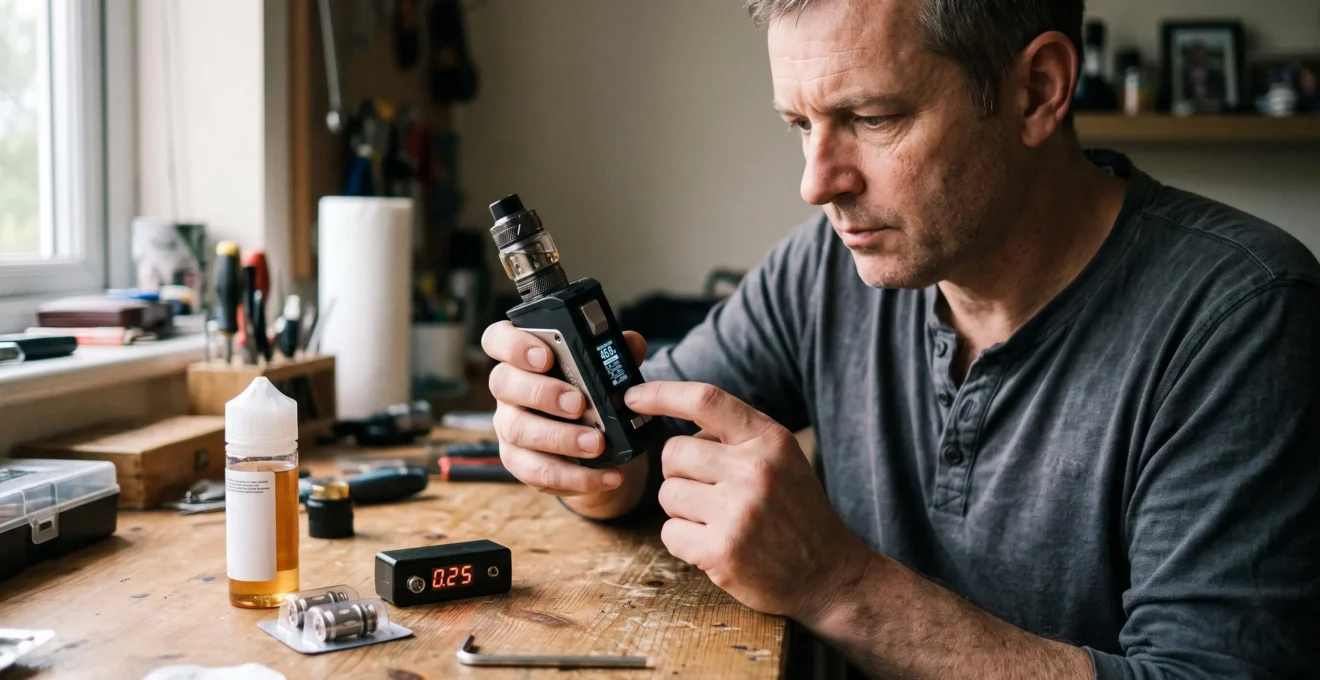
An advanced vape mod makes sense when an experienced adult user has a specific need for adjustable power, compatible atomizers or more detailed control over device operation—and is prepared to manage the additional technical responsibilities. Experience with vaping alone is not enough. Understanding resistance readings, coil limits, battery compatibility and device warnings matters more than how long someone has used a basic vape.
The difference is not simply that an advanced mod can produce more vapor. Adjustable devices allow users to change operating conditions that simpler systems often manage automatically. Greater flexibility therefore creates more opportunities for incorrect configuration, maintenance problems and battery-related hazards.
A regulated mod may offer electronic protections, but those protections are not a substitute for following the manufacturer’s instructions. Nor does additional control establish that a device is safer or less harmful to health. The practical question is whether the extra settings solve an actual limitation of the current device while remaining manageable in everyday use.
Advanced vape mods: the essentials
- An advanced mod is worth considering when meaningful adjustments are unavailable on an existing device, not simply because the user has become more experienced.
- Coil resistance, recommended wattage, compatible battery specifications and temperature-control settings must be understood before use.
- More flexibility comes with additional inspection, maintenance and troubleshooting responsibilities; a capable pod system may remain the more appropriate choice.
- Why Do Advanced Vape Mods Require More Setup Knowledge?
- How Can You Set Up an Advanced Vape Mod Without Overdriving the Coil?
- Advanced Mod or Pod System: Which Better Fits an Experienced User?
- Which Advanced Mod Setup Mistakes Can Cause Overheating or Poor Performance?
- When Is It Worth Switching from a Basic Vape to an Advanced Mod?
- What Can Go Wrong When a Vape Battery and Coil Are Poorly Matched?
- Built-In or Removable Lithium-Ion Battery: Which Is Easier to Maintain?
- What Should Experienced Vapers Know Before Building Custom Coils?
Why Do Advanced Vape Mods Require More Setup Knowledge?
Advanced vape mods require more setup knowledge because they expose operating variables that simpler devices often control automatically. Users may need to select wattage, interpret coil resistance, configure temperature control and verify battery compatibility. These decisions interact, so a setting that appears reasonable in isolation may be unsuitable for the installed coil or power source.
A basic pod usually limits the number of user-adjustable parameters. Depending on its design, the device may identify a compatible cartridge or operate within a predefined power range. An advanced regulated mod can provide broader controls, including variable wattage, power-delivery profiles, temperature-control modes and resistance readings.
Understanding those readings requires both electrical knowledge and practical observation. Resistance, measured in ohms (Ω), describes how strongly an electrical component opposes current. Wattage describes electrical power delivered to the atomizer. Their relationship matters, although the behavior of a regulated mod differs from a mechanical device because electronic circuitry controls the output.
Practical knowledge is equally important. An excessively hot mouthpiece, persistent burnt flavor, unusually slow heating response or repeated error message can indicate a problem that numerical settings alone do not explain.
For example, a resistance reading that changes unexpectedly after installing a new coil may indicate a loose connection, incompatible component or faulty assembly. Increasing the wattage to compensate for disappointing performance would not address those possibilities.
Manufacturer documentation provides the relevant operating boundaries. Innokin‘s Proton Mini technical support instructions describe adjustable wattage, manufacturer-recommended coil limits and temperature-control operation with compatible materials. Those instructions apply to that particular device rather than every advanced mod.
Before considering a transition, an experienced user can assess three questions:
- Can I explain what the resistance value displayed by my device represents?
- Can I identify signs that a coil is wearing out or failing to receive enough liquid?
- Do I understand the battery’s continuous discharge rating and how to check device compatibility?
Three confident answers suggest familiarity with important prerequisites, although they do not establish technical competence on their own. Each uncertain answer identifies an area to learn before adopting more adjustable hardware.
The underlying change is a transfer of responsibility. An advanced mod may give users more control over operation, but it also requires them to recognize when that control should not be exercised.
Once those fundamentals are understood, the next challenge is configuring a compatible coil without treating its advertised operating range as an unconditional guarantee.
How Can You Set Up an Advanced Vape Mod Without Overdriving the Coil?
To avoid overdriving a coil, verify that it is compatible with the atomizer and mod, check its expected resistance, prime it according to the manufacturer’s instructions and begin near the lower end of its recommended wattage range. Increase power conservatively only when operation remains normal, and stop if overheating, abnormal resistance readings or persistent burnt flavor occurs.
The wattage printed on a replacement coil is a manufacturer’s recommendation for that component. It is not a promise that every combination of e-liquid, airflow, puff frequency and coil condition will perform identically across the entire range.
Coils depend on liquid reaching the heating surface through a wick, commonly made from cotton. If heat is supplied faster than the wick can replenish liquid, localized drying and burnt flavor can occur. A damaged or heavily used wick may behave differently from a fresh one even at the same setting.
An experimental study indexed in PubMed examined dry-puff conditions with 13 experienced e-cigarette users, selected coils and different liquids. The researchers observed dry-puff flavor at different power settings depending on the tested configuration. The experimental study on e-cigarette dry-puff conditions indexed in PubMed supports treating coil performance as configuration-dependent, not governed by one universal wattage threshold.
13 experienced users
The participants in the 2021 dry-puff experiment assessed selected combinations of coil resistance, e-liquid and power. The small sample and specific test conditions prevent generalization to every modern mod.
Original experimental research indexed in PubMed, 2021.
A practical initial setup follows the sequence below. Specific values and procedures must always come from the relevant hardware documentation.
- Check compatibility. Confirm that the installed coil, tank and regulated mod are intended to operate together.
- Inspect the assembly. Ensure that the coil is properly seated, the tank is assembled correctly and its electrical contacts are clean and undamaged.
- Verify the resistance. Compare the measured resistance with the coil’s expected specification. A substantial or unstable discrepancy warrants investigation before firing.
- Prime the wick. Follow the coil manufacturer’s liquid-application and saturation instructions. A thicker, higher-VG liquid may wick differently, but there is no universally validated waiting time.
- Begin conservatively. Start toward the low end of the recommended wattage range and assess performance before making small changes within that range.
Unusual heat, persistent burnt flavor or repeated device warnings should prompt the user to stop rather than continue experimenting with power. Condensation can occur during normal operation, so its presence alone does not establish that a coil has been overdriven.
Temperature control introduces another layer of complexity. On compatible regulated devices, it uses changes in coil resistance to estimate temperature and adjust output. The user must select a supported wire material and follow the specified calibration procedure. Incorrect settings can undermine its intended behavior.
Temperature control is not a universal overheating guarantee. It cannot be assumed to detect every wicking failure or device fault. Bypass mode is not a protective substitute: it typically changes how power is delivered and may remove ordinary wattage adjustment from the process.
Five checks before first use
- Confirm coil, tank and mod compatibility; identify the manufacturer’s matching specifications.
- Check the installed coil’s rated wattage range; record its lower and upper limits.
- Compare displayed resistance with the expected specification; record a stable initial reading.
- Prime the wick and complete the required saturation period; confirm that the manufacturer’s preparation steps are finished.
- Start at the recommended low-power setting and assess normal operation; retain the selected setting only if no warning signs occur.
Careful initial configuration reduces avoidable setup errors, but it does not eliminate equipment failure or the risks associated with e-cigarette aerosol. The additional effort should also influence whether an advanced mod is the right device category.
Advanced Mod or Pod System: Which Better Fits an Experienced User?
An advanced mod is generally a better fit for an experienced adult who needs broader hardware compatibility, adjustable power and hands-on maintenance options. A pod system may fit better when portability, simplicity and predictable operation matter more. Neither category is automatically superior, and using an advanced device is not a necessary progression for experienced users.
The choice becomes clearer when it is based on specific operating priorities rather than advertised maximum output or the number of available settings.
| Decision criterion | Advanced regulated mod | Pod system |
|---|---|---|
| Power adjustment | Often offers broader adjustment, subject to model limits | Usually simpler; some models still provide adjustable wattage |
| Portability | Often bulkier with a separate tank | Frequently smaller and easier to carry |
| Routine maintenance | May involve tank cleaning, coil replacement and removable-battery care | Usually fewer separate components to maintain |
| Component choice | May support multiple compatible tanks and coil systems | Often restricted to a cartridge or coil family |
| Initial equipment needs | Potentially includes batteries, charger and maintenance tools | Often fewer accessories |
| Long-term flexibility | Can support replaceable components and rebuildable atomizers | Often depends on manufacturer-specific replacement parts |
An experienced commuter who rarely changes wattage may receive little practical benefit from carrying a larger mod. Even a technically capable user can reasonably prefer a compact, low-maintenance pod for everyday use.
By contrast, someone repeatedly dissatisfied with the fixed output or limited atomizer compatibility of an existing device may have a genuine reason to consider a regulated mod.
Ownership costs also differ. A pod may use proprietary cartridges that must be replaced within one product ecosystem. A mod with a standard compatible connection may support a broader choice of atomizers, although electrical, mechanical and manufacturer compatibility still need to be checked.
A hybrid arrangement is another possibility: one compact device for travel and a mod kept at home. This separates convenience from experimentation, but requires maintaining two sets of equipment and potentially different consumables.
The combined cost includes replacement coils, cartridges, liquids, batteries and any charger required. Greater convenience in one setting does not necessarily justify the expense of maintaining both devices.
It is also worth distinguishing control from health outcomes. A device with more settings does not inherently reduce nicotine exposure, aerosol exposure or other health risks. Usage patterns, liquids and operating conditions remain relevant, and this hardware comparison cannot establish clinical safety advantages.
After choosing a device category, attention should turn to identifying configuration errors and distinguishing ordinary operating warmth from symptoms that require immediate action.
Which Advanced Mod Setup Mistakes Can Cause Overheating or Poor Performance?
Advanced mod problems commonly arise from incompatible electrical components, incorrect assembly, unsuitable power settings or neglected maintenance. Symptoms include unstable resistance readings, abnormal heat, burnt flavor, reduced performance and repeated protection warnings. A warm tank does not necessarily indicate a battery fault, but heat around the battery compartment or signs of battery damage require immediate attention.
Electrical, mechanical and configuration errors can produce similar symptoms, so diagnosis should start by identifying the location and behavior of the problem rather than increasing power.
| Problem category | Possible symptoms | Initial response |
|---|---|---|
| Electrical incompatibility | Battery warnings, unexpected shutdowns or abnormal battery-area heat | Stop use and verify approved battery specifications |
| Poor coil or tank connection | Unstable resistance, atomizer-not-detected messages | Power down and inspect accessible connections for damage or improper seating |
| Excessive wattage | Burnt flavor, harsh operation, excessive heating | Stop firing and inspect the coil and settings |
| Incorrect temperature-control configuration | Unexpected power behavior or temperature-limit messages | Confirm wire material, mode and calibration instructions |
| Worn or poorly saturated wick | Persistent flavor degradation or dry hits | Replace the affected coil or wick as appropriate |
The location of heat provides useful context. A tank can become warm during repeated operation because its heating element is transferring energy to nearby materials. That observation alone is not proof of an electrical failure.
However, unusual heating around the battery compartment, swelling, leakage, hissing or smoke are serious warning signs. Stop using the device immediately, avoid handling a potentially failing cell unnecessarily and follow appropriate emergency precautions if the situation escalates.
Coil wear can create a misleading cycle. Degraded cotton or accumulated residue can reduce liquid delivery and affect flavor. A user who responds by increasing wattage may worsen the problem instead of restoring the expected performance.
Recurring electronic protection warnings should not be dismissed as inconvenient interruptions. They may indicate that the device has detected a condition outside its permitted operating limits.
The U.S. Food and Drug Administration notes that vape battery fires and explosions appear uncommon but can cause serious injuries. Its FDA guidance on preventing vape battery fires and explosions recommends using approved batteries and following manufacturer charging and handling instructions. The agency also acknowledges that the exact causes of these incidents are not fully understood.
A cautious diagnostic approach is to stop use, disconnect the tank where the manufacturer permits, inspect accessible components and verify the installed parts against device specifications. If the unit is otherwise undamaged, a known-compatible replacement coil may help distinguish a coil-related problem from a tank issue.
Any test of a functioning assembly must stay within the manufacturer’s approved operating conditions. Do not conduct repeated firing tests on equipment showing persistent faults, battery-area overheating or physical damage.
When the source cannot be identified confidently, the appropriate next step is qualified servicing or replacement, not bypassing protection circuitry.
Reliable performance is as much about recognizing when to stop using equipment as it is about choosing the right initial settings. This distinction becomes important when deciding whether an upgrade is worthwhile.
When Is It Worth Switching from a Basic Vape to an Advanced Mod?
Switching to an advanced mod is worth considering when a basic vape imposes a recurring, specific limitation that adjustable hardware can address. Examples include insufficient control over power, restricted atomizer compatibility or an interest in maintaining replaceable components. The change is less compelling when an existing device already meets practical needs and the additional settings would rarely be used.
There is no meaningful minimum number of months or years of vaping experience that automatically makes someone ready for advanced hardware. Readiness depends on understanding the equipment, recognizing warning signs and accepting more maintenance.
A useful way to assess the decision is to identify the two or three adjustments that would materially improve device usability. Common candidates include power control, airflow adjustment and a different compatible coil configuration.
If none of those requirements can be met by the existing device, a broader equipment change may be reasonable. If only one feature is missing, a compatible replacement component or a simpler adjustable device may address the issue with less additional complexity.
The financial evaluation should extend beyond the purchase price. Depending on the selected mod, ownership may require removable lithium-ion cells, an approved charger, replacement coils, wick materials, tools and more frequent cleaning.
Higher-power operation can also increase liquid consumption under some usage conditions. An advanced device is therefore not automatically cheaper than a pod, even when its replaceable components appear economical individually.
Consider a hypothetical adult user whose current pod provides satisfactory portability and reliability but no meaningful power adjustment. If that user only wants slightly different airflow, an alternative compatible pod or cartridge may be a simpler solution than purchasing an advanced mod.
Another hypothetical user may consistently need a type of atomizer that the current platform does not support. In that case, a compatible regulated mod could provide a functional advantage, provided the user understands its electrical and maintenance requirements.
Appearance and novelty are weak reasons to upgrade on their own. A device purchased primarily for its display, size or reputation can introduce extra work without resolving a practical limitation.
Long-term usefulness is more closely associated with identifiable needs, accessible replacement components and a willingness to follow safe operating procedures.
Before purchasing or using a device with more demanding power requirements, the most important technical issue to resolve is battery compatibility.
What Can Go Wrong When a Vape Battery and Coil Are Poorly Matched?
When a vape battery and coil configuration are incompatible, the device may experience voltage sag, reduced performance, protection-system shutdowns or excessive battery heating. In severe circumstances, battery failure can create a fire or injury hazard. Compatibility must be evaluated using the mod’s circuitry, approved batteries, intended power and manufacturer specifications—not coil resistance alone.
Electrical behavior differs significantly between regulated mods and mechanical mods.
In a mechanical device, the battery is connected to a resistance load without the electronic power regulation found in a regulated mod. Ohm’s law relates voltage, current and resistance through I = V/R, while electrical power can be expressed as P = V × I.
These relationships explain why lowering resistance can increase current at a given battery voltage. They do not, however, automatically describe the current drawn from a battery inside an electronically regulated mod.
A regulated mod converts battery power into a controlled output to the atomizer. Battery-side current depends on the power demanded, battery voltage, conversion losses and device configuration. In a multiple-battery device, cell arrangement and electronic design also matter.
Consequently, applying a simple coil-resistance calculation directly to the battery current of every regulated mod can produce a misleading compatibility assessment.
The battery’s continuous discharge rating identifies an operating limit specified for the cell under defined conditions. That rating should not be confused with an advertised pulse or peak-current figure.
In practice, a safer compatibility process requires checking the device’s approved battery type, the continuous discharge specification from a traceable manufacturer and the operating limits stated in the mod’s documentation. An adequate safety margin is preferable to planning normal operation at a cell’s claimed maximum capability.
Where a device manufacturer does not provide sufficient information, users should not substitute an unverified online calculation for compatibility confirmation.
Battery quality is another variable. A counterfeit, damaged, aged or incorrectly labeled lithium-ion cell may not behave as its printed specifications suggest. Capacity loss and increased internal resistance can contribute to voltage sag and poorer performance.
Voltage sag describes a reduction in battery terminal voltage under load. It may lead a regulated device to limit output or trigger a low-voltage warning earlier than expected. Increasing wattage cannot repair a deteriorating cell.
Users should never attempt to defeat electronic protections, substitute batteries outside the manufacturer’s approved specifications or continue operating equipment that displays repeated battery faults.
Once compatibility is established, a further ownership decision remains: whether an integrated battery or a removable-cell design better fits the user’s ability to maintain the equipment safely.
Built-In or Removable Lithium-Ion Battery: Which Is Easier to Maintain?
A built-in lithium-ion battery is generally easier to manage day to day because the user does not need to remove, transport or select individual cells. A removable battery can make replacement more straightforward when it ages, but introduces responsibilities for inspection, charging and safe storage. Neither design is inherently free from battery-related hazards.
Integrated batteries simplify normal charging and reduce direct handling of the cell. Their main maintenance limitation appears as the battery ages: when usable capacity declines, replacement may require manufacturer service or an entirely new device.
Removable batteries allow a compatible cell to be replaced without replacing the whole mod. This can extend practical device usability, subject to the condition of the hardware and continued availability of appropriate batteries.
However, replaceability creates additional handling requirements. Spare cells can short-circuit if their exposed terminals contact metal objects such as keys or coins. Damaged insulation can also expose conductive parts of the battery casing.
The UK government advice on e-cigarette battery safety, published in February 2020, recommends keeping removable batteries in protective plastic cases, checking for damage and avoiding overnight charging. It also advises following device warnings and using genuine batteries recommended for the equipment.
Both integrated and removable-battery devices should be charged according to the manufacturer’s instructions, on a clean, stable surface away from flammable materials. Avoid unattended overnight charging, excessive heat exposure and continued use of malfunctioning equipment.
Neither constantly maintaining a full charge nor repeatedly discharging a lithium-ion cell deeply is desirable for long-term battery condition. Device-specific battery management features can affect charging behavior, so manufacturer guidance takes priority.
Inspection of removable cells should include the entire insulating wrap, the insulating ring around the positive terminal where applicable, and the physical condition of the battery casing.
Look for torn or displaced insulation, dents, deformation, corrosion, leakage and other visible damage. A cell showing suspicious physical changes should be taken out of service immediately.
A damaged wrap is not merely cosmetic. Depending on the battery design, much of the metal casing may form part of an electrical terminal, making intact insulation essential to prevent unintended contact.
Where only the external insulation is damaged and the cell is otherwise sound, an appropriately qualified person may be able to assess whether replacement insulation is suitable. Users without the necessary expertise should replace the cell rather than attempt an improvised repair. Damaged or questionable batteries should be taken to an appropriate battery collection facility, with terminals protected according to local collection guidance.
Multi-cell devices introduce further requirements. Users should follow manufacturer instructions concerning cell matching, installation orientation and replacement. Cells of different ages, types or charge states should not be mixed contrary to those instructions.
An external charger may be convenient where it is compatible with the selected cells, but its presence does not automatically make charging safer than using a suitable built-in charging system.
For users who prioritize minimal handling, integrated batteries may offer greater convenience. Removable cells can support longer hardware use, but only when inspection, storage and battery selection are handled consistently.
Key takeaways before considering rebuildable coils
- Rebuildable hardware adds electrical and assembly decisions beyond those required by replaceable factory coils.
- A regulated device and a reliable resistance measurement are important safeguards, but they do not validate an incorrectly assembled coil.
- Any potential savings must be balanced against tools, learning time, maintenance and the consequences of incorrect construction.
What Should Experienced Vapers Know Before Building Custom Coils?
Experienced vapers should understand electrical resistance, material compatibility, secure assembly and reliable measurement before attempting custom coils. Rebuildable atomizers provide greater control over coil construction and maintenance, but introduce additional opportunities for short circuits, unstable connections and wicking problems. Using a regulated device with appropriate protections is preferable to experimenting with an unprotected mechanical mod.
Custom coil construction is distinct from replacing a factory-made coil head. The user becomes responsible for selecting suitable wire, preparing the heating element, securing electrical connections and installing a wick.
This responsibility begins with the atomizer’s specifications. The deck must accommodate the intended wire and configuration, and the resulting assembly must stay within the supported operating limits of the complete device.
Wire materials differ in electrical behavior and compatible operating modes. Kanthal is commonly used for wattage-controlled operation. Appropriate stainless-steel grades, including SS316L where supported, can be used in wattage mode and compatible temperature-control systems. Nickel NI200 is intended for temperature-control use rather than ordinary wattage-mode operation.
Temperature-control compatibility must be established from the device and wire specifications. Selecting a material label that does not correspond to the installed wire can cause incorrect control behavior.
A build also depends on geometry. Wire thickness, coil diameter, number of wraps, material and the number of installed coils all influence the final resistance and heating characteristics.
Because these variables interact, an estimated resistance should never replace an actual measurement. A reliable, compatible resistance meter or suitable regulated testing device is needed to check the completed assembly before use.
There are several distinct construction stages, each with a different potential failure:
- Planning: Select only a wire and coil arrangement supported by the atomizer and regulated mod. An incompatible design should be rejected before assembly.
- Mechanical installation: Ensure the coil is secured according to the atomizer manufacturer’s instructions. Loose connections or unintended contact with the deck can create electrical faults.
- Electrical verification: Measure resistance and investigate unexpected or unstable readings. Do not energize an assembly that has not passed these checks.
- Heating assessment: Follow the manufacturer’s prescribed verification method on protected equipment. Do not improvise dry-firing procedures or heat unsuitable wire materials.
- Wicking and preparation: Install compatible wick material without obstructing the intended liquid flow, then saturate it according to the manufacturer’s instructions before normal operation.
A coil that measures correctly is not necessarily assembled correctly. Lead placement, contact with surrounding metal, insulation and the stability of mechanical connections must also be considered.
Mechanical mods deserve particular caution because they lack the integrated electronic protections present in regulated devices. An electrical fault in an unprotected circuit can place substantial stress on the battery. They are not an appropriate platform for learning basic coil construction.
Rebuildable equipment may reduce dependence on proprietary replacement coil heads, but any financial advantage depends on usage patterns and the cost of materials and equipment.
The initial investment can include measuring tools, suitable wire, cotton, maintenance equipment and replacement atomizer components. Unsuccessful assemblies also consume materials and time.
Greater customization is not a safety benefit by itself. A factory-made coil used within its specified limits may be the more manageable option for an experienced adult who does not want responsibility for constructing and verifying an electrical heating element.
For users interested in rebuildable hardware, learning from the atomizer manufacturer’s documentation and obtaining competent hands-on guidance are more appropriate starting points than attempting unfamiliar builds through trial and error.
The sensible next step is to assess an existing device against its manufacturer’s specifications, identify the exact limitation that motivates a change and decide whether additional adjustability justifies the accompanying responsibilities. No hardware upgrade should be treated as a substitute for appropriate electrical safety or as evidence of reduced health risk.
Can an advanced vape mod be used safely without temperature control?
A compatible regulated mod can operate in wattage mode without temperature control when configured according to its manufacturer’s instructions. However, temperature control is not the only relevant consideration: coil compatibility, battery selection, assembly and maintenance remain important. Neither operating mode guarantees freedom from electrical faults, overheating or health risks.
Does a higher-wattage vape mod always require a lower-resistance coil?
No. Suitable resistance depends on the coil design, atomizer, intended operating range and device specifications. In regulated mods, circuitry controls output power, so resistance alone does not determine battery current. Users should select coils within the complete device’s stated compatibility limits rather than infer compatibility from wattage or resistance in isolation.
Should a removable vape battery be replaced if its protective wrap is torn?
A battery with torn insulation should be removed from service immediately. A qualified assessment may establish whether insulation replacement is appropriate for an otherwise undamaged cell, but replacement is the safer option when the user lacks the necessary expertise. Dented, leaking, deformed or otherwise damaged cells should not be returned to use.
Can a new coil eliminate the burnt taste from an advanced vape mod?
Replacing a worn or damaged coil may resolve burnt flavor caused by degraded wick material. However, incorrect wattage, insufficient priming, poor liquid delivery or a hardware fault can produce similar symptoms. If the problem persists with a correctly installed, compatible replacement, stop use and investigate rather than repeatedly increasing power.
Does an advanced vape mod make vaping less harmful than using a pod?
More advanced controls do not establish a health advantage. Exposure depends on multiple factors, including the liquid, heating conditions and individual use patterns. The technical documentation and experimental evidence discussed here do not demonstrate that advanced mods reduce long-term health risks compared with pods. For people who do not use nicotine or tobacco products, avoiding initiation remains the appropriate choice.