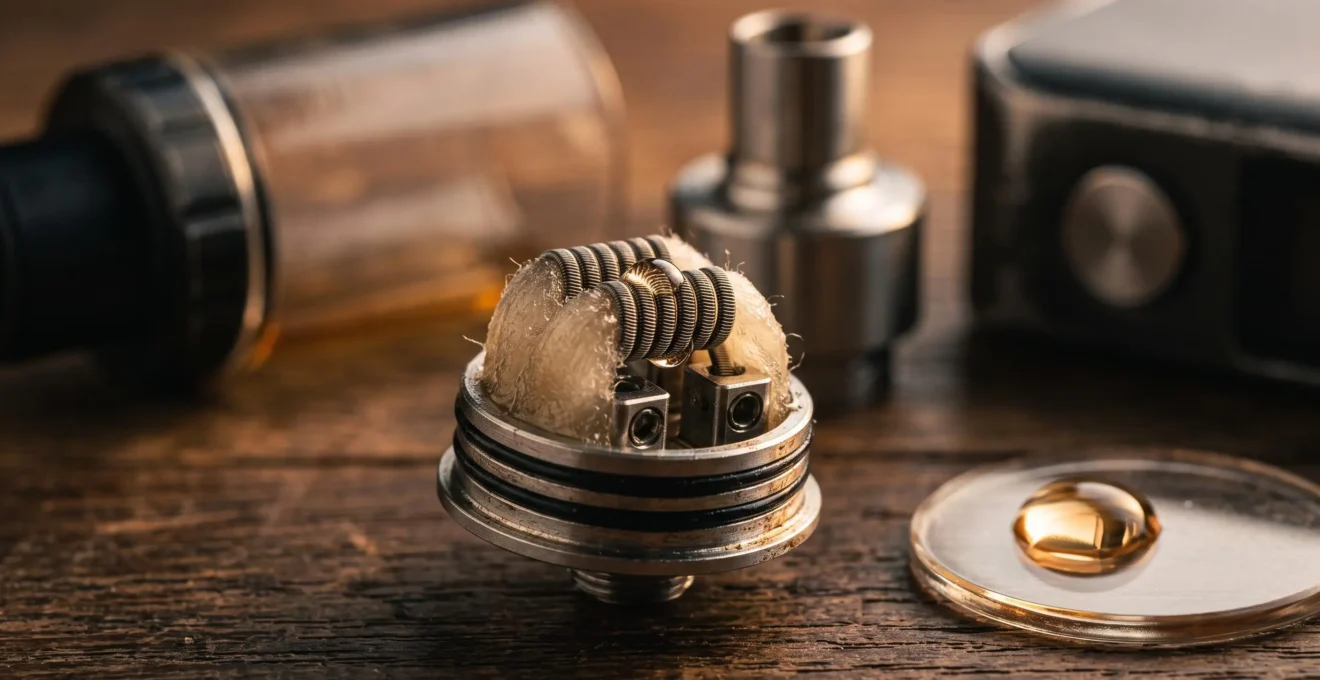
A cigarette burns tobacco. An electronic cigarette heats a liquid. This distinction changes how the inhaled material is produced, what it contains and which chemical reactions can occur during use.
When tobacco burns, heat sustains combustion and releases smoke containing gases and particles formed through complex chemical reactions. A vape instead uses electrical energy to heat e-liquid, creating vapour that cools and forms an aerosol of microscopic droplets. Neither a flame nor burning tobacco is required for this process.
However, combustion-free does not mean chemical-free. The heating element, liquid ingredients and operating conditions can all influence the substances present in the aerosol. Some may present health risks even without tobacco combustion.
Understanding this difference requires looking beyond the visible cloud. The decisive factors are how heat reaches the liquid, how the atomizer controls aerosol formation and what happens when the heating process becomes inefficient.
Combustion-free vaporisation: the essentials
- Burning tobacco involves a self-sustaining combustion reaction; vaping uses electricity to heat e-liquid without igniting tobacco.
- A vape produces an aerosol of suspended droplets and gases, not simply harmless water vapour.
- Avoiding combustion changes exposure to harmful substances but does not eliminate risks from heated liquid ingredients, metals or other aerosol constituents.
- Why Does a Vape Produce Aerosol Without Setting E-Liquid on Fire?
- How Does a Vape Turn Stored E-Liquid into Inhaled Aerosol?
- Vape Aerosol, Vapour or Smoke: Which Term Is Technically Accurate?
- Why Does No Combustion Not Mean No Health Risk?
- When Does a Vape Coil Actually Start and Stop Vaporising E-Liquid?
- Why Can a Vape Not Produce Aerosol Without a Working Atomizer?
- Why Does Vaping Have So Much Specialist Slang and Hardware Terminology?
- Why Is the Atomizer a Core Component of an E-Cigarette?
Why Does a Vape Produce Aerosol Without Setting E-Liquid on Fire?
A vape produces aerosol without setting e-liquid on fire because its heating element transfers electrical energy directly into a liquid instead of initiating sustained combustion. The liquid evaporates near the heated surface, then condenses into tiny airborne droplets. Unlike a burning cigarette, this process does not require a flame, an ember or combustible tobacco to sustain it.
Combustion is a chemical reaction between fuel and an oxidising agent, usually oxygen, that releases heat and produces new substances. In a lit cigarette, the burning tobacco is itself the fuel. Temperatures in the glowing ember can exceed roughly 600°C, although they vary considerably between resting and puffing conditions.
Once ignited, the cigarette can continue smouldering without another external energy source. The burning zone generates smoke and leaves ash as solid material is consumed. Tobacco outside the hottest zone also undergoes thermal decomposition, contributing further compounds to the smoke.
An electronic cigarette operates differently. Its battery supplies electrical power to a resistance heating element. The heat acts on e-liquid delivered to that element, producing vapour without sustained burning. The device does not maintain a tobacco ember between puffs.
The essential distinction is the physical and chemical process, not simply the temperature. E-liquid components can evaporate across a range of temperatures, and their behaviour depends on the mixture, heating surface and airflow. There is no single universal vaporisation temperature for every vape.
Because no tobacco leaf is burning, normal vaping does not generate ash or continuous sidestream smoke from a smouldering cigarette. It also avoids the combustion pathway responsible for carbon monoxide and many toxic substances in cigarette smoke.
Nevertheless, absence of tobacco combustion does not mean absence of thermal decomposition. Excessive heating can still generate unwanted compounds from e-liquid ingredients. These reactions are different from the burning of tobacco, but they matter when evaluating aerosol chemistry.
A visible cloud therefore does not demonstrate that something has caught fire. It reflects droplets that form when heated e-liquid vapour encounters cooler surrounding air.
To understand exactly where those droplets come from, the next step is to follow the liquid through the device, from its reservoir to the heated coil.
How Does a Vape Turn Stored E-Liquid into Inhaled Aerosol?
A vape turns stored e-liquid into inhaled aerosol through a sequence of liquid delivery, electrical heating, evaporation and condensation. E-liquid moves from a tank or pod into a wick, which supplies the heating coil. When electrical power heats the coil, some liquid evaporates. As the resulting vapour mixes with cooler air, suspended droplets form the inhalable aerosol.
The components work together in a defined sequence:
- Liquid storage: A tank, cartridge or pod holds the e-liquid until it is needed.
- Wicking: A porous material, commonly cotton, transports liquid towards the heating element through capillary action.
- Electrical heating: The battery sends current through the resistance element, which converts electrical energy into heat.
- Evaporation: Liquid near the heated surface enters the gas phase.
- Aerosol formation: Cooling and mixing with incoming air cause some vapour to condense into microscopic droplets that travel through the mouthpiece.
This mechanism is described in a Scientific Reports study of e-cigarette aerosol droplets. The researchers examined how aerosol properties and nicotine distribution between gas and particle phases varied under specified device and operating conditions.
Two common e-liquid ingredients are propylene glycol (PG) and vegetable glycerine (VG). Both act as carriers, but they have different physical properties. PG is less viscous and generally more volatile, while VG is thicker and contributes substantially to visible aerosol formation.
The PG/VG ratio therefore affects liquid movement through the wick, evaporation behaviour and aerosol characteristics. However, cloud density cannot be predicted from that ratio alone: electrical power, coil design and airflow also matter.
Experiments also show why aerosol production is conditional rather than automatic. In the Scientific Reports investigation, researchers allowed atomizers to become saturated before testing, reducing the risk of dry heating during their measurements.
If the wick does not deliver enough liquid, part of the heating surface may become excessively hot. If the battery provides insufficient power, the liquid may not evaporate efficiently. Excess liquid around the heating element can also interfere with normal operation.
These problems illustrate why the atomizer is essential: the device may contain both a charged battery and a full tank yet still fail to produce aerosol when liquid delivery or heating is disrupted.
Once the droplets leave the heating chamber, they form the cloud associated with vaping. Describing that cloud accurately requires distinguishing aerosol from both vapour and combustion smoke.
Vape Aerosol, Vapour or Smoke: Which Term Is Technically Accurate?
Aerosol is the most technically accurate term for what a person inhales from a functioning electronic cigarette. Vapour describes material in the gas phase, whereas aerosol describes fine liquid droplets or solid particles suspended in a gas. Smoke is produced by combustion or related thermal processes. A vape cloud resembles smoke visually but forms through a different mechanism.
The three terms refer to different physical states or formation processes, rather than interchangeable descriptions of the same substance.
| Characteristic | Technical meaning | Relevance to vaping |
|---|---|---|
| Smoke | A complex mixture of gases and airborne particles generated through combustion and associated thermal reactions. | Characteristic of burning tobacco, not the intended operation of an e-cigarette. |
| Vapour | A substance present in its gaseous phase. | Forms when e-liquid components evaporate near the heated coil. |
| Aerosol | Liquid droplets or solid particles suspended in a gas. | Describes the droplets suspended in the gas mixture that users inhale and exhale. |
During vaping, heated e-liquid molecules enter the gas phase. As this gas encounters cooler air, some of it condenses into tiny droplets. These droplets scatter light, making the cloud visible. The mechanism resembles the formation of fog or the visible mist near a kettle.
Importantly, an aerosol is not necessarily composed exclusively of liquid droplets. Depending on the device and conditions, vaping emissions can contain both particulate material and gaseous constituents.
The visible resemblance to tobacco smoke therefore says little about chemical composition. Cigarette smoke contains substances arising from the burning and decomposition of tobacco, while vaping aerosol is influenced by heated e-liquid ingredients and the materials inside the device.
The everyday term « vapour » remains common because vaporisation occurs during aerosol production. However, calling the inhaled cloud pure vapour overlooks the droplets that form as the heated material cools.
Nor should « water vapour » be used as shorthand for harmlessness. Most e-liquids are based primarily on PG and VG rather than water, and the aerosol can contain nicotine and other chemicals.
The CDC information on e-cigarettes and their aerosol explicitly distinguishes vaping aerosol from harmless water vapour and identifies potentially harmful substances that may be present.
Terminology also affects comparisons between products. A statement about smoke from burning tobacco cannot automatically be applied to aerosol generated from e-liquid, and the reverse is equally true. Each requires evidence about its own composition and exposure conditions.
Although the two emissions form differently, they can both expose the respiratory system to substances of concern. That is why the absence of visible combustion must never be treated as proof of safety.
Why Does No Combustion Not Mean No Health Risk?
Avoiding tobacco combustion can reduce exposure to many harmful substances associated with cigarette smoke, but it does not make vaping aerosol harmless. Heating e-liquid can generate new chemicals, metallic components may release particles or metals, and ingredients such as nicotine and flavourings can present risks when inhaled. The resulting exposure depends on the product and its operating conditions.
Burning tobacco produces a complex mixture of toxic substances through combustion and thermal decomposition. Removing that process changes the emissions substantially. Under typical conditions examined in scientific reviews, e-cigarette aerosol generally exposed users to lower levels of many toxic substances than combustible cigarette smoke.
However, lower exposure to selected toxicants is not the same as proven long-term safety. The health implications depend on the substances involved, their concentrations, how frequently exposure occurs and the characteristics of the person inhaling them.
The principal remaining concerns can be grouped by where the substances originate:
- Thermal degradation: Propylene glycol and glycerine can break down when heated, generating carbonyl compounds such as formaldehyde, acetaldehyde and acrolein. Formation depends strongly on heating conditions.
- Metallic components: Heating coils, electrical connections and other internal parts may contribute metals, including nickel, chromium or lead, to some aerosols.
- E-liquid constituents: Nicotine can cause dependence, while flavouring chemicals may have inhalation-related concerns that differ from their effects when consumed in food.
- Fine particles and gases: Aerosol droplets and volatile substances provide additional inhalation exposure pathways even without tobacco smoke.
The National Academies review of e-cigarette constituent toxicology examines these mechanisms and documents how emitted substances vary across products and operating conditions.
« There is conclusive evidence that in addition to nicotine, most e-cigarette products contain and emit numerous potentially toxic substances. »
Temperature deserves particular attention. In experiments reviewed by the National Academies, carbonyl formation increased under certain heating conditions. The temperatures reported were specific to individual laboratory configurations and must not be interpreted as universal boundaries between safe and unsafe vaping.
A coil can also become inadequately supplied with liquid. When the wick dries while electrical heating continues, the temperature of exposed regions may rise rapidly, increasing the likelihood of unwanted thermal breakdown.
A distinctly burnt or acrid taste, sometimes called a dry hit, may indicate this problem. It is a reason to stop using the device and check the liquid supply and atomizer condition. However, the absence of a burnt taste does not establish that an aerosol is safe, because potentially harmful emissions can also occur during ordinary operation.
Health comparisons therefore need to distinguish several questions: whether combustion occurs, which substances are emitted, how much of each substance is inhaled and what the evidence establishes about health outcomes.
For adults who smoke, completely replacing combustible cigarettes with vaping may reduce exposure to many combustion-related toxicants. Dual use does not provide the same clear separation from cigarette-smoke exposure, and people who do not use tobacco should not begin vaping on the assumption that it is harmless.
These chemical differences become especially important during the short periods when a coil heats up and cools down. Understanding that timing explains why the same device can produce different results from one puff to another.
When Does a Vape Coil Actually Start and Stop Vaporising E-Liquid?
A vape coil begins vaporising e-liquid when electrical power heats its surface sufficiently for liquid supplied by the wick to evaporate. Vaporisation normally takes place during an activated puff and decreases after power is removed. However, the coil does not cool instantly, so residual heat can continue affecting the liquid briefly after activation ends.
On a button-operated device, pressing the activation button completes the electrical circuit and supplies energy to the heating element. On an automatic device, a draw sensor activates the heating circuit when the user inhales.
Electrical resistance converts this energy into heat. Once the coil becomes sufficiently hot, liquid in contact with the heated region begins evaporating. The resulting vapour mixes with incoming air and forms aerosol droplets as it cools.
On many devices, visible aerosol appears quickly after activation, often within approximately a second. This is a general operating description rather than a universal measured threshold. The precise delay depends on the heating element, power delivery, liquid supply and surrounding conditions.
The power-on period is only one part of the process. After the button is released or the draw sensor deactivates, electrical heating stops, but the coil retains some thermal energy. Any remaining vaporisation diminishes as the element cools.
Consequently, the statement that a vape only vaporises liquid while powered is a useful simplification, not an absolute physical rule. Unlike a cigarette, the device does not continue a self-sustaining combustion reaction between puffs.
Repeated puffs introduce another variable: wick recovery time. Liquid must continuously replace the material evaporated near the coil. If puffs are frequent enough to outpace replenishment, sections of the wick may become insufficiently saturated.
This can create several recognisable operating conditions:
- Consistent aerosol and flavour: Liquid delivery and heating appear reasonably balanced, although normal performance does not establish chemical safety.
- Gurgling or occasional liquid droplets: Excess liquid may have accumulated around the heating chamber or airflow pathway.
- Weak or inconsistent aerosol: Insufficient power, poor electrical contact or inadequate liquid delivery may be interfering with normal operation.
- Harsh, burnt or unusually acrid taste: The wick or nearby residues may be overheating, making continued use inadvisable until the cause is identified.
Different devices manage heating differently. Regulated devices use electronic controls to limit power delivery, enforce activation time limits or implement other protective functions. These features do not guarantee a particular coil temperature or eliminate overheating under every condition.
Coil resistance, thermal mass, power settings and airflow all affect the heating and cooling cycle. Two devices operated for the same puff duration may therefore produce different aerosol quantities and temperatures.
The visible exhaled aerosol illustrates what happens after liquid has been heated, but it does not reveal the coil’s exact temperature. Cloud thickness also changes with airflow, liquid formulation and environmental conditions.
When aerosol production becomes unreliable despite correct activation, the next question is whether the atomizer can still transfer heat to a sufficiently saturated liquid supply.
Why Can a Vape Not Produce Aerosol Without a Working Atomizer?
A vape cannot produce its intended e-liquid aerosol without a functioning atomizer because the atomizer provides the heating interface where electrical energy acts on the liquid. A charged battery and full reservoir are insufficient on their own. The heating element must receive power, and an adequate liquid supply must reach it before normal evaporation and aerosol formation can occur.
The atomizer is therefore more than a container or an accessory. It is the physical location where the essential inputs of vaping meet: electrical energy, e-liquid and airflow.
In many conventional designs, the atomizer includes a resistance heating coil and a wick. Some modern devices use mesh heating elements or integrated pod assemblies, but the operating principle remains similar: an electrically heated surface acts on liquid supplied from a reservoir.
A functioning atomizer requires several conditions to be satisfied simultaneously. Its heating element must maintain an effective electrical connection, the wick or liquid-delivery structure must remain capable of supplying e-liquid, and airflow must permit the generated aerosol to travel towards the mouthpiece.
When one of these conditions fails, the resulting symptoms can help narrow down the problem. They do not, however, establish a definitive diagnosis on their own.
| Observed symptom | Possible explanation | Appropriate initial response |
|---|---|---|
| No aerosol despite activation | Discharged battery, interrupted connection, failed heating element or device protection. | Check device status and manufacturer-approved connections before considering replacement. |
| Weak or inconsistent aerosol | Insufficient liquid delivery, inappropriate power delivery or deterioration of the heating assembly. | Check liquid level, compatibility and condition of replaceable components. |
| Gurgling or liquid in the airflow | Excess liquid around the heating chamber or in the airflow pathway. | Stop using the device temporarily and follow the manufacturer’s guidance for addressing flooding or leaks. |
| Burnt or acrid taste | Dry or degraded wick, overheating or accumulated residues. | Stop use and inspect or replace the designated serviceable component as instructed. |
A broken heating circuit cannot perform the intended electrical heating. A flooded atomizer may receive power but produce irregular aerosol because excessive liquid affects heat transfer and airflow. A deteriorated wick may restrict liquid replenishment even when the coil remains electrically functional.
These failures can sometimes produce overlapping symptoms. For example, weak aerosol might result from an underpowered device rather than a worn wick, while unusual taste may reflect liquid composition as well as atomizer condition.
A practical inspection should therefore proceed from observable, low-risk checks towards manufacturer-approved maintenance rather than immediately assuming one specific fault.
Five checks for an atomizer that is not working properly
- Identify the symptom: Record whether the problem is no aerosol, weak aerosol, gurgling or a burnt taste. The result is a clear description of the fault.
- Check the device status: Look for battery warnings, error indicators or an activation failure. The result is a confirmed device status or a warning requiring further attention.
- Check the liquid supply: Inspect the reservoir level and any visible signs of leaking or flooding, without opening sealed components. The result is an observation of whether liquid supply appears adequate.
- Review component compatibility: Consult the manufacturer’s instructions to verify that the installed pod, coil or replacement part is appropriate. The result is a compatibility check rather than an assumed diagnosis.
- Decide whether service is appropriate: Follow approved maintenance instructions or replace a designated consumable component when necessary. The result is a documented decision to maintain, replace or discontinue use of the faulty assembly.
These checks are general mechanical troubleshooting guidance, not a laboratory test of emissions or a substitute for product-specific safety instructions. Devices with damaged batteries, electrical faults or non-serviceable internal components should not be dismantled or improvised upon.
The vocabulary used to describe these faults can seem unusually technical. In practice, much of vaping’s specialist terminology simply names the components and operating conditions already involved in aerosol production.
Why Does Vaping Have So Much Specialist Slang and Hardware Terminology?
Vaping has developed specialist terminology because its devices combine electrical heating, liquid transport, airflow and replaceable or integrated components. Early enthusiast communities also popularised hardware modification and rebuilding practices, creating practical names for specific designs and behaviours. Terms such as coil, wick, atomizer and sub-ohm identify mechanical differences that ordinary smoking vocabulary does not describe.
Some terminology comes directly from engineering. An atomizer is a component that produces an aerosol; resistance describes how a heating element opposes electrical current; and wicking describes liquid transport through a porous material.
Other terms reflect device configurations or user habits. They may be useful when describing how a device works, but their meanings can vary in informal discussions or commercial descriptions.
The most common expressions become easier to understand when organised around the mechanism of vaporisation.
| Term | Meaning | Connection to aerosol production |
|---|---|---|
| Atomizer | The heating assembly responsible for turning e-liquid into aerosol. | Provides the main liquid-heating interface. |
| Coil | The electrical resistance heating element, which may use wire or mesh. | Generates heat when electrical power is applied. |
| Wick or wicking | Porous material or the movement of liquid through it. | Supplies liquid to the heated surface. |
| Pod or tank | A reservoir or assembly used to hold and supply e-liquid. | Stores the liquid before vaporisation. |
| Sub-ohm | A heating-element resistance below one ohm. | Describes an electrical characteristic, not a guaranteed aerosol output. |
| MTL | Mouth-to-lung inhalation, with aerosol drawn into the mouth before inhalation. | Describes a particular inhalation pattern. |
| DTL | Direct-to-lung inhalation, with aerosol drawn more directly into the lungs. | Describes a different inhalation pattern, often associated with higher airflow. |
| Dry hit | An unpleasant puff associated with insufficient liquid at the heated surface or related overheating. | Can indicate disrupted liquid delivery and increased thermal stress. |
These terms are not independent concepts to memorise. They describe successive parts of the same system: the tank stores liquid, the wick transports it, the coil heats it, the atomizer houses the conversion process and airflow carries the aerosol away.
However, everyday language and technical language do not always align. « Vape » may refer to the complete device, an individual puff or the activity itself. « Coil » may describe only the heating element or an entire replaceable assembly containing both a heater and a wick.
Similarly, « vapour » is frequently used for the visible aerosol, although the two are not technically equivalent. In scientific studies, precise terminology matters because a measurement of gas-phase constituents is not necessarily interchangeable with a measurement of aerosol droplets.
Hardware terminology can also be misleading when used without enough context. A higher power rating, for example, does not establish that a device will operate at a particular temperature or produce a given amount of aerosol. Those outcomes also depend on atomizer geometry, liquid supply and airflow.
Descriptions of inhalation styles such as MTL and DTL should likewise not be interpreted as proof of a specific health outcome. They describe behaviour and device characteristics, not a universal measure of exposure or safety.
When reading product information or research, the useful question is what physical component, electrical characteristic or inhalation behaviour a term actually identifies.
Once these terms are separated from informal marketing language, the atomizer stands out as the component most directly responsible for turning electrical energy and stored liquid into inhalable aerosol.
Key takeaways before examining the atomizer
- The battery provides energy and the reservoir provides liquid, but neither can independently generate the intended vaping aerosol.
- Atomizer condition influences liquid delivery, heat transfer and aerosol composition, so output quality depends on more than electrical power.
- Knowing which parts are designed for replacement helps distinguish ordinary wear from failures requiring professional support or discontinuation of use.
Why Is the Atomizer a Core Component of an E-Cigarette?
The atomizer is a core component of an e-cigarette because it performs the conversion that defines vaping: using electrical heat to turn supplied e-liquid into vapour that subsequently forms aerosol. The battery stores and delivers energy, while the tank stores liquid. The atomizer connects these functions, making its design and operating condition central to aerosol production.
An electronic cigarette can therefore be understood as three interacting systems. The electrical system supplies controlled energy. The liquid-storage and delivery system keeps e-liquid available. The atomizer converts some of that liquid into material that can be carried by airflow.
Although these functions are conceptually distinct, they are not always housed in separate physical components. Refillable tank systems may have replaceable coil heads, while some pod devices integrate the heating element into a sealed, replaceable cartridge. Other products contain non-user-serviceable assemblies.
The atomizer’s importance comes from its function rather than whether it can be removed. Regardless of packaging, a working heating and liquid-delivery interface remains necessary for conventional e-liquid aerosol generation.
Atomizers also undergo operating stresses that help explain their finite service life. The heating element repeatedly warms and cools during activation cycles. At the same time, the wick is exposed to liquid movement, changing temperatures and residues that may accumulate on heated surfaces.
Over time, these conditions can alter liquid transport, heat distribution and the consistency of aerosol formation. Such changes may produce weak output, unpleasant flavours or other performance problems.
There is no universal replacement interval applicable to every atomizer. Service life depends on component construction, liquid composition, electrical settings, usage patterns and the manufacturer’s design.
A replaceable heating assembly should be maintained or replaced according to product-specific instructions. Integrated units should not be assumed to be safely repairable simply because their internal heating element has deteriorated.
Most importantly, a functioning atomizer does not guarantee an absence of harmful emissions. Even normal electrical heating can produce aerosol containing nicotine, particles and other potentially hazardous substances. Thermal degradation and material-related emissions vary across devices and conditions.
This brings the mechanical comparison back to its central point. Tobacco cigarettes rely on sustained combustion of plant material. Electronic cigarettes rely on controlled electrical heating of liquid. Their emissions are different because the underlying processes are different, not because the presence of a coil makes inhalation inherently safe.
For an adult smoker evaluating this distinction, the practical question is whether the device is producing aerosol through its intended heating mechanism, what substances that aerosol can contain and how strongly available evidence supports any health comparison.
When assessing a vaping device, consult its technical documentation, identify the heating and liquid-delivery components, and distinguish normal aerosol production from signs of malfunction. Use reliable public-health evidence to evaluate exposure claims rather than judging safety from the absence of smoke, ash or a flame.
Does an electronic cigarette contain any burning tobacco?
A conventional e-liquid electronic cigarette does not require tobacco combustion. Its heating element uses electrical energy to produce aerosol from liquid. Some e-liquids contain nicotine derived from tobacco, but the presence of tobacco-derived nicotine does not mean tobacco leaf is being burned. Heated-tobacco products are a different category and should not be confused with conventional e-liquid vapes.
Can a vape produce carbon monoxide without burning tobacco?
Conventional vaping avoids the burning-tobacco process responsible for substantial carbon monoxide production in cigarette smoke. That is an important chemical distinction. However, claims of absolutely zero carbon monoxide under every conceivable operating condition would require product-specific evidence. The absence of tobacco combustion should not be converted into an unsupported guarantee that every possible emission is absent.
Does a larger vape cloud mean more nicotine is being inhaled?
Not necessarily. Visible cloud size is affected by e-liquid composition, heating power, airflow and condensation conditions. Nicotine exposure also depends on nicotine concentration, aerosol composition, device operation and puffing behaviour. Experimental research has shown that nicotine can be distributed between aerosol droplets and the gas phase, so visible cloud density alone cannot reliably establish an inhaled nicotine dose.
Can people nearby breathe in exhaled vape aerosol?
Yes. Exhaled aerosol can enter the surrounding air and may be inhaled by other people. It is not simply water vapour, and its constituents can include nicotine and other potentially harmful substances. Exposure varies with the product, room conditions, ventilation and proximity. The fact that a vape does not generate continuous sidestream smoke does not mean its use creates no bystander exposure.
Is switching completely from smoking to vaping the same as eliminating health risks?
No. Completely replacing combustible cigarettes with vaping can reduce exposure to many toxic substances generated by tobacco combustion. However, vaping continues to expose users to aerosol constituents that may be harmful, and its long-term health effects are not fully established. Continuing to smoke while vaping preserves exposure to cigarette smoke. Eliminating tobacco and vaping exposure altogether avoids the risks associated with both products.