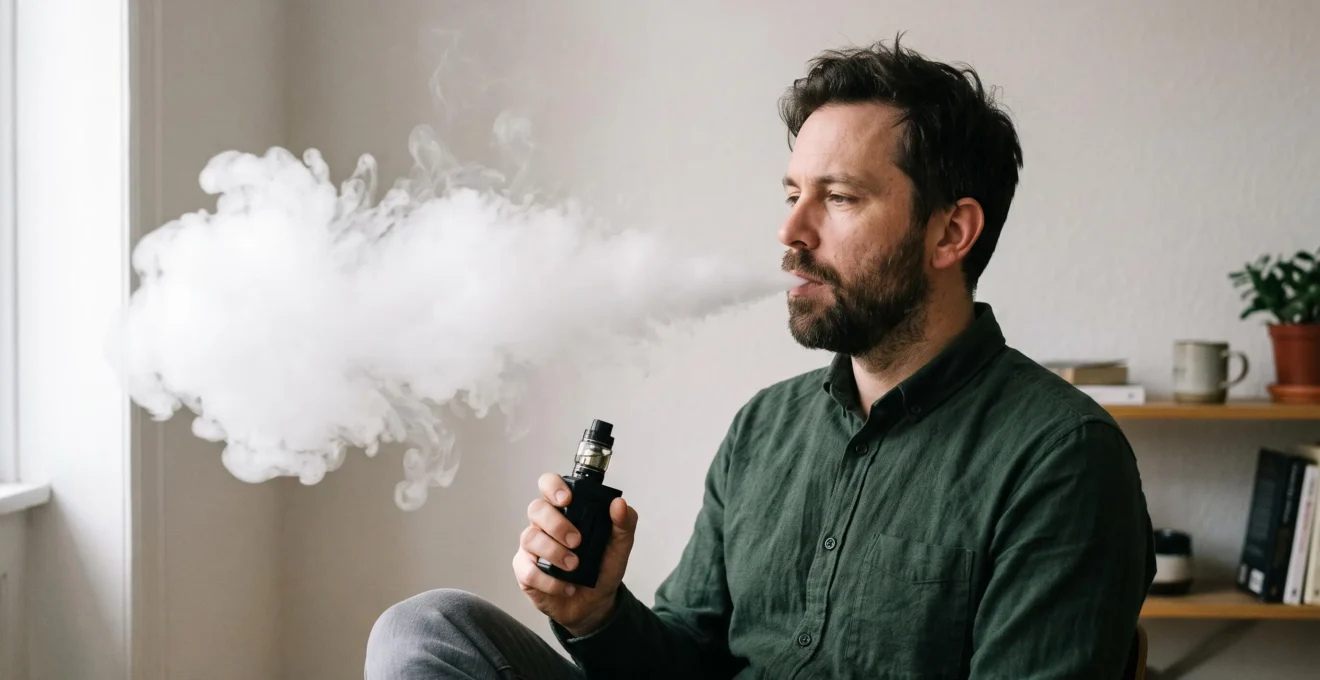
Denser vape clouds are not simply the result of raising wattage. They depend on how effectively a device converts e-liquid into aerosol, how reliably the wick replenishes liquid around the heating element, and how airflow distributes and cools that aerosol during a draw. Vegetable glycerin (VG) content, coil geometry, battery performance and inhalation technique all influence the result.
A device can produce an impressive cloud on its first puff yet struggle to maintain the same output throughout a session. Repeated draws may expose inadequate wicking, battery limitations or a coil operating beyond its comfortable range. Conversely, a balanced setup may deliver less dramatic peak output but remain noticeably more predictable.
The important distinction is between producing the largest possible cloud and producing repeatable aerosol output without overheating the coil or compromising comfort. Understanding that difference helps experienced adult users assess their equipment without relying on maximum-power settings as a universal solution. Larger clouds should not be confused with greater safety or better nicotine delivery.
What determines consistent vape cloud density?
- Coil performance matters more than maximum wattage: the wick must replenish liquid fast enough to support the selected power and puff frequency.
- VG ratio and airflow influence visible output: both must remain compatible with the coil, device design and intended inhalation style.
- Consistency is a system-level result: stable power delivery, appropriate maintenance and realistic operating limits matter alongside cloud size.
- Why Does More Power Not Always Produce Better Vape Clouds?
- How Can You Improve Vapour Output Without Pushing a Coil Beyond Its Rated Range?
- Pod System or Larger Tank: Which Produces Denser Vapour More Consistently?
- What Can Go Wrong When You Push a Vape for Maximum Cloud Production?
- When Does Lower Vapour Output Mean Your Coil Needs Attention?
- How Can You Troubleshoot Weak Vapour Before Raising the Wattage?
- What Are the Trade-Offs of Chasing Maximum Vape Cloud Production?
- How Does Direct-to-Lung Vaping Differ from a Tighter MTL Draw?
Why Does More Power Not Always Produce Better Vape Clouds?
More power does not always produce better vape clouds because aerosol generation depends on the relationship between coil heating, liquid supply and airflow. Higher wattage can increase aerosol output under suitable conditions, but excessive heating may outpace wick replenishment, producing dry puffs, uncomfortable temperatures and declining performance during repeated use.
Electrical resistance and applied power help determine how a heating element behaves. However, resistance alone does not establish the best wattage. Coil material, heating surface area, wick design and the manufacturer’s intended operating range also matter. Two coils with similar resistance can perform differently because their construction and liquid-delivery characteristics are not identical.
An experimental study of power levels and e-liquid composition investigated a device with a nominal 1.5-ohm atomizer and a manufacturer-specified range of 8–20 W. The researchers tested power levels from 7 W to 22 W, observing increased measured aerosol output with higher power under their laboratory conditions.
7–22 W
The experimental power range used in the 2018 aerosol study. Its findings concern a specific device and liquid formulations, not a recommended setting for other coils.
Taylor & Francis, 2018, original experimental research on electronic cigarette aerosol generation.
That relationship does not mean output will keep improving indefinitely. A coil’s usable operating range is constrained by how quickly its wick can supply liquid and how effectively the device dissipates heat. If repeated draws remove liquid faster than it can return, the heating element can operate under insufficiently wetted conditions.
It is also important to distinguish aerosol mass, visible cloud volume and apparent opacity. These measurements are related but not interchangeable. Airflow can change the temperature, dilution and visual appearance of an exhaled cloud without producing an equivalent increase in aerosol mass.
Battery behaviour adds another variable. A regulated device may compensate for declining battery voltage within its designed operating limits, whereas some devices reduce available output as charge falls. Advertised peak wattage therefore says little about performance throughout an entire battery cycle.
The useful operating point is the range in which output, flavour and temperature remain predictable across ordinary draws. It does not have to coincide with the highest setting printed on the coil.
Once the coil is operating within its intended limits, changes elsewhere in the system may explain more of the remaining variation than additional wattage.
How Can You Improve Vapour Output Without Pushing a Coil Beyond Its Rated Range?
Vapour output can sometimes be improved within a coil’s rated range by ensuring effective wicking, using a compatible e-liquid, maintaining unobstructed airflow and allowing enough time for liquid replenishment between draws. The objective is to remove restrictions on normal aerosol generation, not to force a coil beyond its thermal or electrical design limits.
The wick is a critical part of this process. Its job is to bring e-liquid into contact with the heating element as liquid is vaporised and aerosol is formed. If that supply becomes inadequate, performance may deteriorate even when the displayed wattage has not changed.
Vegetable glycerin influences aerosol production, but liquid compatibility matters. The previously discussed experimental research found greater measured aerosol output with the higher-VG formulation in its particular test conditions. That result should not be interpreted as proof that the thickest available liquid will perform best in every device.
Small wick openings and certain compact pod designs may struggle with comparatively viscous liquids. Temperature can also affect liquid flow. A formulation suitable for one tank may replenish too slowly in another, especially during frequent draws.
Airflow deserves attention because it affects draw resistance, heating conditions and how aerosol mixes with incoming air. Increasing airflow may support a cooler, more comfortable draw in equipment designed for it, but maximum airflow does not automatically create the densest aerosol. Greater dilution can also change apparent cloud opacity.
Practical checks include confirming that a new coil has been primed according to the manufacturer’s instructions, keeping the liquid level sufficient to feed the wick, and making sure the tank is assembled without obstructing liquid channels or compromising seals.
A useful observational distinction is whether output stays weak from the beginning or deteriorates only after several consecutive draws. Recovery following a pause suggests that liquid replenishment or temperature may be contributing. It is not, by itself, a definitive diagnosis.
The best combination is device-dependent. A liquid, airflow setting and puff pattern that work well with a large replaceable-coil tank may produce inconsistent results in a compact pod.
These differences become particularly important when comparing hardware formats, because pod systems and larger tanks are designed around different performance priorities.
Pod System or Larger Tank: Which Produces Denser Vapour More Consistently?
A larger tank designed for high-airflow operation generally offers greater potential aerosol output than a compact, low-power pod. However, neither format guarantees better consistency. Reliable performance depends on coil compatibility, wicking capacity, battery regulation and maintenance, while the best device format depends on whether visible output, portability or nicotine delivery is the main priority.
Pod systems typically emphasise compact size, straightforward operation and relatively modest liquid consumption. Many support restricted mouth-to-lung inhalation, although more powerful pod-mod devices can support looser draws and different coil configurations.
Larger refillable tanks, including sub-ohm designs, may accommodate greater airflow, larger heating surfaces and higher liquid capacity. These characteristics can support greater aerosol production when the device, coil and liquid work together appropriately. They do not establish that every larger tank maintains wick saturation or coil temperature better than every pod.
The NHS distinguishes compact pod devices, refillable vape pens and adjustable mods in its advice on choosing a vaping device. Its public health guidance also explains that relatively discreet devices can deliver nicotine while producing small clouds. Nicotine satisfaction and aerosol volume are therefore separate considerations.
The following comparison describes common design tendencies rather than rules applying to every product.
| Criterion | Compact pod system | Larger tank system |
|---|---|---|
| Typical design priority | Portability, simplicity and discretion | Adjustability, airflow and output capacity |
| Visible vapour potential | Usually more limited in low-power models | Often greater with suitable coils |
| Common draw style | MTL or restricted DTL | Restricted DTL or DTL |
| Liquid compatibility | Frequently designed around specific formulations | Depends on the installed coil and wick design |
| Maintenance | Cartridge or integrated-coil replacement is common | Separate coil and tank maintenance is common |
| Long-term practical concern | Availability of compatible proprietary pods | Availability and cost of replacement coils |
Consistency also involves access to replacement components. A well-functioning device becomes less practical if the required cartridges or coils are difficult to obtain. Conversely, a widely supported coil family can simplify maintenance over time without guaranteeing that its performance will remain unchanged.
For adults prioritising discreet nicotine delivery, a suitable compact system may be sufficient. For those comparing aerosol-producing capacity across longer sessions, a larger tank offers different design possibilities, accompanied by additional maintenance and consumption considerations.
Whichever format is chosen, operating it aggressively introduces limits that cannot be solved simply by selecting a larger device.
What Can Go Wrong When You Push a Vape for Maximum Cloud Production?
Pushing a vape for maximum cloud production can increase the likelihood of dry puffs, overheating, uncomfortable aerosol temperatures, rapid liquid consumption and accelerated component wear. Operating outside manufacturer specifications also introduces avoidable electrical and battery risks. Greater output is not necessarily more satisfying, and the additional aerosol may increase exposure to inhaled substances.
One important failure mechanism begins with inadequate liquid replenishment. If a heating element receives insufficient liquid during operation, local temperatures may rise and the wick can produce an unpleasant burnt sensation. Persistent overheating may damage wick material and alter flavour, sometimes making coil replacement necessary.
Research published in the International Journal of Environmental Research and Public Health examined the detection of these conditions. The laboratory research on dry-puff conditions used specified coil and liquid combinations together with assessments by experienced adult vapers.
Experimental evidence: dry-puff conditions are configuration-dependent
In the 2021 study, researchers examined clearomizer coils rated at 1.2 and 1.6 ohms, using defined liquid formulations and controlled puff conditions. Preliminary testing identified dry-puff flavour at or below 25 W in the combinations examined, while it was absent at 10 W.
The results demonstrate that unpleasant operating conditions can emerge when power is unsuitable for a particular configuration. They do not establish a universal dry-puff threshold or safe wattage for other devices.
Another consequence is increased e-liquid consumption. When more liquid is aerosolised during each puff, a tank may need more frequent refilling. Depending on the liquid and usage pattern, this can also affect nicotine intake. Lower nicotine concentration does not automatically mean lower total nicotine exposure when liquid consumption increases.
Battery performance is another constraint. Higher electrical demand can shorten the time between charges, while unsuitable batteries, damaged cells or modifications to protective features can create serious hazards. Government battery safety guidance advises using appropriate batteries, following manufacturer instructions and avoiding damaged equipment.
Heat-related symptoms require attention rather than compensation through further power changes. A device that becomes unusually hot, malfunctions or shows signs of battery damage should not continue to be operated.
There is also a sensory trade-off. Different VG/PG proportions, temperatures and airflow characteristics can change flavour perception and throat sensation. A visually substantial cloud does not guarantee stronger flavour or a more comfortable draw.
A less dramatic but more common warning is gradual loss of normal vapour output, which may point to a coil requiring inspection rather than additional power.
When Does Lower Vapour Output Mean Your Coil Needs Attention?
Lower vapour output may indicate a coil problem when it develops gradually alongside muted flavour, persistent off-tastes or visible wick contamination. A sudden drop is less specific and may involve insufficient liquid, a flooded coil, restricted airflow, poor electrical contact or reduced available battery power. The pattern of change matters more than cloud size alone.
Coils are consumable components. Repeated heating and exposure to e-liquid residues can change the condition of their heating surfaces and wicks. Sweetened or heavily flavoured liquids may leave deposits that affect liquid contact, while frequent use increases the number of heating cycles a coil experiences.
A gradual decline over several days of comparable use is consistent with normal coil ageing, particularly when flavour quality deteriorates at the same time. There is no universal replacement interval because coil construction, liquid composition, power settings and individual usage vary.
Other symptoms require a different interpretation. Gurgling can suggest excess liquid in the airflow or coil area rather than a worn-out wick. A burnt taste can indicate insufficient liquid supply or wick damage. Darker liquid may reflect residue or other changes, but colour alone does not establish that a coil has failed.
Before replacing a coil, inspect the device when it is powered off and cool, following its maintenance instructions. Check whether airflow openings are blocked, whether the coil or pod is correctly seated and whether the tank seals appear intact.
For replaceable-coil systems, visible dark residue or obvious wick damage may support the case for replacement. However, not all wick material can be inspected directly, and disassembling a sealed cartridge is not an appropriate diagnostic method.
A useful distinction is whether the problem affects every draw or mainly follows repeated use. Continuous deterioration accompanied by an unpleasant taste may indicate coil wear. Performance that temporarily recovers after a pause may instead suggest replenishment limitations.
Replace a coil according to its condition and the manufacturer’s guidance, rather than assuming that every reduction in visible aerosol means the coil has reached the end of its life.
When these signs are ambiguous, a short, structured troubleshooting sequence helps distinguish a coil problem from another device fault.
How Can You Troubleshoot Weak Vapour Before Raising the Wattage?
Weak vapour should be investigated by checking liquid supply, coil installation, airflow, battery condition and visible device faults before changing wattage. Comparing when the reduction occurs can reveal whether the problem is persistent, related to consecutive draws or associated with battery discharge. Increasing power without identifying the cause may aggravate inadequate wicking or overheating.
Start with the simplest observable conditions. An insufficient liquid level can interrupt wick replenishment, while a closed or obstructed airflow path can change draw resistance and aerosol delivery. A loose pod or contaminated electrical contact may prevent normal operation even when the heating element itself is usable.
Battery state also matters. Some regulated devices maintain their selected output over much of the discharge cycle; others limit available power as the battery becomes depleted. A sudden change that coincides with low charge is therefore worth checking against the device’s normal behaviour.
Less obvious limitations include condensation in airflow passages, cold temperatures that affect liquid viscosity, and a thick VG-dominant formulation used with a coil intended for more readily flowing liquids.
Before making electrical adjustments, use the following five checks to document the symptoms and identify whether normal maintenance resolves them.
Five checks to document weak vapour output
- Check the liquid level: confirm that the device contains enough compatible liquid to supply the wick. Record whether the level was insufficient.
- Inspect the coil or pod: with the device switched off and cool, confirm correct seating and any required priming. Record visible damage, residue or installation problems.
- Inspect the airflow path: check the intended airflow setting and accessible openings for blockage or condensation. Record whether an obstruction was present.
- Check battery and device status: review the charge indicator, error messages and connection condition. Record the displayed status without bypassing protective features.
- Compare the symptom pattern: note whether weak output occurs immediately, follows repeated draws or coincides with declining battery charge. Produce a short observation log before deciding on maintenance or replacement.
For example, consider a hypothetical device that performs normally at the beginning of a session but develops weak output and an unpleasant taste after repeated draws. That pattern could indicate inadequate wick replenishment. It would not justify increasing wattage, and operation should stop if dry or burnt sensations occur.
In contrast, persistently weak output alongside connection warnings points toward an electrical or installation problem that should be resolved according to the device manual. Persistent faults, abnormal heating or battery damage warrant discontinuing use rather than experimenting with settings.
This method avoids treating every performance complaint as a demand for more heat. It also creates a more reliable basis for deciding whether the coil, liquid or device needs attention.
Even when a setup functions normally, pursuing the highest possible output still carries practical costs that are easy to overlook.
What Are the Trade-Offs of Chasing Maximum Vape Cloud Production?
Maximum vape cloud production involves compromises in liquid consumption, coil wear, charging frequency, device size, discretion and potentially inhaled exposure. Larger visible clouds do not necessarily improve nicotine satisfaction or overall usability. A more meaningful performance target is stable, comfortable operation within equipment specifications rather than the greatest cloud volume obtainable from a single draw.
The most immediate trade-off is resource consumption. Greater aerosol mass per puff generally requires more liquid to be converted into aerosol. Across repeated use, that can increase refilling frequency and ongoing liquid expenditure.
Higher electrical demand can also reduce time between charges. Coil replacement costs may rise when operating conditions produce more rapid deposit formation, excessive heat or repeated wick stress. The exact relationship depends on the hardware, formulation and actual usage.
These costs are not always obvious when comparing devices by their advertised maximum wattage. A lower-output system may require fewer consumables and be easier to manage daily, even though its visible clouds are smaller.
Nicotine delivery introduces another important distinction. The amount of nicotine absorbed depends on more than cloud size, including liquid concentration, device characteristics and use patterns. A large cloud is not a reliable visual indicator of nicotine delivery or satisfaction. Greater liquid consumption can also increase total nicotine exposure.
The public health context matters. Vaping is not risk-free, and inhaling more aerosol should not be considered inherently safer or healthier. For adults using vaping to stop smoking, controlling cravings and avoiding a return to cigarettes are more relevant goals than producing maximum clouds. People who do not smoke should not begin vaping for cloud production.
Social practicality imposes further limits. Dense exhaled aerosol can be intrusive in shared environments, reduce visibility and conflict with restrictions on vaping in public or private spaces. Rules differ across English-speaking countries and individual venues, so discretion remains a practical consideration.
Overall performance is therefore better evaluated through a combination of consistency, comfort, maintenance burden, consumption and intended use. Cloud density is only one dimension.
One of the most consequential choices underlying these compromises is the inhalation style a device is designed to support.
Key takeaways before choosing a draw style
- Choose hardware around the intended inhalation pattern rather than selecting maximum wattage first.
- Compare nicotine delivery needs separately from visible aerosol output; larger clouds are not an inherently better result.
- Prioritise liquid compatibility, comfortable airflow and sustained performance within manufacturer specifications.
How Does Direct-to-Lung Vaping Differ from a Tighter MTL Draw?
Direct-to-lung (DTL) vaping involves inhaling through a relatively open airflow path directly into the lungs, while mouth-to-lung (MTL) vaping draws aerosol into the mouth before inhalation. DTL devices commonly support greater airflow and aerosol output, whereas tighter MTL devices generally prioritise a more restricted, cigarette-like draw and lower liquid consumption.
The distinction is partly mechanical. Equipment designed for DTL inhalation often combines relatively low-resistance coils, larger airflow openings and higher operating power. This allows a substantial volume of air to pass across the heating area during a draw.
MTL equipment generally uses a more restricted airflow path and often operates at lower power. The resulting aerosol volume is usually smaller, although flavour perception and nicotine delivery cannot be predicted from draw style alone.
Nicotine concentration and formulation should also be compatible with the device and usage pattern. Higher-strength nicotine liquids are often associated with lower-output MTL equipment, while higher-output DTL systems are commonly paired with lower nicotine concentrations. These are conventional pairings, not universal safe concentration rules.
The visual difference between the styles is significant, but perceived density remains more complicated than cloud size. An MTL draw can feel concentrated in the mouth while producing a small exhaled plume. A DTL draw may produce a much larger visible cloud because more aerosol and air move through the system.
Hybrid and restricted-DTL devices blur the distinction, so the two categories should not be treated as a rigid division based on resistance or wattage alone.
For practical comparison, an adult who prioritises a familiar, restrained draw and discreet use may find an MTL-oriented system better aligned with those requirements. Someone evaluating higher aerosol output may encounter DTL-oriented hardware, but should still consider consumption, exposure, comfort and device limitations before changing equipment.
Before making any equipment adjustment, identify the device’s intended draw style, confirm that its coil and liquid are compatible, and compare normal performance against the manufacturer’s specifications. The objective should be dependable, comfortable operation, not the largest possible cloud.
Does a higher VG percentage always produce thicker vape clouds?
No. Higher VG content increased measured aerosol output under the conditions of the cited 2018 experiment, but liquid viscosity and coil compatibility limit how broadly that result applies. A formulation that is too viscous for a particular wick design may perform inconsistently.
Can two vape coils with the same resistance produce different amounts of vapour?
Yes. Resistance is only one electrical characteristic. Differences in heating surface area, coil material, wick construction, airflow and operating conditions can affect aerosol production. Equal resistance does not imply equal heating behaviour or identical manufacturer ratings.
Why can vape clouds become weaker as the battery runs down?
Some devices reduce available power as battery charge declines or when operating limits are reached. Other regulated devices maintain their selected output over much of the usable charge range. Check the manufacturer’s specifications and device indicators before attributing weaker output to the battery.
Does more visible vapour mean more nicotine is being delivered?
Not necessarily. Nicotine delivery depends on liquid concentration, aerosol generation, device behaviour and how the device is used. Cloud size alone cannot reliably indicate the amount of nicotine absorbed. More aerosol may also increase exposure to substances other than nicotine.
Is consistently dense vapour a sign that a vape is operating safely?
No. Stable aerosol production is a performance characteristic, not evidence of safety. A device can produce repeatable clouds while still exposing the user to potentially harmful substances. Battery condition, manufacturer operating limits and the broader health risks of vaping must be assessed separately.