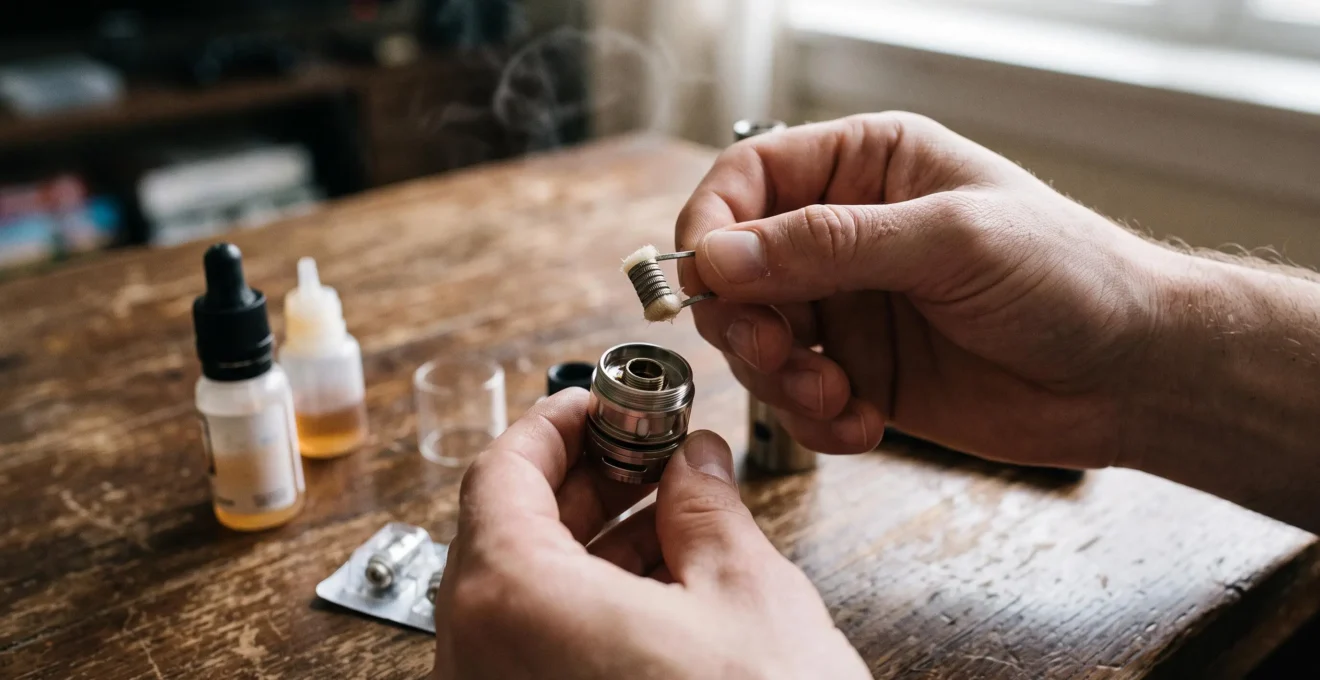
A metallic heating coil is the component that converts electrical energy into heat inside a vape atomizer. Its material, resistance, surface area and thermal mass influence how quickly the device produces aerosol, how consistently it heats e-liquid and how the resulting draw feels and tastes.
Yet the metal itself is only part of the equation. A stainless-steel coil and a Kanthal coil can behave differently, but so can two coils made from the same alloy. Wire thickness, power delivery, airflow, e-liquid composition and wick saturation all affect the temperature reached during operation.
These interactions explain why a coil can deliver acceptable flavour at one power setting but produce harsh, inconsistent draws at another. They also explain why resistance alone cannot reliably predict vapour output or chemical emissions.
Understanding the relationship between the heating element, the wick and the device electronics makes it easier to identify compatibility problems, recognise early signs of deterioration and replace a coil before permanent wick damage occurs. Proper operation can reduce avoidable overheating, although it does not eliminate the health risks associated with vaping aerosols.
Metallic Vape Coils: The Essentials
- Coil material, geometry and applied power jointly determine heating speed and temperature behaviour; no single metal guarantees better flavour.
- Resistance helps identify a coil’s intended operating style, but airflow, wicking capacity and recommended wattage also determine its performance.
- Persistent flavour changes, visible deposits and repeated dry hits are practical reasons to inspect or replace a coil before further deterioration.
- Why Do Different Vape Coil Metals Heat at Different Speeds?
- How Can You Inspect a Vape Coil Before Performance Drops?
- Low-Resistance or Higher-Resistance Coils: Which Better Fits Your Vape Style?
- What Happens When a Vape Coil Runs Too Hot for the Device Setup?
- When Should You Replace a Vape Coil Before It Starts Tasting Burnt?
- Why Does a Vape Taste Burnt When the Wick Cannot Keep Up?
- What Can Happen If You Increase Power Just to Produce More Vapour?
- How Do You Choose and Replace Atomizer Coils Without Shortening Their Lifespan?
Why Do Different Vape Coil Metals Heat at Different Speeds?
Different vape coil metals heat at different rates because they have different electrical resistivities, heat capacities and temperature-dependent resistance properties. However, the metal alone does not determine heating speed. Wire thickness, coil mass, applied power and e-liquid saturation also influence ramp-up time, which is the delay between activating the device and producing aerosol.
Electrical resistivity describes how strongly a material resists current flow. Heat capacity describes how much energy a material needs to increase its temperature. In a vape coil, these properties interact with the wire’s length, cross-sectional area and electrical power supplied by the device.
Kanthal, an iron-chromium-aluminium alloy, has relatively high electrical resistivity and is commonly used in wattage-controlled devices. Nichrome, typically a nickel-chromium alloy, has lower resistivity and is often associated with responsive heating in comparable coil constructions.
Stainless steel offers a combination of mechanical durability, moderate electrical resistivity and measurable resistance changes as temperature rises. These characteristics make suitable stainless-steel grades usable in both power mode and compatible temperature-control systems.
Pure nickel and titanium are principally associated with temperature-control applications. Their electrical resistance changes with temperature in ways that compatible devices can monitor. However, material-specific device settings are essential, and these metals should not be treated as interchangeable with ordinary wattage-mode coils.
Temperature-control electronics estimate coil temperature from changes in electrical resistance. Metals with a sufficiently predictable temperature coefficient of resistance can support this approach when paired with appropriate firmware and coil specifications. Kanthal’s relatively small resistance change makes it generally unsuitable for conventional resistance-based temperature control.
Flavour differences require more caution. Stainless steel is often described as a practical compromise between durability, heating response and flavour fidelity, but this is not proof of superior taste. Metallic or unusual notes can also result from residue, overheating, manufacturing contamination or wick damage rather than the underlying alloy alone.
Experimental research into heating-coil surface chemistry and propylene glycol decomposition found that Kanthal, nichrome and stainless-steel surfaces influenced carbonyl formation under controlled laboratory conditions. These findings concern chemical reactions, not a direct sensory ranking of coil materials.
A thick, high-mass stainless-steel coil may therefore heat more slowly than a thinner Kanthal coil under a particular power setting. Coil geometry and device settings must be considered alongside material before drawing conclusions about ramp-up or flavour.
The next consideration is whether the coil maintains that behaviour after repeated use, when residue and wick condition begin influencing its performance.
How Can You Inspect a Vape Coil Before Performance Drops?
Inspect a vape coil by checking for dark deposits, discoloured heating surfaces, damaged cotton and residue near its airflow openings. Performance changes may also appear before visible deterioration, including muted flavour, irregular vapour delivery or unfamiliar firing sounds. A useful inspection combines a visual check with observations of how the device behaves at its normal settings.
Switch off the device, disconnect it from charging and allow the atomizer to cool before removing any accessible parts. Follow the manufacturer’s disassembly instructions, especially for sealed pods or coil heads that are not designed to be opened.
Look for the following signs:
- Dark, crusty deposits: accumulated e-liquid residue may be covering the heating surface, potentially affecting heat transfer and flavour consistency.
- Discoloured wire or mesh: visible surface changes can indicate thermal exposure or ageing, although colour alone cannot establish whether a coil is defective.
- Browned or blackened cotton: damaged wicking material is a stronger warning sign, particularly when accompanied by a persistent burnt taste.
- Residue around airflow openings: accumulation may interfere with airflow or contribute to irregular draw behaviour.
A controlled laboratory analysis of e-cigarette coil temperatures and metal surfaces observed surface pitting, deposits and compositional changes following repeated experimental heating cycles. These microscopic observations demonstrate that metal surfaces can change with use, but they do not establish a universal visual replacement threshold for commercial coils.
When flavour seems unusually weak, first consider whether the e-liquid has changed, whether the tank is sufficiently filled and whether the battery is delivering the expected power. A different liquid formulation can produce different flavour and vapour characteristics even with a functioning coil.
Likewise, popping and gurgling do not automatically indicate coil failure. These sounds may accompany excess liquid around the heating element or condensation in the airflow path. Persistent flooding, leaks or irregular heating warrant checking the tank assembly and seals.
For a newly installed coil, verify wick saturation before interpreting poor flavour as a manufacturing defect. The cotton must absorb enough liquid before the first activation. Priming instructions vary by design, but allowing the filled coil to saturate is an important initial check.
If the coil appears sound but produces unexpected vapour density, its resistance and intended operating style should be checked before increasing power.
Low-Resistance or Higher-Resistance Coils: Which Better Fits Your Vape Style?
Low-resistance coils are generally associated with higher-power, direct-lung vaping, while higher-resistance coils commonly support lower-power, mouth-to-lung use. Neither category is inherently better. The appropriate choice depends on the device’s supported power range, airflow design, e-liquid formulation and desired draw characteristics, not resistance alone.
Electrical resistance is measured in ohms (Ω). Coils below 1 Ω are commonly described as sub-ohm coils. However, this classification does not by itself establish how much power a coil can safely tolerate or how much aerosol it will produce.
The following comparison describes common design patterns rather than universal specifications.
| Criterion | Low-resistance coils | Higher-resistance coils |
|---|---|---|
| Common resistance category | Below 1 Ω | Often 1 Ω or above |
| Typical draw style | Direct-lung or open restricted direct-lung | Mouth-to-lung or tighter restricted draws |
| Common operating approach | Often designed for higher wattage | Often designed for lower wattage |
| Airflow | Generally more open | Generally more restricted |
| E-liquid compatibility | Frequently paired with higher-VG formulations when specified | Frequently paired with thinner formulations when specified |
| Liquid and battery use | Can be greater in higher-output configurations | Can be lower in lower-output configurations |
VG, or vegetable glycerine, increases an e-liquid’s viscosity relative to formulations containing more propylene glycol (PG). A viscous formulation may replenish certain small wicking channels more slowly. The coil manufacturer’s recommended liquid characteristics therefore matter alongside resistance.
Low-resistance configurations can consume more e-liquid and battery energy per session when operated at higher power. Greater thermal loading may also accelerate residue accumulation or wick deterioration, although coil lifespan depends heavily on the specific design and operating conditions.
0.6 Ω: 13.2 ± 1.0 mg per puff
In one experimental pod configuration, a 0.6 Ω coil operating at 21 W produced this measured aerosol mass. The same study reported 12.3 ± 0.8 mg at 16 W for a 0.8 Ω coil, and 7.4 ± 0.3 mg at 10 W for a 1.2 Ω coil. Because resistance, power and hardware configuration differed, these observations cannot isolate resistance as the sole cause.
Experimental findings from research on coil resistance, ageing and aerosol production, published in Chemical Research in Toxicology in 2023.
The study illustrates why resistance must be interpreted together with operating power. Coil surface area, heat distribution and the wick’s ability to supply liquid are also important. A low-resistance coil operated outside its intended range may perform less consistently than a higher-resistance coil matched correctly to its device.
For selection purposes, begin with the required draw style and the manufacturer’s coil specifications. Then consider whether the expected e-liquid consumption, battery demand and maintenance needs suit the intended usage pattern.
Once those variables are matched, avoiding excessive heat becomes the next priority because even a compatible coil can deteriorate when operated outside suitable conditions.
What Happens When a Vape Coil Runs Too Hot for the Device Setup?
When a vape coil becomes too hot for its device setup and liquid supply, the wick may dry out or char, residues can accumulate more quickly and flavour may become harsh or distorted. Continued overheating can permanently damage the cotton and alter the heating surface, making normal performance difficult to restore even after the tank is refilled.
Overheating is not a single event with one universal temperature threshold. It develops from the balance between electrical energy delivered to the coil and heat removed by the liquid, airflow and surrounding components.
When the wick is adequately saturated, energy is transferred into heating and vaporising the supplied liquid. If the liquid supply cannot keep pace, less energy is carried away through vaporisation and the heating element may reach higher temperatures.
Common causes include:
- Operating a replaceable coil above its manufacturer-rated wattage range.
- Activating the device while the tank is nearly empty or the wick is insufficiently saturated.
- Using an unsuitable power delivery mode or an unregulated device with an incompatible coil configuration.
- Repeatedly activating the coil without allowing sufficient liquid replenishment.
Sweetened e-liquids may leave deposits that darken or thicken during heating. These residues can interfere with the exposed heating surface and contribute to a progressively less accurate flavour profile. Excessive thermal exposure can then cause cotton discolouration, scorching and permanent wick damage.
The consequences are not limited to taste. Higher-temperature or dry-heating conditions can change the chemical composition of generated aerosol. Laboratory investigations have demonstrated that coil materials, surface conditions and operating parameters can affect decomposition products, although experimental outcomes cannot be converted into universal temperature limits for consumer devices.
To assess a possible mismatch, compare the resistance and recommended wattage marked on the coil or its packaging with the device’s supported modes and power settings. A device capable of supplying high wattage does not mean every compatible-looking coil is designed to receive it.
A burnt cotton wick generally cannot be restored by washing the coil. Cleaning may remove some external residue from an appropriate reusable heating element, but it does not reverse charring inside a sealed replaceable coil head.
A damaged coil may consequently make fresh e-liquid taste flat, smoky or unusually harsh. Continued use can obscure the liquid’s original flavour, while attempts to compensate by increasing power may worsen the underlying condition.
The practical question is when these changes justify replacement, ideally before overheating develops into a persistent burnt draw.
When Should You Replace a Vape Coil Before It Starts Tasting Burnt?
Replace a vape coil when flavour remains noticeably altered, vapour delivery becomes consistently irregular or visible deposits and wick discolouration suggest deterioration that ordinary maintenance cannot resolve. There is no universal replacement interval. Coil life depends on e-liquid composition, operating power, usage frequency, wick condition and the design of the replaceable heating element.
Counting calendar days can provide a maintenance reminder, but it does not reliably measure how much thermal or chemical exposure a particular coil has experienced.
Instead, look for changes relative to the coil’s normal performance with the same liquid and settings:
- Persistent flavour loss: accumulated deposits or damaged wicking material may interfere with normal heating and flavour delivery.
- Repeatedly inconsistent vapour: after checking liquid supply, battery level and airflow, persistent changes may indicate a coil-related problem.
- Increasing power requirements: feeling the need to exceed previously adequate settings can be a warning to investigate rather than automatically increase wattage.
- Darkened or damaged cotton: visible scorching, particularly with an abnormal taste, is a strong reason to stop using the coil.
- Recurring dry hits: repeated failures to replenish liquid suggest that the wick or the overall setup is no longer functioning appropriately.
Coil ageing does not necessarily produce a steady decline in aerosol mass. In the previously discussed 2023 experimental research, ageing did not significantly alter measured aerosol mass or coil temperature in the tested configuration, although it affected carbonyl formation. Vapour output therefore cannot serve as a universal indicator of coil condition.
Sweetened or dark-coloured formulations can leave noticeable residues, but liquid colour alone is not a validated measure of coil lifespan. Power settings, how frequently the coil is activated and how effectively the wick remains saturated can all change maintenance needs.
A useful replacement rhythm comes from tracking each installed coil’s starting performance and recording when persistent changes emerge. Compare successive coils under similar conditions rather than applying a fixed schedule borrowed from another device.
Keeping a spare compatible coil available also reduces the temptation to continue using one that produces unpleasant dry hits or degraded flavour. Replacing a damaged component can prevent fresh liquid from being used in an atomizer that no longer delivers its intended performance.
Many apparently premature coil failures begin with inadequate liquid delivery, so understanding the wick is essential before deciding whether a replacement alone will resolve the problem.
Why Does a Vape Taste Burnt When the Wick Cannot Keep Up?
A vape tastes burnt when the heating coil consumes liquid faster than the wick can replenish it, allowing the cotton near the heating surface to become excessively hot. If the cotton scorches, its damaged fibres can produce a persistent burnt note. A temporarily undersaturated wick may recover after replenishment, but genuinely charred cotton usually requires coil replacement.
The wick acts as the liquid transport system. In many replaceable coil heads, cotton draws e-liquid from the surrounding tank towards the metallic heating element through capillary action.
When the coil activates, it heats the liquid held in and around the wick. Continued operation requires new liquid to move into the heated region quickly enough to replace what has been vaporised.
A dry hit occurs when this balance breaks down. The wick may contain too little liquid locally even when the tank itself is not completely empty.
Several usage conditions can contribute:
- Successive activations: repeated draws with insufficient recovery time may temporarily outpace capillary replenishment.
- High power: faster liquid consumption increases demand on the wicking system.
- Unsuitable high-VG liquid: a viscous formulation may move inadequately through channels designed for thinner liquids.
- Insufficient initial saturation: activating a newly installed coil before its cotton is fully wetted can damage the wick during first use.
If an isolated harsh draw suggests temporary undersaturation, stop activating the device. Allow the coil to cool, verify that sufficient compatible e-liquid is present and follow the manufacturer’s saturation instructions before considering another use.
If flavour returns to normal, insufficient liquid delivery may have been temporary. However, an immediately recognisable burnt taste that persists after adequate saturation suggests irreversible scorching.
Continuing to activate a damaged wick is not a reliable recovery technique. Likewise, increasing wattage or repeatedly firing the device without inhaling does not repair charred cotton and may increase thermal damage.
Prevention depends on matching liquid viscosity to the coil, maintaining adequate tank fill and allowing the wick enough opportunity to replenish liquid between activations.
The same liquid-delivery limitation explains why increasing power does not always produce the expected improvement in vapour density.
What Can Happen If You Increase Power Just to Produce More Vapour?
Increasing vape power can raise aerosol output within a coil’s intended operating range, but excessive wattage may overwhelm liquid delivery and cause harsh flavour, dry hits and faster deterioration. Beyond the coil’s effective operating conditions, additional power does not guarantee more usable vapour. It may instead produce hotter, less consistent draws and accelerate thermal damage.
Wattage describes the rate at which the device supplies electrical energy to the heating element. Increasing it generally increases the potential heat input, but actual coil temperature also depends on heat loss and the amount of liquid being vaporised.
At a suitable setting, additional energy may produce more aerosol because the wick delivers enough liquid to support the increased demand. Problems arise when electrical heating begins to exceed the coil’s capacity to transfer that energy into adequately supplied liquid.
The progression can involve several interacting effects:
- Greater power increases the demand for liquid at the heating surface.
- Liquid replenishment becomes insufficient during some activations.
- Local heating conditions become less stable, potentially causing harsh or dry draws.
- Residue accumulation or wick scorching further reduces flavour consistency.
- Repeated unsuitable operation can shorten the useful life of the coil.
More power can therefore produce a counterintuitive result: a draw that feels hotter but fails to deliver the expected increase in satisfying vapour. This is particularly relevant when a coil is already near its liquid-supply limit.
Flavour is also affected by heating conditions. Some volatile flavour compounds may be altered or delivered differently at higher temperatures, while excessive thermal decomposition can introduce undesirable aerosol constituents. Neither flavour intensity nor vapour density alone establishes the chemical safety of a particular setting.
Rather than exceeding the rated power range, check whether adjustable airflow is appropriate, whether the e-liquid suits the coil and whether an alternative manufacturer-compatible coil offers the intended surface area and power specification.
Adjustments should remain within the manufacturer’s instructions. A different coil design can change vapour characteristics, but it also changes the system’s thermal and liquid-delivery requirements.
Reliable performance ultimately depends on choosing the correct replacement component and preparing it properly before its first activation.
Key Takeaways Before Replacing a Coil
- Verify the exact coil model and its supported operating specifications rather than choosing by resistance or brand alone.
- Treat the wick and heating element as a combined system: correct power cannot compensate for inadequate liquid delivery.
- Use the coil’s normal flavour and draw characteristics as a maintenance reference, and investigate persistent changes before increasing power.
How Do You Choose and Replace Atomizer Coils Without Shortening Their Lifespan?
Choose a replacement atomizer coil by confirming its compatibility with the exact device or tank, operating mode, resistance range and intended e-liquid. To avoid premature damage, prepare the wick according to manufacturer instructions, allow adequate saturation and begin at the lower end of the recommended power range. Regular inspection and correct liquid levels help maintain consistent operation.
A coil that physically fits into a tank is not necessarily suitable for every supported device setting. Coil families can include different resistances, heating structures and recommended power ranges, even when the external components look similar.
Before installing a replacement, compare its model designation with the tank’s compatibility list. Then check the stated resistance, supported control mode and recommended wattage.
Also consider the established draw style and liquid formulation. A coil intended for a relatively open, higher-power draw may not perform as designed in a restrictive airflow setup or with a liquid that cannot reach its heating surface sufficiently quickly.
Manufacturer documentation provides an appropriate starting point for installation. For example, Innokin‘s official device maintenance instructions describe applying two to three drops of e-liquid to the wicking holes of applicable coils, allowing ten minutes for saturation after filling and starting variable-power devices at the low end of the coil’s recommended range. These instructions apply to compatible equipment and should not be assumed suitable for every coil design.
Five Checks for a Correct Coil Replacement
- Confirm compatibility: identify the device and tank models, then record the exact replacement coil designation from the manufacturer’s compatibility information.
- Check electrical specifications: compare the coil’s labelled resistance, wattage range and supported operating mode with the device, and verify that the combination is permitted.
- Prepare the wick: follow the coil-specific priming directions, fill the tank with compatible e-liquid and confirm that the manufacturer’s prescribed saturation period has elapsed.
- Verify initial settings: if variable power is supported, begin at the low end of the recommended wattage range and make only manufacturer-permitted gradual adjustments, recording the chosen setting.
- Establish a baseline: note the initial flavour, vapour consistency and operating settings so that future performance changes can be recognised without relying on an arbitrary replacement interval.
Routine maintenance also matters after installation. Keep sufficient liquid in the tank to supply the wicking openings during use, and store the device in accordance with its manual to reduce leakage and avoid prolonged inappropriate storage conditions.
Inspect accessible airflow passages and tank components when replacing a coil. Cleaning procedures should follow the manufacturer’s instructions; sealed disposable coil heads should not be dismantled or dry-fired in an attempt to restore damaged cotton.
For devices used intermittently, check that the liquid level and wick condition are appropriate before reactivation, particularly after storage. Visible leakage, unexpected resistance readings or abnormal heating should prompt inspection and, where necessary, discontinuation of use until the problem is resolved.
The most useful maintenance habit is consistency: use compatible components, remain within rated settings and respond to abnormal flavour or device behaviour before further stressing the heating element.
For the next coil change, check the device manual, record the coil’s stated electrical limits and follow its saturation instructions before activation. This gives the replacement a suitable operating starting point without assuming that any particular metal or resistance guarantees superior flavour or performance.
Can a vape coil’s metal change the chemical composition of the aerosol?
Yes. Experimental research indicates that heating-element materials and surface conditions can influence chemical reactions involving e-liquid constituents. However, measured effects depend on temperature, electrical power, liquid formulation and test conditions. Such findings do not establish that one metallic coil material is universally safer than another.
Can stainless-steel vape coils work in both wattage and temperature-control modes?
Some stainless-steel coils can operate in both modes, provided the specific alloy, coil construction and device electronics support them. Temperature-control compatibility must be confirmed from the manufacturer’s specifications rather than inferred from the words « stainless steel » alone.
Does a metallic taste always mean the heating coil is damaged?
No. An unusual taste may be associated with residue, contamination, e-liquid changes, incorrect operating conditions or a deteriorated coil. Taste alone cannot establish that metal is being released into the aerosol. A persistent unexplained taste warrants stopping use and inspecting the device and coil for compatibility, contamination or damage.
Is it possible to clean a replaceable coil instead of replacing it?
Some accessible, reusable heating elements can be maintained according to their design, but most sealed replaceable coil heads contain cotton that cannot be restored after scorching. Washing or removing surface deposits does not necessarily eliminate embedded residues or reverse wick damage. Follow the manufacturer’s cleaning and replacement instructions.
Does a coil that still produces vapour necessarily remain in good condition?
No. Aerosol production may remain relatively stable even while other aspects of coil condition or aerosol chemistry change. The experimental ageing research discussed above found changes in carbonyl formation without a significant corresponding change in aerosol mass in the tested configuration. Vapour production should therefore be considered alongside wick condition, flavour changes and device operation.