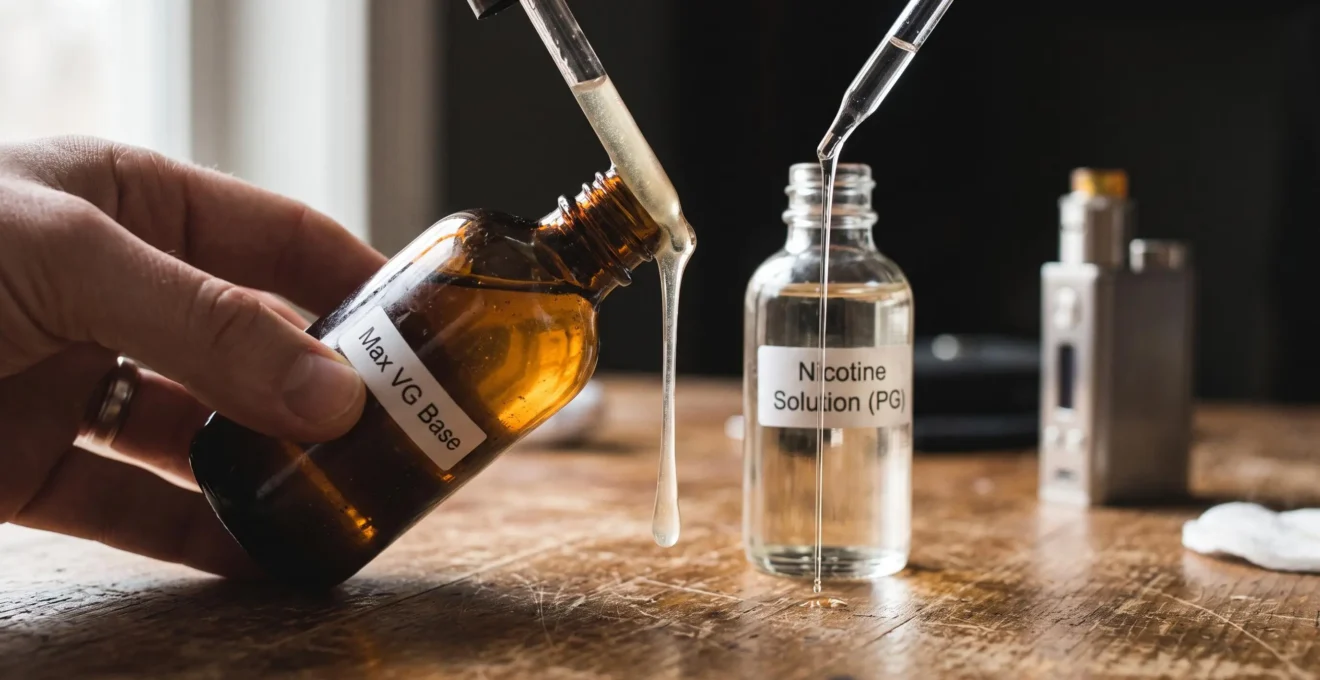
Vegetable glycerin (VG) affects two important characteristics of e-liquid: how easily it moves through a vape coil’s wick and how much aerosol the device can produce. Increasing the VG proportion generally makes an e-liquid thicker and can increase aerosol output under suitable operating conditions. However, thicker liquid also moves more slowly through narrow wicking channels, potentially limiting performance in devices that cannot replenish their coils quickly enough.
Propylene glycol (PG), the other main base ingredient, is considerably less viscous. This difference explains why a balanced 50/50 VG/PG blend is often associated with compact, lower-powered devices, while higher-VG formulations are commonly used in more powerful systems designed for greater liquid consumption.
Neither ratio is universally better. Coil construction, available power, airflow, temperature and the manufacturer’s specifications all influence compatibility. Understanding how these factors interact helps adult users assess an existing device without assuming that more VG automatically means better performance.
Vegetable glycerin and e-liquid performance at a glance
- Higher VG content increases viscosity, which can slow liquid delivery through narrow coil wicks and increase the likelihood of dry hits when replenishment is inadequate.
- VG-rich formulations can produce greater aerosol mass under suitable conditions, but coil design, heating conditions and airflow also determine visible cloud production.
- Choose a VG/PG ratio according to the manufacturer’s guidance, coil construction and vaping style rather than the device’s size or resistance alone.
- Why Can High-VG E-Liquid Struggle in Some Small Pod Systems?
- How Can You Match VG Content to Your Coil and Vape Device?
- High VG or 50/50 E-Liquid: Which Better Fits Your Device?
- What Problems Can Thick VG E-Liquid Cause in a Small Coil?
- When Can Cold Weather Make High-VG E-Liquid Harder to Vape?
- Thinner or Thicker E-Liquid: Which Wicks More Easily Through a Coil?
- Why Do Some Vape Setups Produce Much Larger Clouds Than Others?
- What Makes a Vape Produce Denser Vapour Without Sacrificing Consistency?
Why Can High-VG E-Liquid Struggle in Some Small Pod Systems?
High-VG e-liquid can struggle in some small pod systems because its greater viscosity slows movement through narrow wicking channels. If the coil consumes liquid faster than the wick can replenish it, parts of the heating element may become insufficiently saturated. This can cause intermittent dry hits, uneven flavour and reduced performance, particularly during repeated puffs.
A vape coil depends on capillary action: liquid travels from the reservoir into a porous wick and reaches a heated surface. Viscosity affects the resistance encountered during this movement. The Scientific Reports study of capillary evaporation in e-cigarette wicks examined how liquid composition, wick porosity and electrical power influence this process.
Small pods can face two separate constraints. The first is liquid supply: narrow feed openings, restricted wick geometry or a densely packed absorbent material may limit replenishment. The second is the device’s heating and airflow configuration. A low-powered coil may be optimised for a particular evaporation rate rather than the liquid consumption associated with a different formulation.
Warning signs can include an occasional burnt taste, declining aerosol output during successive puffs or unusually slow liquid movement inside the reservoir. Pulling harder is not a reliable solution: it does not necessarily improve capillary supply and may alter the device’s intended airflow conditions.
A practical initial check is to ensure the reservoir contains sufficient liquid, allow the wick to saturate according to the manufacturer’s instructions and observe whether performance deteriorates during normal use. A burnt taste is a reason to stop activating the coil rather than repeatedly testing it.
Importantly, compact size does not automatically mean high-VG incompatibility. Some devices have wider feed channels or wick structures designed for thicker formulations. The geometry of the liquid supply system matters more than appearance alone.
The next step is to interpret the coil and device specifications together, rather than using the VG percentage as an isolated compatibility test.
How Can You Match VG Content to Your Coil and Vape Device?
Match VG content to a vape device by checking its supported coil types, recommended power range, airflow configuration and e-liquid guidance. Higher-resistance mouth-to-lung coils often use more fluid formulations, while some lower-resistance direct-to-lung systems accommodate thicker liquids. These are useful starting patterns, not universal rules: wick construction and manufacturer recommendations remain decisive.
Coil resistance provides context about the device’s intended electrical operating conditions. Higher-resistance coils are frequently paired with lower power and restricted airflow. Lower-resistance coils may operate at higher power with more open airflow and greater liquid consumption. However, resistance does not directly measure wick permeability, so it cannot establish an exact VG/PG ratio by itself.
Use three connected criteria when evaluating compatibility:
| Device characteristic | Typical implication | What to verify |
|---|---|---|
| Higher-resistance coil | Often used with thinner liquids and lower power | Manufacturer’s recommended liquid ratio and coil design |
| Lower-resistance coil | May support greater liquid consumption and higher VG content | Liquid feed capacity and stated power range |
| Restricted MTL airflow | Commonly associated with modest aerosol output | Whether the specific atomizer supports thicker formulations |
| Open DTL airflow | Often accompanies systems designed for higher aerosol output | Recommended e-liquid composition and compatible coil |
| Wick and liquid channels | Determine how readily liquid reaches the heating element | Coil-specific compatibility and manufacturer documentation |
Manufacturer specifications may explicitly state a supported VG/PG ratio. When they provide only resistance and wattage, those figures identify operating limits but do not establish a guaranteed liquid ratio. Look for the coil’s intended vaping style, replacement-coil documentation and any specific guidance on liquid viscosity.
Manufacturer example: an MTL atomizer supporting different ratios
Innokin identifies its Ares Finale as a rebuildable atomizer primarily intended for mouth-to-lung vaping. Nevertheless, its Ares Finale support documentation states that the atomizer can work with both 50VG/50PG and 70VG/30PG e-liquids.
The manufacturer also explains that performance can differ between individual coil builds. This example demonstrates why vaping style or resistance alone cannot determine compatibility across all devices.
After fitting a new compatible coil, follow the specified priming and waiting instructions. Observe whether the wick becomes adequately saturated and whether normal operation remains consistent. Slow movement visible in a bottle or tank can suggest higher viscosity, but it does not prove that the internal wick is inadequately saturated.
If a liquid repeatedly fails to supply an otherwise correctly installed and functioning coil, a formulation with more PG may be worth considering, provided the device manufacturer permits it.
This device-first approach also clarifies the practical differences between common 50/50 blends and high-VG liquids.
High VG or 50/50 E-Liquid: Which Better Fits Your Device?
A 50/50 VG/PG e-liquid is often better suited to compact, lower-powered systems that benefit from relatively fluid liquid, while high-VG blends are commonly associated with devices designed for greater liquid supply and aerosol production. The choice also affects throat sensation and maintenance requirements. Neither formulation is automatically preferable without considering the coil’s specifications and intended operating conditions.
The central distinction is viscosity. A 50/50 blend generally moves more easily through narrow channels than a 70VG/30PG or more VG-rich formulation. Conversely, a system designed around thicker liquid may experience oversupply, flooding or leakage when used with an excessively thin formulation.
The two categories also differ in their potential aerosol characteristics. VG-rich liquids can produce greater aerosol mass in suitable atomizers, whereas PG-rich formulations are commonly associated with a more pronounced throat sensation. Actual results vary with formulation, nicotine content, airflow and hardware.
| Comparison | 50/50 VG/PG | High VG, such as 70VG/30PG |
|---|---|---|
| Viscosity | Relatively fluid | Thicker and generally slower-flowing |
| Wick replenishment | Often easier through narrow channels | Requires adequate liquid-feed capacity |
| Aerosol production | Depends on device operating conditions | Can increase aerosol mass in compatible setups |
| Throat sensation | Typically more PG-related throat sensation | Often a softer PG-related throat sensation |
| Typical device association | Many MTL pods and lower-powered coils | Many higher-powered DTL and sub-ohm setups |
| Potential mismatch | Flooding or leakage in some high-flow coils | Insufficient wicking in restrictive coils |
Intermediate formulations can make the choice less binary. A 60VG/40PG blend is somewhat more viscous than 50/50, while 70VG/30PG moves further towards the high-VG category. They are not guaranteed compromises: a device that specifies 50/50 should not be assumed to support 70/30 merely because a 60/40 formulation exists.
Coil maintenance deserves attention as well. Deposits can accumulate on heated surfaces and affect flavour or aerosol output. However, coil fouling cannot reliably be attributed to VG concentration alone. Flavourings, added sweeteners, thermal conditions and usage patterns can also influence deposit formation and replacement frequency.
Consequently, lifetime running costs may depend on how often a particular liquid and coil combination requires replacement, not simply on the bottle’s purchase price.
When the selected liquid exceeds a coil’s ability to replenish its wick, the consequences become particularly apparent in small heating assemblies.
What Problems Can Thick VG E-Liquid Cause in a Small Coil?
Thick VG-rich e-liquid can contribute to dry hits, irregular aerosol output and premature wick damage when a small coil cannot replenish liquid quickly enough. Insufficient saturation leaves areas of the heating element exposed to excessive local heating. Deposits and declining performance can also develop over time, although these problems are influenced by formulation and operating conditions rather than VG alone.
Under normal operation, the wick continuously delivers liquid to the heated coil. If replenishment falls behind evaporation, the remaining liquid becomes unevenly distributed. Localised dry areas can reach damaging conditions, resulting in unpleasant flavour and deterioration of the absorbent material.
A 2024 experimental study, described in the PubMed record of a study on e-cigarette dry hits, compared saturated-wick operation with dry-hit conditions. Researchers observed thermal decomposition of cotton wicking material after dry hitting and increased cytotoxicity under the tested in vitro exposure conditions.
The experimental formulation was not a high-VG comparison, so the findings do not establish that VG specifically caused the observed damage. They do demonstrate why insufficient liquid supply is a more serious concern than a temporary reduction in visible vapour.
Two performance problems should be distinguished. Insufficient wicking occurs when liquid cannot reach the heating surface quickly enough. A separate issue arises when the coil’s thermal output and airflow are poorly matched to its intended operating conditions. Reduced vapour alone cannot distinguish these causes, and a liquid’s viscosity does not independently determine whether it can evaporate at a given power.
Another potential problem is coil fouling, sometimes called gunking. Dark deposits on the heating surface can accompany declining flavour and aerosol production. Although some residues may result from thermal reactions involving e-liquid ingredients, describing them specifically as VG caramelisation would oversimplify the chemistry. Sweeteners and flavouring compounds can be important contributors.
For troubleshooting, begin with the manufacturer’s priming and liquid-level guidance. Avoid repeated activation after a burnt sensation, and check whether the coil has exceeded its recommended operating conditions. If a compatible coil continues to taste burnt after appropriate saturation, replacement may be necessary. A reduction in power may help only where the manufacturer supports adjustment within the specified operating range.
Even a normally compatible high-VG liquid may become harder to supply when the surrounding temperature falls.
When Can Cold Weather Make High-VG E-Liquid Harder to Vape?
Cold weather can make high-VG e-liquid harder to use because vegetable glycerin becomes more viscous as temperature falls. This increased thickness slows movement through wicks and narrow liquid channels, potentially reducing coil replenishment. A device that performs consistently indoors may therefore show intermittent dry hits or weaker aerosol production after exposure to winter conditions.
The relationship between temperature and viscosity is especially relevant to VG-rich formulations, which are already thicker than comparable PG-rich mixtures at ordinary room temperatures. Cooling increases resistance to flow, while the coil’s liquid demand may remain similar when the device is activated.
Common situations include leaving a device in a cold vehicle, carrying it outdoors for extended periods or storing refill bottles in an unheated room. The liquid may move noticeably more slowly in its container, although this visible behaviour is only an indication of viscosity rather than a direct measurement of wick saturation.
Typical warning signs include slower liquid flow, reduced vapour output and a burnt sensation that appears after the device has been exposed to colder conditions. Nevertheless, these symptoms are not exclusive to temperature-related viscosity changes. Coil wear, inadequate liquid levels and electrical problems may produce overlapping effects.
When a refill bottle has become cold, the straightforward precaution is to let it return gradually to a normal indoor temperature before use. Avoid microwaves, radiators and direct heat sources, which can create uncontrolled heating and unnecessary risks for the formulation and its container.
Coils should still be primed according to the manufacturer’s instructions. Additional time may be needed for a cold, viscous formulation, but no universal waiting period can be inferred from VG percentage alone.
If cold-weather compatibility remains an issue, a more balanced VG/PG formulation may be suitable where the device’s specifications allow it. Changing the ratio is preferable to forcing an inadequately saturated coil to operate.
Temperature is one influence on viscosity; the next distinction is how liquid thickness interacts with the physical construction of the wick.
Thinner or Thicker E-Liquid: Which Wicks More Easily Through a Coil?
Thinner e-liquid generally moves more readily through a coil’s porous wick than thicker e-liquid, assuming comparable wick construction and operating conditions. PG-rich mixtures tend to be less viscous than VG-rich ones, so they can replenish narrow liquid channels more easily. However, faster movement is not always better: excessive liquid supply can cause flooding or leakage in an unsuitable device.
Wicking is a capillary transport process. The spaces between cotton fibres or within another porous material draw liquid towards the heating surface. Viscosity resists this movement, while the wick’s pore structure, wetting characteristics and channel geometry influence how quickly liquid can travel.
A short, adequately supplied wick may handle a thicker formulation differently from a long, densely packed wick connected to narrow feed openings. Consequently, two coils using identical e-liquid can demonstrate different replenishment behaviour.
Mesh heating elements also need to be considered as part of the complete assembly. A larger heating surface may distribute heat differently, but the surrounding wick must still deliver sufficient liquid across that surface. The word « mesh » alone does not guarantee high-VG compatibility.
A simple observation can help identify relative fluidity. When comparing appropriately stored bottles at similar temperatures, a thicker liquid may move more slowly when the container is gently tilted. This is a rough visual indication rather than a calibrated viscosity test, and it cannot establish how the liquid will behave inside a particular coil.
Similarly, liquid movement through a tank window is not a validated measurement of internal wick saturation. Actual compatibility depends on the match between supply and consumption, not on achieving the fastest possible flow.
Where the feed channels are comparatively large, an overly thin liquid may reach the heating chamber faster than the coil can manage it under certain conditions, contributing to flooding or leakage. This illustrates why selecting the lowest-viscosity formulation is not a universal solution.
Once liquid delivery is adequate, differences in heating and airflow help explain why some devices generate much greater visible aerosol than others.
Why Do Some Vape Setups Produce Much Larger Clouds Than Others?
Some vape setups produce larger visible clouds because they combine suitable e-liquid composition with greater aerosol generation, effective liquid replenishment and airflow designed to carry aerosol away from the coil. Higher VG content can increase aerosol mass under certain conditions, but power, atomizer construction, operating temperature and puff characteristics also influence the result. VG percentage alone cannot predict cloud size.
Cloud production is a system-level outcome rather than a single ingredient property. Heating generates aerosol from the supplied liquid, while airflow transports and mixes that aerosol with incoming air. The interaction among liquid supply, heating conditions and airflow determines both output and consistency.
Laboratory research on high-power electronic nicotine delivery systems has investigated these interactions. A study of e-cigarette aerosol characteristics and PG/VG ratios found that aerosol mass generally increased as PG content decreased for most tested atomizers under the reported temperature conditions. Results also depended on atomizer configuration and temperature, preventing a universal cloud-volume prediction.
Power influences the rate at which a heating element transfers energy to liquid. However, increasing power without sufficient replenishment may produce excessive local heating instead of reliably increasing usable aerosol output.
Resistance also needs context. Lower-resistance coils are often found in systems intended for greater power, but resistance alone does not determine aerosol production. Coil surface area, electrical control, wick design and liquid availability all influence the outcome.
Airflow is another essential variable. More open airflow can support an operating configuration designed for greater aerosol output, while restricted airflow is commonly associated with smaller, more concentrated puffs. Excessive airflow, however, may dilute the visible plume rather than simply making it denser.
Throat sensation and flavour perception can change alongside these adjustments. PG content, nicotine, flavour formulation, temperature and aerosol delivery interact, so larger clouds should not automatically be interpreted as either stronger or weaker flavour.
Finally, visible cloud size is not identical to aerosol mass. Ambient temperature, humidity, dilution and puff duration can change how a plume looks. Two configurations producing similar aerosol quantities may therefore appear different in different environments.
Higher aerosol output should not be mistaken for greater safety or product quality. More aerosol can also mean greater exposure to its constituents, depending on the formulation and use conditions.
The practical objective is not simply to maximise output, but to maintain consistent liquid delivery and thermal operation without dry hits or overheating.
Key considerations before adjusting vapour density
- Check liquid supply and coil condition before interpreting reduced aerosol as a need for additional power.
- Keep the VG/PG ratio, airflow configuration and operating power within the device manufacturer’s supported conditions.
- Judge consistency across normal operation rather than relying on the appearance of a single large cloud.
What Makes a Vape Produce Denser Vapour Without Sacrificing Consistency?
Consistent vapour density depends on maintaining an appropriate balance between liquid replenishment, coil heating and airflow throughout normal operation. Higher VG content or additional power may increase aerosol output in a compatible setup, but neither adjustment guarantees stable performance. A properly saturated coil operating within manufacturer specifications is more important than pursuing the highest possible wattage.
Consistency means that successive puffs produce reasonably stable aerosol output and flavour without developing dry or burnt sensations. When the wick replenishes liquid at an adequate rate and thermal conditions remain controlled, the system is less likely to experience sudden performance changes.
Before changing settings, identify the device’s operating limits. A coil’s recommended wattage range is a boundary for intended use, not an instruction to operate continuously at its maximum. Changes outside that range may increase thermal stress or make liquid replenishment inadequate.
For devices offering supported adjustments, assess existing settings first. Airflow should match the coil’s intended vaping style, while any power changes should remain within the specified range. A higher-VG formulation should only be considered when manufacturer guidance supports it.
Maintenance is equally important. A low reservoir level can restrict liquid access in some designs. A worn or fouled coil can reduce performance, while poor electrical contacts may interfere with reliable operation. These issues should be ruled out before attributing every variation to the VG/PG ratio.
Five checks for consistent coil and e-liquid performance
- Confirm the coil model. Record the exact coil or cartridge identification and its manufacturer-stated compatibility requirements.
- Check the e-liquid composition. Read the bottle’s VG/PG ratio and note whether it falls within the device’s stated recommendations.
- Verify the operating configuration. Record the current power setting, if adjustable, and confirm that it stays within the coil’s documented range.
- Inspect the liquid supply. Confirm that the reservoir is sufficiently filled and that the coil has been primed according to the manufacturer’s instructions; note any persistent burnt taste or leakage.
- Make a compatibility decision. Identify whether to retain the current setup, replace a damaged coil or select a manufacturer-supported e-liquid ratio, without repeatedly operating a coil that tastes burnt.
These checks help distinguish issues that can reasonably be addressed through normal maintenance from those requiring a different compatible formulation or replacement component. They are not a laboratory method for measuring aerosol mass or proving coil saturation.
Excessive heating should never be treated as a shortcut to improved performance. A stable, moderately operated system may provide more reliable output than one repeatedly pushed to the edge of its supported conditions.
Before selecting a replacement e-liquid, compare its stated VG/PG composition with the exact coil manufacturer’s guidance, then prioritise adequate wicking, normal maintenance and operation within the specified settings.
Does a higher VG percentage always mean more visible vapour?
No. Higher VG content can increase aerosol mass under suitable conditions, but visible output also depends on the atomizer, temperature, airflow and puff characteristics. A device unable to supply high-VG liquid adequately may produce less consistent aerosol rather than larger clouds.
Can a 70VG/30PG e-liquid be used in an MTL atomizer?
Some MTL atomizers support 70VG/30PG e-liquid, while others are intended for thinner formulations. Innokin’s Ares Finale is one documented example of an MTL-focused atomizer compatible with both 50/50 and 70VG/30PG liquids. Its compatibility does not establish the same capability for unrelated devices.
Is VG percentage the same as e-liquid viscosity?
No. VG percentage describes formulation composition, while viscosity is a physical property describing resistance to flow. Increasing VG generally increases viscosity in comparable VG/PG mixtures, but temperature and other ingredients also influence how thick the finished e-liquid behaves.
Does thick e-liquid necessarily shorten coil life?
Not necessarily. Thick liquid may contribute to insufficient wicking in an incompatible coil, but coil longevity also depends on heating conditions, flavourings, sweeteners, liquid supply and maintenance. A darkened coil cannot be reliably diagnosed as damaged specifically by VG without further evidence.
Does producing denser vapour make an e-liquid safer?
No. Visible vapour density is not a measure of safety. E-cigarette aerosol can contain nicotine and other potentially harmful substances, and exposure depends on the formulation, device and operating conditions. Greater cloud production should not be interpreted as reduced health risk.