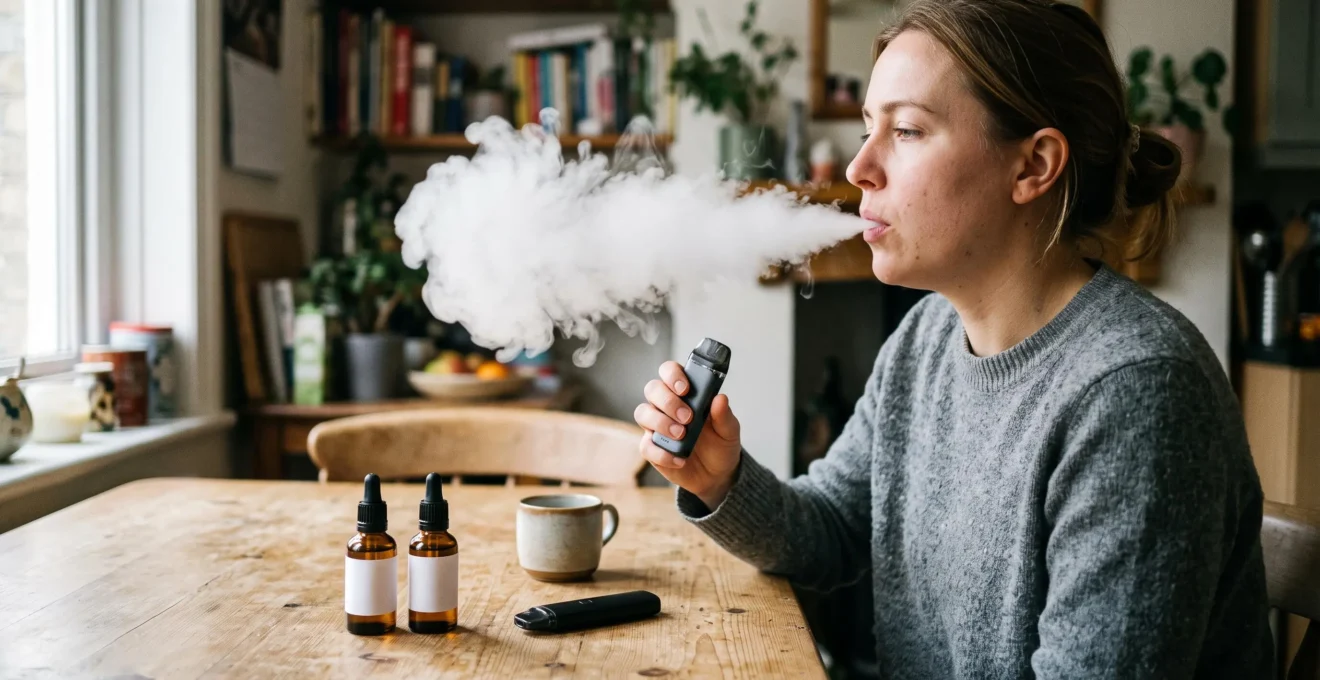
A vape throat hit is the sensation felt in the throat when inhaling aerosol from an electronic cigarette. It can range from a mild, barely noticeable feeling to a pronounced catch resembling part of the sensation associated with cigarette smoke. The strength of that sensation depends on more than the nicotine concentration printed on an e-liquid bottle.
Nicotine chemistry, propylene glycol (PG), vegetable glycerin (VG), flavorings, device power, airflow and inhalation technique all influence how vaping feels. Coil condition also matters: a worn or poorly saturated wick can introduce unpleasant harshness that should not be confused with a normal throat hit.
For adult smokers transitioning away from cigarettes and existing vapers comparing liquids or devices, the useful distinction is between a noticeable throat sensation and unwanted irritation. A stronger hit does not necessarily indicate more nicotine delivery, and a smoother aerosol is not necessarily safer. Understanding the variables makes it easier to identify what has changed without adjusting several settings unnecessarily.
Vape throat hit: the essentials
- Nicotine formulation matters: freebase nicotine generally feels sharper than comparable nicotine salt formulations, even at similar labeled concentrations.
- PG/VG composition, device power, airflow and inhalation patterns influence throat sensation, but their effects are not always predictable from a single setting.
- Sudden harshness, burnt flavor or persistent coughing may indicate a coil problem, unsuitable liquid or irritation rather than a desirable nicotine effect.
- Why Can Two E-Liquids with Similar Nicotine Levels Feel Completely Different?
- How Can You Reduce an Overly Harsh Throat Hit Without Changing Devices?
- Strong or Smooth Throat Hit: Which Feels More Natural to Former Smokers?
- What Vape Problems Can Make a Normal Throat Hit Feel Unusually Harsh?
- When Should You Change E-Liquid or Coil Because the Throat Hit Feels Wrong?
- What Should You Consider If High-PG E-Liquid Feels Too Harsh?
- Which Setup Mistakes Can Make an MTL Vape Feel Weak or Uncomfortable?
- How Does Freebase Nicotine Affect Vape Sensation and E-Liquid Choice?
Why Can Two E-Liquids with Similar Nicotine Levels Feel Completely Different?
Two e-liquids with the same nicotine concentration can produce noticeably different throat hits because nicotine strength is only one part of aerosol sensation. Freebase nicotine generally produces a sharper feeling than nicotine salts, while PG/VG composition, flavorings, device power and inhalation technique can further change perceived harshness.
A bottle labeled 6 mg/mL identifies its nominal nicotine concentration, not the intensity of the sensation it will create. Nicotine’s chemical form affects how it interacts with the mouth and throat. Freebase nicotine is relatively alkaline, while nicotine salts contain protonated nicotine produced through an acid-based formulation.
In a JAMA Network Open randomized trial comparing nicotine salts and freebase nicotine, 119 adults evaluated formulations with comparable nicotine concentrations using a pod-style device. Nicotine salts received lower average harshness ratings than freebase nicotine, despite closely matched liquid characteristics.
36.0 versus 56.9
Average harshness ratings on a 0–100 scale for nicotine salts and freebase nicotine, respectively. The trial evaluated formulations averaging approximately 23.6 mg/mL, so the results should not be treated as measured differences between commercial 6 mg/mL liquids.
JAMA Network Open, randomized clinical trial, 2021.
Nicotine-related sensation also differs from the irritation associated with warm aerosol, certain flavor ingredients or a drying sensation in the throat. A sharp but consistent feeling may reflect the formulation, whereas scratchiness accompanied by a burnt taste suggests a different problem.
Device configuration adds another variable. The same liquid can behave differently in a low-power mouth-to-lung (MTL) pod and a higher-power direct-to-lung (DTL) device because their aerosol production and inhalation conditions differ.
To compare two liquids meaningfully, use a compatible device with consistent settings and inhalation patterns, changing only the liquid between comparisons. Allow for normal coil saturation and avoid drawing conclusions from a damaged coil.
The same number on two bottles does not guarantee the same experience. Establishing which variable differs is the first step toward understanding unwanted harshness.
How Can You Reduce an Overly Harsh Throat Hit Without Changing Devices?
An overly harsh vape throat hit may become less uncomfortable by correcting excessive power, checking coil saturation, adjusting the PG/VG balance or choosing a different nicotine formulation. The safest troubleshooting approach is to stop when irritation occurs, inspect the device and change one relevant variable at a time rather than attempting to tolerate the discomfort.
Begin with the operating conditions. If the device has adjustable wattage, confirm that it is within the coil manufacturer’s specified range. For an adjustable device already operating correctly, a lower compatible power setting may reduce aerosol intensity and temperature-related discomfort. Avoid increasing power to compensate for weak vapor when the cause is uncertain.
Liquid composition provides another option. A higher VG proportion may feel smoother in some setups, although the relationship between PG/VG ratio and throat sensation is not universal. Thicker liquids also need to wick properly, so a change in formulation must remain compatible with the device.
Nicotine formulation can also influence comfort. Nicotine salts frequently feel less harsh than freebase formulations at comparable concentrations, but smoother inhalation does not mean lower nicotine exposure. Reducing nicotine concentration is another option when the current strength feels excessive, although the appropriate concentration also depends on the user’s nicotine needs and smoking history.
Other possible contributors include:
- Worn or burnt coils: damaged wick material can create an acrid sensation that liquid changes will not solve.
- Insufficient saturation: a newly installed coil needs the manufacturer-recommended priming or soaking procedure.
- Repeated or prolonged puffs: these can increase demand on the wick and alter aerosol conditions.
- Flavor ingredients: cooling agents, menthol and some cinnamon or citrus formulations may produce sensations perceived as unusually intense.
One practical approach is to record the current nicotine formulation, PG/VG ratio, coil, power setting and noticeable symptoms before making a change. This establishes a baseline without requiring multiple new purchases.
Persistent throat irritation, recurring cough or pain should not be treated as a device-tuning challenge. Stop vaping and seek medical advice when symptoms continue, worsen or become concerning. Breathing difficulty requires prompt medical attention.
Reducing an uncomfortable hit is not simply a matter of making vapor feel weaker. The aim is to identify whether liquid composition, normal device operation or a developing fault explains the experience.
Strong or Smooth Throat Hit: Which Feels More Natural to Former Smokers?
Some former smokers find a noticeable throat hit more familiar because cigarette smoking involves distinct physical sensations in the mouth and throat. Others prefer a smoother vape, particularly when sharp inhalation causes coughing or discomfort. Neither preference is universal, and familiarity with cigarette smoke should not be confused with nicotine satisfaction or reduced health risk.
The sensation of smoking is shaped by several factors, including smoke composition, temperature, inhalation behavior and nicotine exposure. Electronic cigarettes generate aerosol rather than tobacco smoke, so even a pronounced throat hit is not an exact reproduction of smoking.
A former smoker may interpret an extremely mild vape as unfamiliar or unsatisfying despite receiving nicotine. Conversely, a stronger hit may cause discomfort without improving satisfaction. The important distinction is between a sensation that feels familiar and an irritating experience that the user feels compelled to endure.
Smoking history and inhalation habits can provide a starting point for comparing sensations, but they cannot reliably predict an individual’s preferred formulation. A person accustomed to drawing cigarette smoke into the mouth before inhaling may find an MTL device familiar. Someone with different inhalation habits may respond differently to the same airflow and aerosol intensity.
The following comparison highlights practical differences rather than fixed user categories.
| Consideration | Stronger throat hit | Smoother throat hit |
|---|---|---|
| Typical sensation | More noticeable catch or sharpness in the throat | Less pronounced throat impact |
| Potential appeal | May feel familiar to some former smokers | May suit users bothered by harshness |
| Possible formulation | Freebase nicotine may contribute to sharper sensation | Nicotine salts may reduce perceived harshness |
| Main limitation | Excessive intensity can cause discomfort | Smoothness can conceal a relatively high nicotine concentration |
| Health interpretation | Strong sensation does not prove adequate nicotine delivery | Smooth sensation does not establish lower exposure or risk |
Preferences can also change as someone becomes more accustomed to vaping. A sensation that initially seems too subtle may later feel acceptable, while a formerly familiar sharp hit may become unnecessary or irritating. There is no evidence-based timetable requiring these preferences to change after a particular number of weeks.
For adult smokers considering vaping as a substitute for cigarettes, the broader objective matters more than reproducing throat irritation. Avoiding continued cigarette smoking is more important than achieving an exact sensory match, and vaping itself is not risk-free.
The preferred intensity remains personal, but unexpectedly aggressive harshness warrants troubleshooting rather than acceptance as part of the transition.
What Vape Problems Can Make a Normal Throat Hit Feel Unusually Harsh?
A normally comfortable vape can become unusually harsh when a coil deteriorates, the wick is insufficiently saturated, power exceeds the coil’s operating range or liquid supply becomes inconsistent. These faults can produce burnt, dry or irritating aerosol sensations that resemble an excessively strong throat hit but are not necessarily caused by nicotine concentration.
A dry hit occurs when the wick cannot supply enough liquid for normal aerosol generation. This may happen with an inadequately primed replacement coil, an almost empty tank, an unsuitable liquid viscosity or repeated puffs that outpace the wick’s replenishment.
Dry-hit conditions deserve particular attention because the problem is not limited to taste. A 2024 Toxicology study on dry-hit aerosol toxicity compared aerosols produced under dry-hit and saturated-wick conditions. Researchers observed increased cytotoxicity in cultured lung cells exposed to dry-hit aerosol, along with thermal deterioration of cotton wick material.
The experiment cannot quantify long-term human health effects across commercial vaping devices. It does, however, support avoiding dry-hit operation rather than treating its harshness as an ordinary nicotine sensation.
Coil wear may develop gradually rather than causing an immediate burnt taste. Changes in flavor, aerosol production and throat sensation can appear together, although none is a precise diagnostic test on its own. Darkened cotton may indicate accumulated residue, but appearance alone cannot establish whether the coil is functioning safely.
Other possibilities include liquid that has changed during storage, a power setting inconsistent with the coil specification or residue and condensation around the mouthpiece. These factors require separate checks rather than assuming all harshness has one cause.
A controlled comparison can help narrow down the problem: inspect the device, confirm the correct settings and, where appropriate, compare a properly prepared replacement coil with the existing one using the same compatible liquid. If the abnormal sensation persists, stop rather than repeatedly inhaling irritating aerosol.
Five checks for an unexpectedly harsh vape
- Record the change: note whether harshness appeared suddenly or gradually, together with any burnt taste or coughing. Deliverable: a short symptom record.
- Check liquid supply: inspect the tank level and visible wick condition without operating a dry device. Deliverable: confirmation that the coil can receive liquid.
- Verify compatibility: compare the installed coil and wattage against the manufacturer’s instructions. Deliverable: the confirmed coil specification and operating range.
- Inspect the consumables: look for visible coil damage, unusual liquid changes or excessive mouthpiece residue. Deliverable: a record of any abnormal findings.
- Make one corrective change: replace a damaged coil or another identified faulty component, following the preparation instructions. Deliverable: a clear record of what was changed and whether the issue remains; do not continue using the device if irritation persists.
Recognizing these faults early helps distinguish a maintenance issue from an unsuitable liquid and leads naturally to the question of which component should be replaced.
When Should You Change E-Liquid or Coil Because the Throat Hit Feels Wrong?
Consider replacing a vape coil when burnt flavor persists, vapor production falls unexpectedly or harshness increases despite correct liquid supply and compatible settings. An e-liquid may need replacing when its appearance, smell or flavor has changed abnormally, its storage history is uncertain or its formulation consistently causes discomfort with a properly functioning device.
Coil lifespan cannot be reduced to one reliable number of days. Usage frequency, liquid composition, coil design, power and maintenance conditions vary considerably. Sweetened or residue-forming liquids may change coil performance, but an exact replacement interval cannot be inferred from sweetness alone.
The most useful maintenance approach is to monitor changes against a known baseline. A coil that produces a persistent burnt taste after normal checks is a stronger reason for replacement than a calendar reminder based on an arbitrary lifespan estimate.
E-liquid requires a different assessment. Darkening can occur as formulations age or change during storage, but color alone does not establish whether a liquid is unsuitable. Consider the manufacturer’s storage guidance, stated shelf life where supplied, unusual separation, contamination, altered odor and changes in flavor.
When the same liquid remains uncomfortable with a correctly installed, fully saturated replacement coil, the liquid becomes one possible explanation. Nicotine formulation, ingredient sensitivity and device compatibility still need consideration. Conversely, if a known compatible liquid develops a burnt sensation only with an older coil, that points more strongly toward a hardware-related problem.
Changing the liquid and coil simultaneously may remove the symptom without revealing its source. In the absence of obvious damage or contamination, changing one item at a time provides clearer information.
There are exceptions: a visibly damaged coil should not be reused for comparison, and questionable or contaminated liquid should be discarded rather than tested through inhalation. Diagnostic certainty is less important than avoiding further exposure to an irritating aerosol.
If a replacement does not resolve the discomfort, reconsider the formulation and its compatibility with the device rather than repeatedly purchasing the same components.
What Should You Consider If High-PG E-Liquid Feels Too Harsh?
If a high-PG e-liquid feels too harsh, consider whether its PG/VG composition, nicotine formulation, device settings or personal tolerance is contributing to the sensation. Increasing the VG proportion may improve comfort in some devices, but it is not a guaranteed solution. Coil compatibility and the possibility of persistent irritation matter more than following a universal ratio.
Propylene glycol is a relatively low-viscosity carrier used in e-liquids, while vegetable glycerin is thicker and commonly associated with visible aerosol production. Both can contribute to sensory effects, and their proportions influence the physical characteristics of the liquid.
The conventional description of PG as providing throat hit and VG as providing smoothness is useful as a broad comparison, but it oversimplifies the evidence.
An experimental study of PG/VG ratios and vaping sensations examined five compositions in 16 experienced e-cigarette users at fixed nicotine concentration and device power. Mixtures of PG and VG produced stronger reported airway sensations than liquids made entirely from either ingredient.
Higher VG content also increased perceived visibility of exhaled aerosol. These results show that throat sensation does not necessarily increase in a straight line with PG percentage.
For someone experiencing discomfort, the main options involve different trade-offs:
- Choose a compatible higher-VG liquid: this may change perceived smoothness and aerosol appearance, but thicker liquid can wick poorly in some narrow-channel MTL coils.
- Review nicotine formulation: a nicotine salt formulation may feel smoother than comparable freebase nicotine, without guaranteeing lower nicotine exposure.
- Check power: excessive wattage relative to coil specifications can contribute to unwanted heat and poor wick performance.
- Review flavor ingredients: a particular flavor may account for discomfort independently of the base-liquid ratio.
A user experiencing repeated mouth or throat irritation may suspect sensitivity to PG or another ingredient. However, symptoms alone cannot diagnose PG allergy or sensitivity, and switching to very high-VG liquid is not a medically established universal remedy.
If symptoms persist, stop exposure and seek professional assessment. Switching liquid ingredients without understanding the cause may simply introduce another poorly tolerated formulation.
The PG/VG balance is only one part of inhalation comfort. Airflow and coil selection become particularly important in lower-power MTL devices.
Which Setup Mistakes Can Make an MTL Vape Feel Weak or Uncomfortable?
An MTL vape may feel weak or uncomfortable when the coil, airflow, power setting and e-liquid are poorly matched. Excessively open airflow can change the perceived intensity of a draw, while unsuitable nicotine concentrations or insufficient wick saturation can create unpleasant sensations. MTL performance depends on the complete setup, not just the nicotine strength.
Mouth-to-lung vaping involves drawing aerosol into the mouth before inhaling, broadly resembling the sequence used by many cigarette smokers. MTL devices commonly operate with different airflow and power characteristics from DTL systems designed for larger inhalations.
Using a coil intended for a different operating style can cause problems. A high-power DTL coil paired with a concentrated nicotine liquid may deliver an unexpectedly intense experience, whereas a low-power device using an unsuitable coil or setting may produce insufficient aerosol for the user’s expectations.
Airflow changes the way aerosol is drawn through the mouthpiece. A restricted draw may feel more concentrated to some users, while an open draw may feel less pronounced. However, airflow does not independently determine throat hit: aerosol output, nicotine chemistry, puff duration and individual perception also matter.
Another common mismatch involves liquid composition. High-VG e-liquids are more viscous, so they may not replenish certain small MTL wicks efficiently. Attempting to compensate through longer or repeated puffs can make inadequate saturation more problematic.
A new coil requires preparation according to its manufacturer’s instructions. Filling a pod or tank and inhaling before the wick has adequately absorbed liquid can produce an unpleasant dry sensation and may damage the wick.
Rather than automatically buying another device, confirm the coil’s intended power range, supported liquid composition, correct installation and the available airflow settings. When comparing configurations, change one setting at a time and stop if the aerosol becomes irritating.
Once compatibility and maintenance are established, nicotine chemistry provides the remaining explanation for many differences between otherwise similar liquids.
Key takeaways before choosing a nicotine formulation
- Judge nicotine concentration and throat sensation separately: a smooth aerosol can still contain substantial nicotine.
- Check coil suitability, saturation and operating conditions before concluding that a formulation is inherently too strong.
- Compare freebase and nicotine salt products on formulation, intended device use and individual tolerance rather than brand claims alone.
How Does Freebase Nicotine Affect Vape Sensation and E-Liquid Choice?
Freebase nicotine generally creates a sharper throat sensation than comparable nicotine salt formulations because its chemical form affects nicotine behavior in aerosol and its interaction with the throat. Nicotine salts are formulated with acids to increase the proportion of protonated nicotine and often feel smoother. The practical choice also depends on concentration, device conditions and individual tolerance.
Freebase nicotine is the unprotonated form of nicotine. Its alkaline characteristics contribute to the distinctive sensory effects reported with some freebase e-liquids. Nicotine salts contain a greater proportion of protonated nicotine, which can be produced using acids such as benzoic acid.
These distinctions affect local throat sensation, but they should not be simplified into a universal claim that freebase nicotine reaches the bloodstream faster than nicotine salts. Systemic nicotine delivery depends on additional formulation, device and user-related variables.
Research in Tobacco Control examining direct-to-lung vaping combined physical modeling with human sensory measurements. Under the studied conditions, predicted nicotine delivery to throat surfaces was approximately five to ten times higher with freebase formulations than with protonated formulations. Predicted gaseous nicotine absorption in the throat was associated with reported harshness, with a correlation of 0.62.
Those findings concern modeled local exposure and sensory responses under specific DTL conditions. They do not establish universal blood nicotine absorption rates or describe every low-power MTL device.
The practical distinction between formulations can be summarized as follows.
| Factor | Freebase nicotine | Nicotine salts |
|---|---|---|
| Chemical characteristics | Greater proportion of unprotonated nicotine | Greater proportion of protonated nicotine |
| Typical throat sensation | Often sharper | Often smoother at comparable concentrations |
| Concentration considerations | Higher concentrations may become uncomfortable | Higher concentrations may feel less harsh |
| Device considerations | Must match the coil, power and intended liquid concentration | Often used in low-power pods; concentration and device compatibility remain important |
| Important limitation | A stronger hit does not prove faster systemic absorption | A smoother hit does not imply a lower nicotine dose or lower health risk |
Freebase nicotine may suit an existing adult vaper who prefers a more noticeable sensation at an appropriate nicotine concentration. Nicotine salts may feel less irritating to another user at a comparable concentration. Neither formulation is universally superior, and using a concentrated liquid in a high-output device without confirming compatibility can produce excessive nicotine exposure.
Even among products using the same nicotine type, differences in PG/VG ratio, flavor formulation and operating conditions can alter the perceived hit. Equal labeled concentrations are therefore not a guarantee of identical sensations across brands.
For the next comparison, check the existing liquid’s nicotine type and concentration, confirm the device’s specifications, and record any change in comfort without tolerating persistent irritation. If throat symptoms continue, stop vaping and consult a healthcare professional rather than repeatedly modifying the setup.
Does a stronger vape throat hit mean more nicotine is being absorbed?
No. Throat hit is a subjective sensory experience influenced by nicotine chemistry, local throat exposure, liquid composition and device conditions. It does not reliably measure nicotine absorbed into the bloodstream or the total nicotine delivered during a vaping session.
Can nicotine-free e-liquid still produce a throat sensation?
Yes. Aerosol temperature, PG/VG composition and flavoring ingredients can produce noticeable airway sensations even without nicotine. The absence of nicotine does not mean inhaled aerosol cannot irritate the mouth or throat.
Does smoother vapor mean that a vape is safer?
No. Smoothness describes how aerosol feels, not its toxicological safety. A smoother nicotine salt formulation may contain as much nicotine as a harsher freebase formulation, and both can expose users to aerosol constituents. Sensory comfort is not an adequate measure of health risk.
Why might a vape feel harsher after being used repeatedly?
Repeated puffs can place greater demands on liquid replenishment within the wick, particularly when the liquid is viscous or the coil is already deteriorating. Inadequate saturation may create dry-hit conditions. Stop using the device if a burnt or sharply irritating sensation develops, and inspect it before further use.
When is throat irritation a reason to seek medical advice?
Persistent throat pain, repeated coughing, worsening irritation or symptoms that do not resolve after stopping vaping warrant medical assessment. Sudden breathing difficulty, severe chest pain or other serious respiratory symptoms require urgent medical attention. Device adjustments should not replace appropriate healthcare.